Departure
90%
vs 95% ▼ 5
 MY FS FLIGHTS
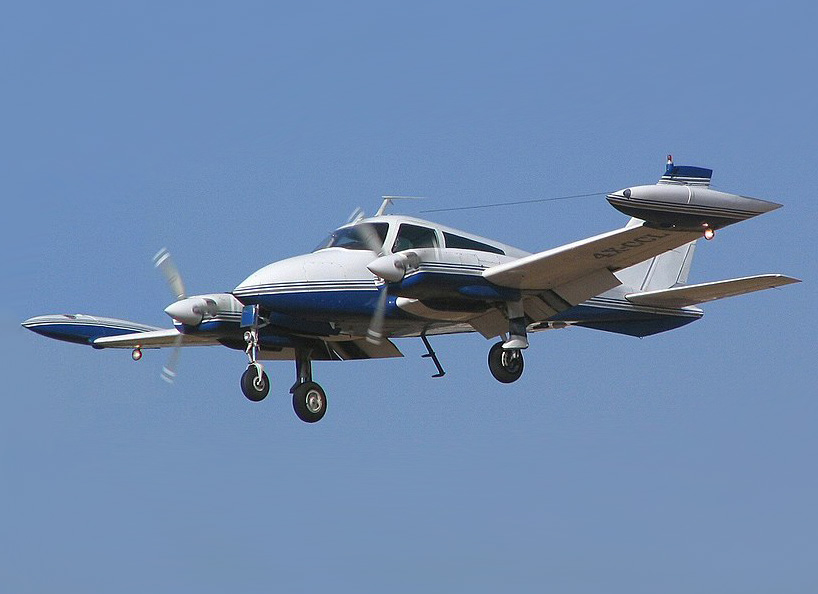
The Cessna 310 is an American twin-engine, low-wing cabin monoplane built by Cessna from 1954 to 1980, aimed squarely at the owner-flown and corporate transport market rather than flight training. Distinguished by its sleek lines, wingtip 'tuna tank' fuel tanks and brisk cruise speeds for a piston twin, it became a favourite of business flyers, charter operators and the US Air Force alike, and is fondly remembered as the aircraft flown by Sky King on 1950s television.
The Cessna 310 is a four-to-six-seat, low-wing, twin-engine monoplane manufactured by Cessna between 1954 and 1980. It was only the second twin Cessna put into production, following the wartime Cessna T-50, and went on to become one of the definitive American light business twins of its era. Sold to owner-pilots and corporate operators rather than as a trainer, it was also adopted by the United States military, which flew it as the L-27 and later the U-3. Over six thousand 310 and 320 series aircraft were built in total.
The 310 prototype, powered by 240 hp Continental O-470-B engines, first flew on January 3, 1953, and the design was certified on March 22, 1954, with deliveries beginning that year. Cessna promoted it heavily as a purpose-built business tool, with company president Dwane L. Wallace arguing in a 1954 Flying magazine cover story that the demand for a proper twin among businesses was effectively unlimited. The type evolved steadily through 26 years of production. Early aircraft used engine exhaust thrust augmenter tubes and stored all fuel in tip tanks; in 1964 the exhaust was rerouted to flow beneath the wing because the augmenter tubes were considered too noisy. The 310C of 1959 introduced more powerful 260 hp Continental IO-470-D engines, and the 310D of 1960 brought swept-back vertical tail surfaces. An extra cabin window appeared on the 310F, from which the turbocharged 320 Skyknight was developed; fitted with TSIO-470-B engines and an extra window on each side, the 320 was built from 1961 to 1969, when it gave way to the similar Turbo 310. The 310G, certified in 1961, introduced the canted 'stabila-tip' wingtip fuel tanks that became a hallmark of Cessna's twin-engine range. The 310K, certified in late 1965, replaced the rear two windows with a single side window and offered optional three-blade propellers. Later 310Q and turbocharged T310Q models had a redesigned rear cabin with a skylight window, while the final 310R and T310R were identifiable by a lengthened nose housing a baggage compartment. Production ended in 1980, with the type having evolved from a five-seater with pressure-carbureted engines into a turbocharged six-seater with known-icing certification; it also formed the basis for the pressurized Cessna 340 and led to the larger Cessna 411. Aircraft engineer Jack Riley later produced heavily modified variants, the Riley Rocket 310 and Riley Turbostream 310, replacing the standard 310 hp Continentals with 350 hp Lycoming TIO-540 turbocharged, intercooled engines driving three-blade Hartzell propellers in a counter-rotating arrangement for improved performance and single-engine safety.
The 310 is a low-wing, all-metal twin-engine monoplane with retractable landing gear, seating four to six depending on model. A defining feature of the type is its wingtip-mounted fuel tanks, nicknamed 'tuna tanks' for their fish-like profile, each holding 50 gallons in early aircraft; from the 310G onward these were replaced by canted 'stabila-tip' tanks intended to improve stability in flight. Early aircraft used Continental O-470-B engines of 240 hp, later replaced from the 310C onward by 260 hp Continental IO-470-D units, while turbocharged models such as the 320 Skyknight used TSIO-470-B engines and the final 310R and T310R were fitted with 285 hp Continentals. The final production 310R had a gross weight of 5,500 lb. Riley's modified Rocket and Turbostream versions substituted 350 hp turbocharged, intercooled Lycoming TIO-540 engines with counter-rotating three-blade Hartzell propellers, giving a 5,400 lb gross weight aircraft a weight-to-power ratio of 7.71 lb per horsepower. The considerable fuel mass carried out in the wingtips gives the aircraft substantial roll inertia, a characteristic noted of the type generally.
Cessna's own Riley-modified 310 Rocket and Turbostream variants achieved a cruising speed of 260 knots (480 km/h; 300 mph) at 18,000 feet and a rate of climb of 3,000 feet per minute at a gross weight of 5,400 lb. Standard production aircraft carried a large useful load, 2,000 lb or more, while retaining speeds high for a twin-engine piston type and, with aftermarket Robertson STOL kits, the ability to operate from short runways. The 310R, with a gross weight of only 5,500 lb and a power loading of just under 10 lb per horsepower, offers a virtual guarantee of excellent climb performance. The tip-tank fuel arrangement, carrying around 300 lb of fuel well outboard on each wing, gives the aircraft notable roll inertia that pilots must account for.
The type progressed through a long sequence of model letters: the 310A through 310R, each introducing incremental changes such as the swept tail of the 310D, the extra cabin window of the 310F, the canted wingtip tanks of the 310G, the single side window and optional three-blade propellers of the 310K, and the redesigned rear cabin with skylight of the 310Q and turbocharged T310Q. The final 310R and T310R featured a lengthened nose with a baggage compartment. The turbocharged 320 Skyknight, developed from the 310F and built between 1961 and 1969 (with the 320E marketed as the Executive Skyknight), was succeeded by the similar Turbo 310. Military variants included the L-27A, redesignated U-3A in 1962, of which the USAF purchased 160 examples as an unmodified 310A, and the upgraded L-27B (later U-3B), essentially a military 310F with the more powerful 260 hp engines, longer nose and swept vertical fin, of which 36 were delivered in 1960-61. Independently, engineer Jack Riley produced the heavily reengined Riley Rocket 310 and Riley Turbostream 310, fitted with 350 hp Lycoming TIO-540 engines and counter-rotating propellers for markedly improved performance.
The Cessna 310 was a common charter aircraft for the many air taxi operators that emerged during the post-war general aviation boom, valued over contemporaries such as the Piper PA-23 Apache for its speed, operating economics and aftermarket modifications, including Robertson STOL kits that made it popular for bush flying worldwide. In 1957 the United States Air Force selected the 310 as a light utility aircraft for transport and administrative support, operating it as the L-27A, unofficially nicknamed the 'Blue Canoe', later redesignated U-3A in 1962; a USAF study found the type's direct operating costs to be less than $12 an hour after a year of service. U-3 aircraft saw active service in South Vietnam during the Vietnam War, flying courier routes between air bases, and some examples were later transferred to the US Army and US Navy, with the type remaining in American military service into the mid-1970s. In a notable private episode, Cuban defector Major Orestes Lorenzo Pérez flew a 1961 Cessna 310 back into Cuba on December 19, 1992, landing on a coastal highway near Varadero to retrieve his wife and two sons before returning safely to Marathon, Florida. The type also achieved cultural recognition through the 1950s television and radio series Sky King, in which a 310B and later a 310D played the lead aircraft, 'Songbird'.
Pilots who have flown the type describe the 310, particularly the later T310R, as a lively performer for a piston twin, combining light weight and generous horsepower with distinctive looks that give it real character on the ramp. The wingtip fuel tanks, while a visual signature of the design, add roll inertia that must be respected, and the landing gear rigging is often singled out as an area needing careful maintenance and attention, though it is a fundamentally stout undercarriage when correctly set up. As an owner-flown cross-country machine rather than a trainer, the 310 rewards pilots seeking genuine point-to-point speed and useful load from a classic twin, and its long production run means later models offer known-icing certification and turbocharged high-altitude cruise performance alongside the charm of the earlier 'tuna tank' originals.