Departure
96%
vs 95% ▲ 1
 MY FS FLIGHTS
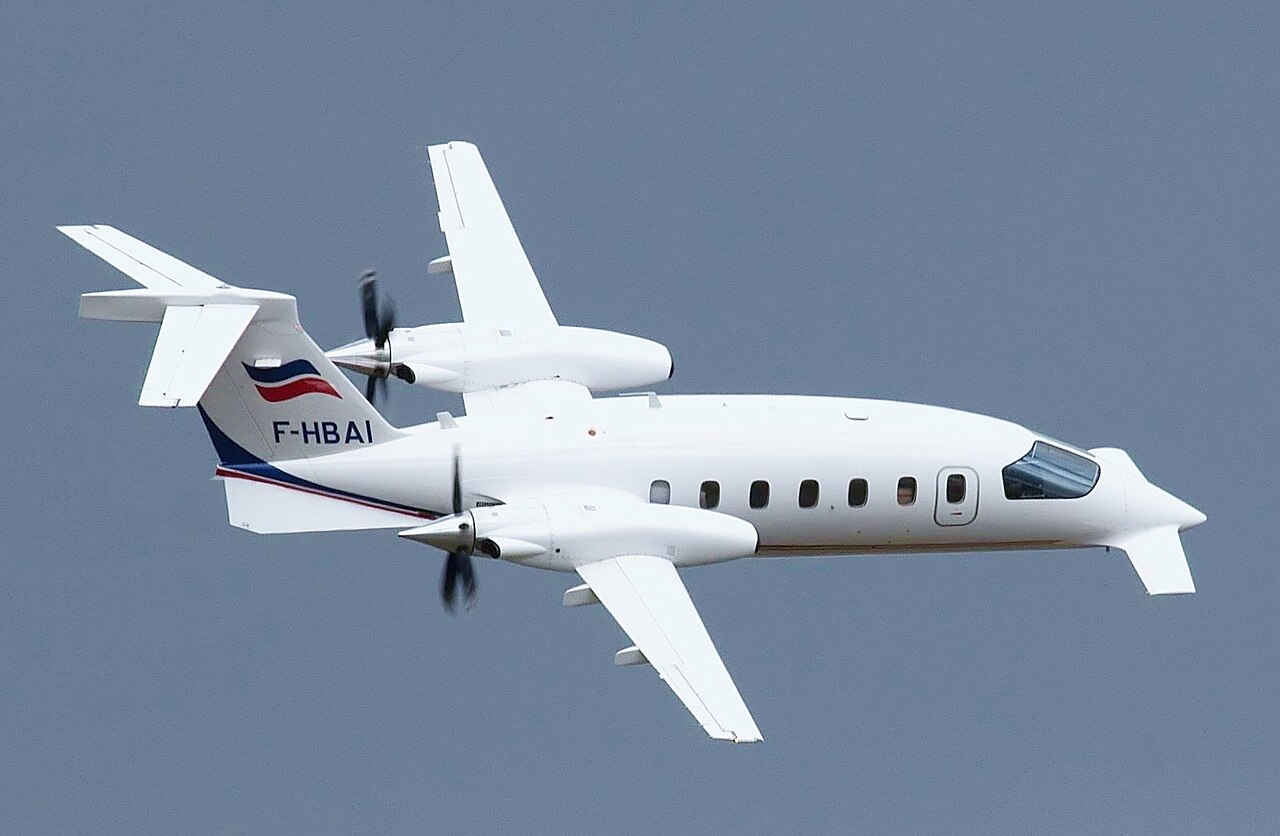
The Piaggio P.180 Avanti is an Italian executive turboprop notable for its unusual three-surface layout, combining a forward canard, a conventional tailplane and a main wing carrying two pusher turboprop engines. Designed by Piaggio Aero and first flown in 1986, it earned a reputation as the fastest production propeller-driven aircraft in the world, appealing to operators wanting jet-like speed with turboprop economics. For simmers it offers an unconventional handling model and a striking visual and aerodynamic profile rarely seen in general aviation types.
The Piaggio P.180 Avanti is an executive/VIP light transport aircraft designed and built by Piaggio Aero in Italy. It is powered by twin wing-mounted turboprop engines arranged in a pusher configuration, and seats up to nine people in a pressurized cabin. Its design is of three-surface configuration, featuring a small forward canard wing in addition to a conventional tailplane and main wing, with the main wing spars passing behind the passenger cabin area. It can be flown by one or two pilots and has no direct turboprop competitors, with its closest rivals being light jets such as the Raytheon Premier I and Cessna Citation CJ2+.
Engineering studies for the aircraft that would become the Avanti began in 1979, with designs tested in wind tunnels in Italy and the United States during 1980 and 1981, conducted by Professor Jan Roskam of the University of Kansas, using Wichita State University's wind tunnel and Boeing's transonic wind tunnel in Seattle, along with Professor Gerald Gregorek at Ohio State University using OSU's 2D pressure wind tunnel. Piaggio's chief engineer Alessandro Mazzoni filed a patent for the Avanti design in 1982. Beginning in 1983, Gates Learjet partnered with Piaggio to develop the fuselage, with the aircraft referred to during this period as the Gates Piaggio GP-180; Learjet's influence can be seen in the steeply raked windshield and the two large ventral delta fins under the tail, which at high angles of attack provide a nose-down pitching moment to help avoid a stall and increase stability by damping yaw and Dutch roll. Gates Learjet's financial problems ended the collaboration in January 1986, but Piaggio continued the project, and the first prototype flew on 23 September 1986. Italian certification was received on 7 March 1990, and American certification followed on 2 October 1990. The first 12 fuselages were manufactured in Wichita, Kansas, by H & H Parts and Plessey Midwest before being flown to Italy for final assembly. Avanti Aviation Wichita ran out of money in 1994 and the project languished until a group of investors led by Piero Ferrari became involved in 1998. The 100th aircraft was delivered in October 2005 and the 150th in May 2008; by October 2010 the Avanti and Avanti II fleets had logged over 500,000 flying hours. An improved Avanti II obtained European and US certification in November 2005, with 70 aircraft ordered within six months, including 36 by Avantair. The Avanti II received Russian type approval in 2011. Production of the further-improved Avanti EVO moved to a new factory at Albenga Airport, with the first example built there delivered in 2016, a year after production shifted from the previous Genoa Cristoforo Colombo Airport plant. On 22 November 2018 Piaggio Aerospace entered receivership after declaring itself insolvent when its restructuring plan failed; deliveries had fallen from a 2008 peak of 30 to just three in 2018 following the loss of a key US fractional customer. On 21 June 2019 the Italian government committed to 716 million euros in orders, including funding for nine new Avanti Evos and an upgrade of 19 earlier aircraft, in an effort to make the business more attractive to a buyer. By December 2020, 246 aircraft had been built.
The Avanti's three-surface configuration comprises a small forward canard, a main wing, and a conventional tailplane, with the main wing spars routed behind the passenger cabin to keep the cabin unobstructed. Two ventral delta fins are fitted under the tail, a legacy of the Gates Learjet collaboration on the fuselage, which help provide a nose-down pitching moment at high angles of attack and improve stability by damping yaw and Dutch roll. Power comes from two Pratt & Whitney Canada turboprop engines mounted on the wing in pusher configuration; the original Avanti used PT6A-66 engines, the same as fitted to the Beech Super King Air 200, while the Avanti II received uprated PT6A-66B engines. Piaggio states that the overall design allows the wing to be 34 percent smaller than on conventional aircraft, and that low-drag laminar flow is maintained to around 50 percent of the wing chord, compared with around 20 to 25 percent for conventional tractor turboprops where propeller wash disturbs the airflow over the wing. The Avanti II's Rockwell Collins Pro Line 21 avionics suite replaced earlier instrumentation with flat-panel colour liquid crystal displays providing heading, attitude and navigation information along with TCAS collision avoidance, TAWS ground proximity warning, and real-time graphic weather depiction. The pressurized cabin offers a stand-up height of 5 feet 9 inches and a width of 6 feet 1 inch, and is typically configured for seven passengers with an extra seat available in the enclosed lavatory. Because the propellers and engine exhausts are positioned behind the cabin, interior noise is markedly reduced compared with conventional turboprops, with Piaggio quoting 68 dBA.
The Avanti is recognised by the FAI as the fastest propeller-driven aircraft, with a recorded speed of 927.4 km/h (576.3 mph; 500.8 kn). The Avanti II, fitted with uprated PT6A-66B engines, flies about 18 km/h (11 mph) faster than the original model with improved fuel economy, and can reach a maximum cruise speed of around 390 knots, some 100 knots faster than the Beech Super King Air 200 despite sharing the same PT6A-66 engine family. Specific range for the Avanti II is quoted at 3.1 km/kg (0.76 nmi/lb). Range is given variously as approximately 1,300 nautical miles, allowing nonstop flights between city pairs such as Los Angeles and Denver or Paris and Athens, with a maximum range cited elsewhere at around 2,795 km. The aircraft has a sea-level standard-day maximum-gross-weight takeoff distance of 869 m (2,851 ft) and a landing roll of 872 m (2,861 ft). Despite the quiet cabin, the Avanti has attracted noise complaints on the ground at airports such as Aspen-Pitkin County Airport in Colorado and Naples Municipal Airport in Florida, where it was assessed as the noisiest aircraft using the facility, with one airport authority official describing its high-pitched exterior sound as comparable to fingernails on a chalkboard.
The original P.180 Avanti received Italian certification in March 1990 and American certification in October 1990. The Avanti II, an improved model with uprated Pratt & Whitney Canada PT6A-66B engines and a new Rockwell Collins glass-panel avionics suite, obtained European and US certification in November 2005. The Avanti EVO, a further-developed variant, was announced in 2014 and entered production at the new Albenga Airport factory, with the first example delivered in 2016. A military derivative, the P.1HH HammerHead unmanned aerial vehicle based on the Avanti EVO airframe, first flew in 2013; a prototype crashed off Sicily in May 2016 after 100 hours of flight testing, and a second prototype flew in July 2017, followed by two further aircraft.
The Avanti has served primarily as an executive and VIP transport, popular with corporate operators and charter companies for its combination of jet-like speed and turboprop operating economics, claimed to be as much as 40 percent more cost-efficient than competing jets. Avantair operated a substantial fractional-ownership fleet, having ordered 36 Avanti IIs, though the loss of this key US customer after the 2008 financial crisis contributed to a sharp decline in later sales. Military and government operators have also used the type, including the Italian Air Force, Italian Army and Italian Navy. In 2019 the Italian government ordered nine new Avanti Evos and funded the upgrade of 19 earlier aircraft as part of a support package for manufacturer Piaggio Aerospace.
In Microsoft Flight Simulator the P.180 Avanti II has been modelled by FlightFX, whose rendition targets cruise speeds approaching Mach 0.7, a service ceiling of 41,000 feet and a range of roughly 1,500 nautical miles. The add-on features Pro Line 21-style avionics with a custom CAS panel and softkey menus, a flight and engine model built with feedback from real pilots aiming for book-accurate takeoff, climb and cruise performance, and dedicated steering and beta-range prop controls for precise ground handling, including functional autofeather. Simplified and Advanced modes let pilots choose between an easier workflow and full procedural realism, while custom recorded audio and a noise-canceling system reflect the type's real-world reputation for a quiet cabin despite its distinctive high-pitched exterior sound.