Departure
95%
vs 96% ▼ 1
 MY FS FLIGHTS
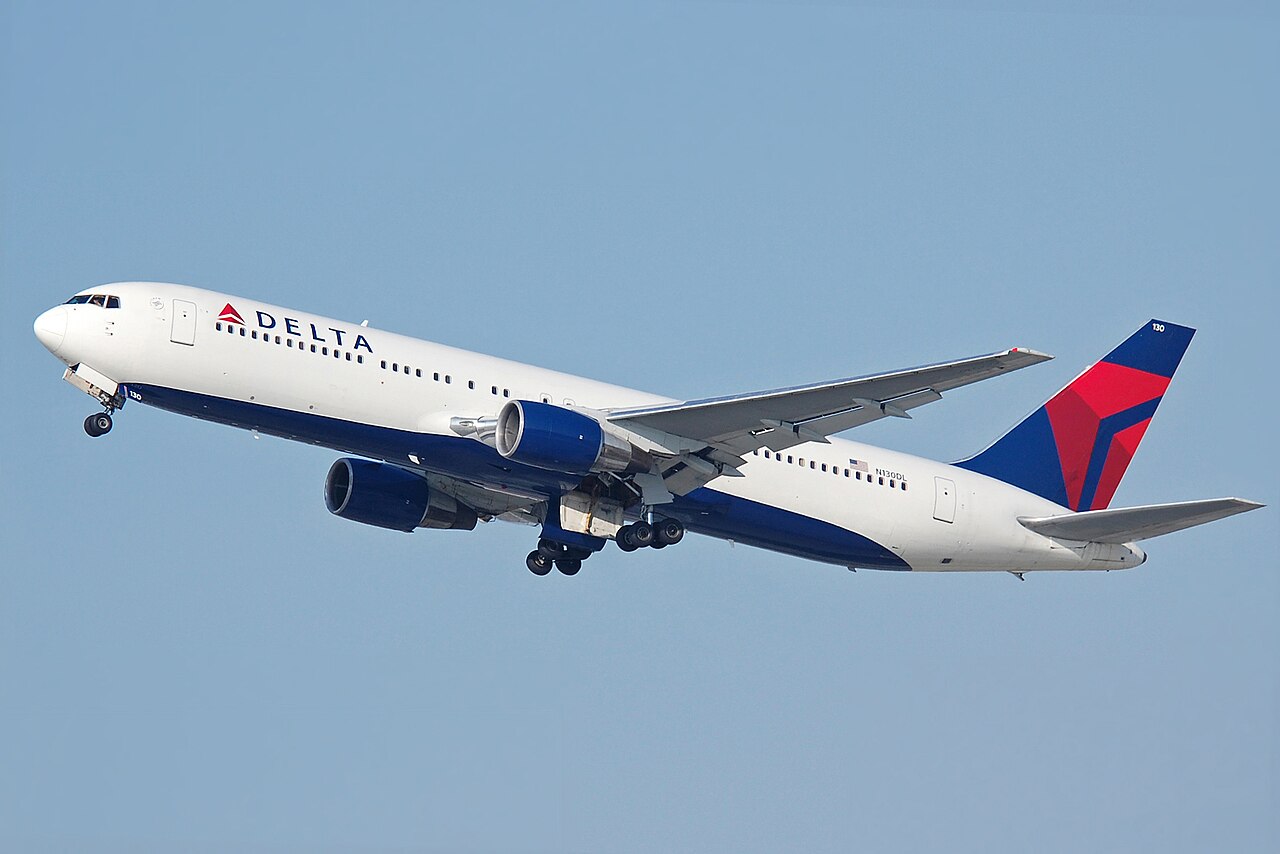
The Boeing 767-300ER is the extended-range, stretched version of Boeing's first wide-body twinjet, and it became the most popular variant of the 767 family. A two-crew glass-cockpit airliner with a seven-abreast cabin, it was built for long, medium-density routes and was a mainstay of transatlantic and long-haul operations. For a sim pilot it offers a classic 1980s-designed widebody that remains in widespread airline and freight use.
The Boeing 767 is an American wide-body airliner developed and manufactured by Boeing Commercial Airplanes. It was designed to complement the larger 747, with a seven-abreast cross-section accommodating smaller LD2 cargo containers. The 767-300ER is the extended-range version of the stretched 767-300. It entered service in 1988 and became the most popular variant of the family. Until the 777 debuted in 1995, the 767-300 and 767-300ER were Boeing's second-largest wide-bodies behind the 747. Competitors have included the Airbus A300, A310 and A330-200, and the type's successor is the 787 Dreamliner.
The 767 grew out of the 7X7 study, begun around 1972 for a smaller wide-body jetliner to replace the 707 and other early-generation narrow-bodies. Boeing signed risk-sharing agreements with Aeritalia and the Civil Transport Development Corporation, a consortium of Japanese aerospace companies, which was its first major international joint venture. The initial short take-off concept drew little customer enthusiasm and was redefined as a mid-size, transcontinental-range airliner. By 1976 a twinjet layout, similar to the Airbus A300, had become the baseline. The programme was launched as the 7X7 on 14 July 1978, the prototype first flew on 26 September 1981 and the 767 was certified on 30 July 1982. The 767-200 entered service with United Airlines on 8 September 1982. Boeing announced a stretched development of the 767-200 in February 1982. The 767-300 features a 6.42 m (21 ft 1 in) stretch, made up of fuselage plugs ahead of the wing centre section (3.07 m, 10 ft 1 in) and behind it (3.35 m, 11 ft). The flight deck and systems were carried over directly from the 767-200, with only minor changes related to the higher weights. The 767-300 first flew on 30 January 1986, and the higher-weight Extended Range version followed on 19 December 1986. The 767-300ER entered service in 1988. Rolls-Royce RB211-524G engines became available from 1989. A loosening of ETOPS rules starting in 1985 allowed the 767 to operate transatlantic flights, and sales accelerated in the mid-to-late 1980s, with 1989 the most prolific year at 132 firm orders. By the early 1990s the 767 was Boeing's annual best-selling aircraft. In 2005 Boeing chose to continue 767 production despite record 787 sales, to give customers waiting for the Dreamliner a more readily available option, and the 767-300ER was subsequently offered to customers affected by 787 delays, including All Nippon Airways and Japan Airlines. In 2008 the first 767-300ER retrofitted with blended winglets from Aviation Partners debuted with American Airlines. The 2019 unit cost of a -300ER was US$217.9 million.
The 767 is Boeing's first wide-body twinjet, with a conventional tail and a supercritical wing for reduced aerodynamic drag. Its two-crew glass cockpit, a first for a Boeing airliner, was developed jointly with the 757, allowing a common pilot type rating. The 767-300ER has a wing span of 47.57 m (156 ft 1 in), a length of 54.94 m (180 ft 3 in) and a height of 15.85 m (52 ft 0 in). Wing area is 283.3 sq m (3,050 sq ft). The flight crew is two. Powerplant options for the 767-300 include Pratt & Whitney JT9D-7R4 and JT9D-7R4E, PW4050 and PW4052, General Electric CF6-80A, CF6-80A2, CF6-80C2B2 and CF6-80C2B4F, and Rolls-Royce RB211-524G engines. The 767-300ER can have the same options, or in addition the PW4056 (56,750 lb), the CF6-80C2B6 (60,000 lb) or the PW4060 rated at 60,000 lb take-off thrust. On the 767-300ER, empty weight is 81,374 kg (179,400 lb) with PW4060s and 80,603 kg (177,700 lb) with CF6-80C2B4s. Operating empty weight is 90,535 kg (199,600 lb) with PW4060s and 90,175 kg (198,800 lb) with CF6-80C2B4s. Maximum take-off weight is 181,890 kg (401,000 lb) with PW4060s and 175,540 kg (387,000 lb) with CF6-80C2B4Fs. Typical seating is 210 in a three-class layout or 269 in two classes (24 premium and 245 economy, seven abreast), with a maximum of 350 at eight abreast. A typical 767-300ER seats 218. Underfloor capacity is 20 LD2 containers.
Maximum cruising speed is 900 km/h (486 kt) and economical cruising speed is 850 km/h (460 kt). The 767-300ER typically seats 218 over a range of 5,980 nmi (11,070 km; 6,880 mi). Range with design payload is 10,880 km (5,875 nm) with PW4060s and 10,195 km (5,505 nm) with CF6-80C2B4Fs. The 767-300ER's range has proved very popular with airlines using it on long-range, low-density flights. Blended winglets retrofitted to in-service aircraft reduce drag and improve efficiency.
The 767-200 is 159 ft (48.5 m) long and typically seats 216 over 3,900 nmi, and the 767-200ER seats 181 over 6,590 nmi. The 767-300 is 180 ft (54.9 m) long and typically seats 269 over 3,900 nmi. The 767-300ER is the higher-weight, extended-range version of the -300, with greater range and maximum take-off weight and more engine options. The 767-300F freighter was launched in 1993 and debuted in October 1995. It has a strengthened undercarriage and wing structure, a cargo handling system, no cabin windows and a main-deck freight door, and carries 24 containers. The further stretched 767-400ER entered service in September 2000 and is 201.3 ft (61.37 m) long. Military derivatives of the 767 include the E-767 surveillance aircraft and the KC-767 and KC-46 tankers.
The 767-300ER was widely used on long-range, low-density routes and transatlantic services made possible by ETOPS approval. It was the most produced 767 variant, and 652 767-300s of all kinds (including ERs) had been ordered by late 2002, of which 607 had been delivered. Delta Air Lines is the largest passenger operator of the 767 family, and FedEx Express, UPS Airlines and United Airlines are also primary users of the type overall. After 787 delays the -300ER was supplied to operators such as All Nippon Airways and Japan Airlines as an interim option.
Flying the 767-300ER means operating a two-crew glass-cockpit twinjet, with a flight deck that shares its design philosophy and type rating with the 757. Its long range, high-capacity cabin and ETOPS heritage make it a natural choice for long-haul and transatlantic sectors, and the variety of engine options and operator liveries gives plenty of scope for realistic airline-style flying.