Departure
97%
vs 95% ▲ 2
 MY FS FLIGHTS
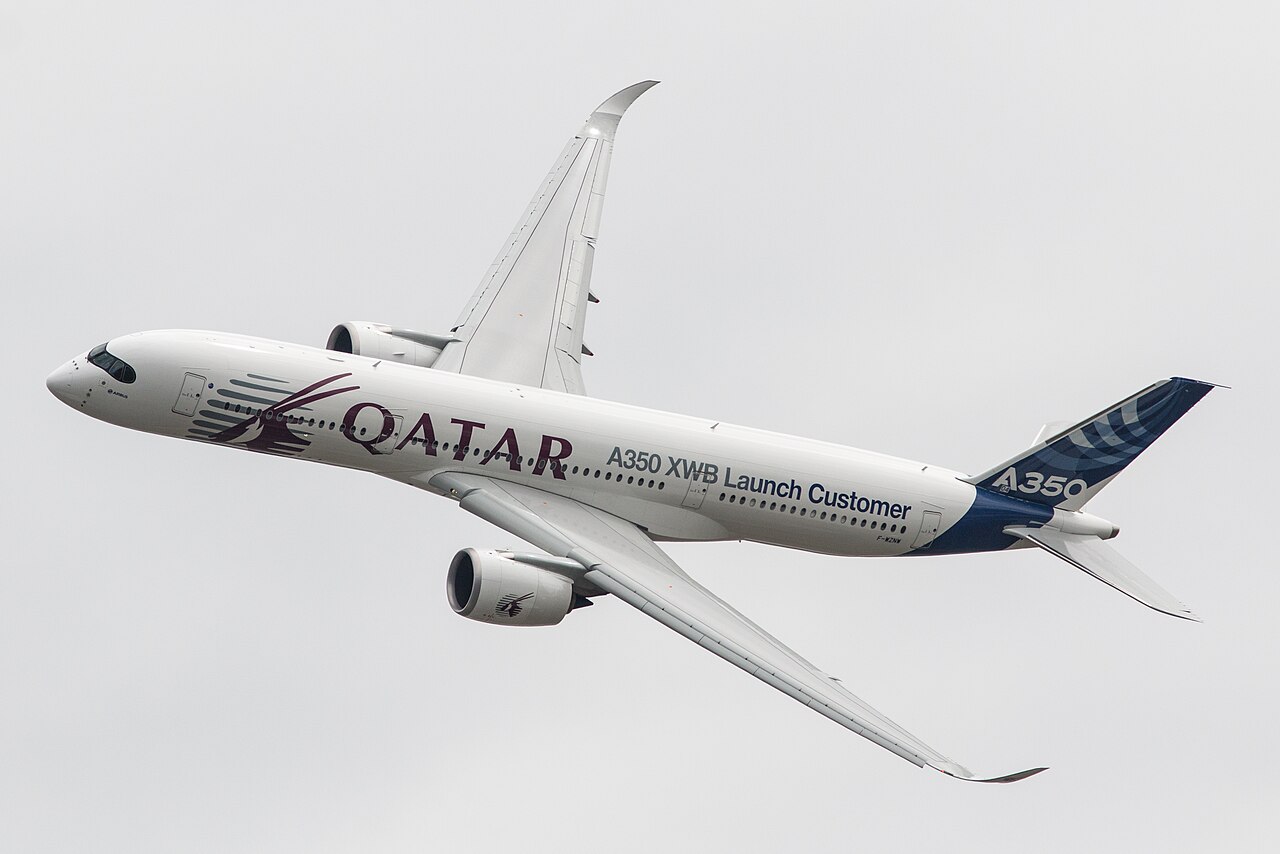
The Airbus A350-900 is a long-range, wide-body, twin-engine airliner and the baseline model of the composite A350 XWB family built by the European Airbus consortium. Conceived as Airbus's answer to the Boeing 787 Dreamliner, it combines a largely carbon-fibre airframe with Rolls-Royce Trent XWB-84 engines to offer efficient, quiet long-haul operations. For a simulator pilot it represents a modern, high-technology widebody flown on some of the world's longest scheduled routes by carriers such as Qatar Airways, Singapore Airlines and Turkish Airlines.
The A350-900 is a wide-body, long-range airliner of European origin, produced by the Airbus consortium with final assembly at Toulouse and the wing manufactured at Broughton in the UK. It carries the ICAO type designator A359 and forms the baseline, clean-sheet member of the A350 XWB (eXtra Wide Body) family. Constructed from more than 50 percent composite materials, mostly carbon-fibre reinforced polymer, it was designed to compete directly with the Boeing 787 Dreamliner and also sits against the larger Boeing 777-200 and 777-300 in the widebody market.
The A350-900 first flew on 14 June 2013 and was developed as a direct response to the Boeing 787 Dreamliner. It received EASA type certification on 30 September 2014 under certificate EASA.A.151, followed by FAA certification on 12 November 2014 under TCDS T00063IB. The first production aircraft was delivered to launch customer Qatar Airways on 22 December 2014, and the type entered commercial service on 15 January 2015, operating the Doha to Frankfurt route. Airbus has reported that the A350 programme broke even financially by 2019. Development was not without difficulty: the programme experienced supply-chain pressures, including late fuselage parts from Spirit AeroSystems, and Airbus became involved in a high-profile dispute with Qatar Airways over accelerated paint degradation on several A350 airframes. In April 2025 EASA certified the Trent XWB-84 EP (Enhanced Performance) engine upgrade for the A350-900, delivering approximately 1 percent lower fuel burn through improved fan, compressor and turbine aerodynamics. Production of the type had reached 534 aircraft.
The A350-900 is a cantilever mid-wing monoplane with retractable, nose-wheel landing gear, wing-mounted engines on pylons, and fuel carried in both wing and fuselage tanks. The wing is a two-spar, multi-rib, fail-safe CFRP box with trailing-edge single-slotted Fowler flaps, full-span leading-edge slats, outboard spoilers, inboard airbrakes and CFRP winglets; it has an average thickness/chord ratio of 12.3 percent, a three-quarter chord sweep angle of 31.9 degrees, 3.5 degrees of incidence and 6.0 degrees of dihedral. The fuselage is a pressurised CFRP semi-monocoque, fail-safe structure of circular section, wider than that of the A330 and offering 9-abreast seating with 45 cm (18 in) wide seats, along with a higher cabin pressure and wider panoramic windows than earlier Airbus widebodies. Power comes from two Rolls-Royce Trent XWB-84 turbofans, each rated at 374.5 kN (84,190 lbf). Overall dimensions include a wingspan of 64.75 m, an overall length of 66.8 m (fuselage length 65.26 m), a height of 17.05 m, and a gross wing area of 442.0 square metres; fuselage exterior width is 5.96 m. Weights include an operating empty weight of 142,400 kg, maximum structural payload of 53,300 kg, zero-fuel weight of 195,700 kg, maximum landing weight of 207,000 kg and maximum take-off weight of 280,000 kg, with a usable fuel capacity of 110,524 kg (140,795 litres). The cabin measures 5.61 m at its maximum width and 49.76 m in length, with a maximum height of 2.54 m and a floor area of 275.5 square metres, giving a passenger compartment volume of 472 cubic metres. The underfloor belly holds have a usable cargo volume of 241.5 cubic metres and can accommodate 36 LD3 containers. In 2018 the unit cost of an A350-900 was quoted as 317.4 million US dollars.
The A350-900 has a maximum operating Mach number of 0.88 (950 km/h) at 9,450 m and a critical Mach speed of 0.85. Maximum cruising speed is 903 km/h (Mach 0.85) at 11,000 m, with an economic cruising speed of 871 km/h (Mach 0.82) at the same altitude. Service ceiling is 13,100 m, and range with maximum fuel at maximum take-off weight is quoted at 15,925 km. Fuel consumption at economic cruise speed is 5,907.7 kg/hr. In a full-scale evacuation trial with 423 passengers aboard, the aircraft was cleared in 39 seconds.
The A350-900 is the baseline, clean-sheet variant of the A350 XWB family from which further family members were developed, though the source material here concentrates specifically on the -900 model rather than on other family variants.
Launch customer Qatar Airways took delivery of the first production A350-900 on 22 December 2014 and put the type into service on 15 January 2015 on the Doha to Frankfurt route. The aircraft went on to become a mainstay of long-haul widebody fleets worldwide, with primary operators including Turkish Airlines, which is the largest A350 customer with 110 aircraft on order, Qatar Airways, Singapore Airlines with 64 aircraft, Finnair, Iberia, Delta Air Lines, Cathay Pacific, Asiana Airlines, French Bee, Air France, Lufthansa, Ethiopian Airlines, LATAM Brasil, Aeroflot, Japan Airlines, Thai Airways and Vietnam Airlines. A typical two-class cabin seats 315 passengers, made up of 48 business class and 267 economy class seats at 32-inch pitch, with an exit-limit high-density configuration accommodating up to 440 passengers and a high-density layout of 423 passengers at mainly 10-abreast seating.
Flown on some of the longest scheduled routes in commercial aviation, the A350-900 offers a cruise regime around Mach 0.85 at altitudes up to 11,000 metres and beyond, up to its service ceiling of 13,100 metres, with a maximum range in the region of 15,925 km on full fuel at maximum take-off weight. Its twin Rolls-Royce Trent XWB-84 engines and composite structure make it representative of the current generation of efficient long-haul widebodies, and its combination of long sector times and high-altitude cruise performance make it a natural choice for pilots wanting to fly extended intercontinental services.