Departure
96%
vs 95%
 MY FS FLIGHTS
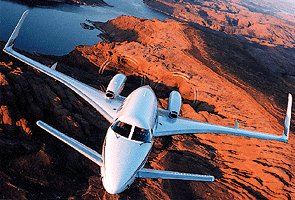
The Beechcraft Starship is a twin-turboprop, six- to eight-passenger executive transport produced by Beech Aircraft Corporation between the mid-1980s and 1995, notable as the first all-composite business aircraft to receive FAA certification. With its canard-and-pusher-propeller configuration, swept wingtip rudders in place of a conventional tail, and one of the earliest glass cockpits fitted to a civilian aircraft, it remains one of the most radical-looking business aircraft ever built, and its rarity and engineering ambition still fascinate pilots and enthusiasts today.
The Starship, Beech's Model 2000, is a pressurized, twin-turboprop business aircraft intended as a faster, larger-cabin successor to the company's King Air line. It is immediately recognisable for its canard-wing layout, rear-mounted pusher engines, all-composite carbon-fibre airframe, and the absence of a conventional vertical tail, with directional control instead provided by rudders on its wingtip winglets, which Beechcraft termed tipsails. It holds the distinction of being the first composite aircraft placed into production and the first full-composite business-class aircraft certified by the FAA.
Development began in 1979 as Beech looked for a successor to the King Air that could fly faster and carry more passengers. On August 25, 1982, Beech contracted Burt Rutan's Scaled Composites to refine the concept and build an 85-percent-scale proof-of-concept aircraft, which first flew in August 1983; this early aircraft lacked pressurization and certified avionics and has since been scrapped. Beech then built three full-scale prototypes: NC-1, used for aerodynamic testing and fitted with an ejection seat and the only conventional electromechanical avionics on any Starship; NC-2, used for avionics and systems testing; and NC-3, used for flight-management-system and powerplant testing. NC-1 made the type's first flight on February 15, 1986. The programme suffered repeated delays, initially from underestimating the complexity of composite manufacturing and later from correcting a pitch-damping problem and developing the stall-warning system. Development cost around 300 million dollars, and the first production aircraft flew on April 25, 1989. Production continued until 1995, by which time 53 airframes had been built, with fewer than 30 delivered to customers.
The Starship's airframe is built almost entirely from carbon-fibre-reinforced polymer composite, chosen for its strength-to-weight ratio, though the empty weight of production aircraft ultimately exceeded Beech's original target by several thousand pounds. A small, retractable front wing of variable-geometry design produces lift and counteracts the nose-down pitching moment created by extending the flaps, while the swept wingtip tipsails carry the rudders in place of a central fin, avoiding the transmission of propeller noise into the fuselage that a conventional tail would cause. Power comes from two rear-mounted Pratt & Whitney Canada PT6A-67A pusher turboprops, a layout chosen to keep the propellers further from the cabin and to avoid propeller-tip vortices striking the fuselage, at the cost of the propellers operating in turbulent airflow off the wings. The cockpit featured a 14-tube Rockwell Collins Proline 4 AMS-850 glass cockpit, the first all-glass instrument suite fitted to a business aircraft. The aircraft was designed for single-pilot operation but had provisions for a two-person crew. Typical figures for a Model 2000A example include a wingspan of 54.42 ft, length of 46 ft, height of 13 ft, wing area of 280.88 sq ft, empty weight of 10,120 lb, and gross weight of 14,900 lb; by the end of development the type had grown to a larger cabin volume than the King Air 350 while sharing the same gross ramp weight of 15,010 lb (6,808 kg).
The canard configuration was intended to make the Starship effectively stall-proof: the forward lifting surface stalls before the main wing, causing the nose to drop and allowing normal flight to resume before the main wing can stall. A Model 2000A is credited with a maximum speed of 385 mph and a range of 1,814 miles. Despite its advanced aerodynamics, the Starship was not a fast aircraft by the standards of contemporary business jets; at maximum cruise it was reportedly 89 knots slower than the Cessna Citation V and 124 knots slower than the Learjet 31, both of which were priced similarly, while the Piper Cheyenne turboprop was both faster and roughly a million dollars cheaper.
The initial production version was the Model 2000. An improved Model 2000A followed in the early 1990s, offering six-passenger accommodation. Beyond these, the Starship's development lineage included the 85-percent-scale proof-of-concept aircraft built by Scaled Composites and the three full-scale flight-test prototypes, NC-1, NC-2, and NC-3, each dedicated to different areas of testing during certification.
Sales fell well short of expectations, with only 11 Starships sold in the three years following certification, a result attributed to the aircraft's 3.9-million-dollar list price, its unconventional appearance, a luxury tax then in effect in the United States, and the broader economic slowdown of the late 1980s. In 1991 Beech began offering two-year leases to stimulate demand. Following Raytheon's acquisition of Beech in 1993, the parent company judged that supporting such a small, specialised fleet was not commercially viable and from 2003 began decommissioning the type, scrapping many airframes for parts while donating others to museums, aviation maintenance schools, and research institutions; recipients included the Kansas Aviation Museum, the Beechcraft Heritage Museum in Tullahoma, Tennessee, and the Museum of Flight in Seattle. FAA-mandated structural reinforcements added weight to surviving aircraft and required pilots to hold a specific type rating. By the mid-2020s only a handful of Starships remained airworthy, with four examples maintained by Aerospace Quality Research and Development at Addison Airport in Texas, sustained through a dedicated parts inventory and specialist composite-repair expertise.
For a pilot studying or flying the type, the Starship's appeal lies in its unconventional handling philosophy: the variable-geometry canard was engineered so the forward surface stalls first, causing a gentle nose-down pitch that keeps the main wing flying and makes a full stall very difficult to achieve. The pusher-propeller layout and glass-cockpit avionics suite, advanced for a business aircraft of its era, give it a distinctly different feel and instrument panel from contemporaries of the period, while its extreme rarity and single-pilot certification make it a genuine curiosity for anyone wanting to fly a design so far removed from the conventional straight-wing, tractor-engine business turboprops it was meant to replace.