Departure
84%
vs 95% ▼ 11
 MY FS FLIGHTS
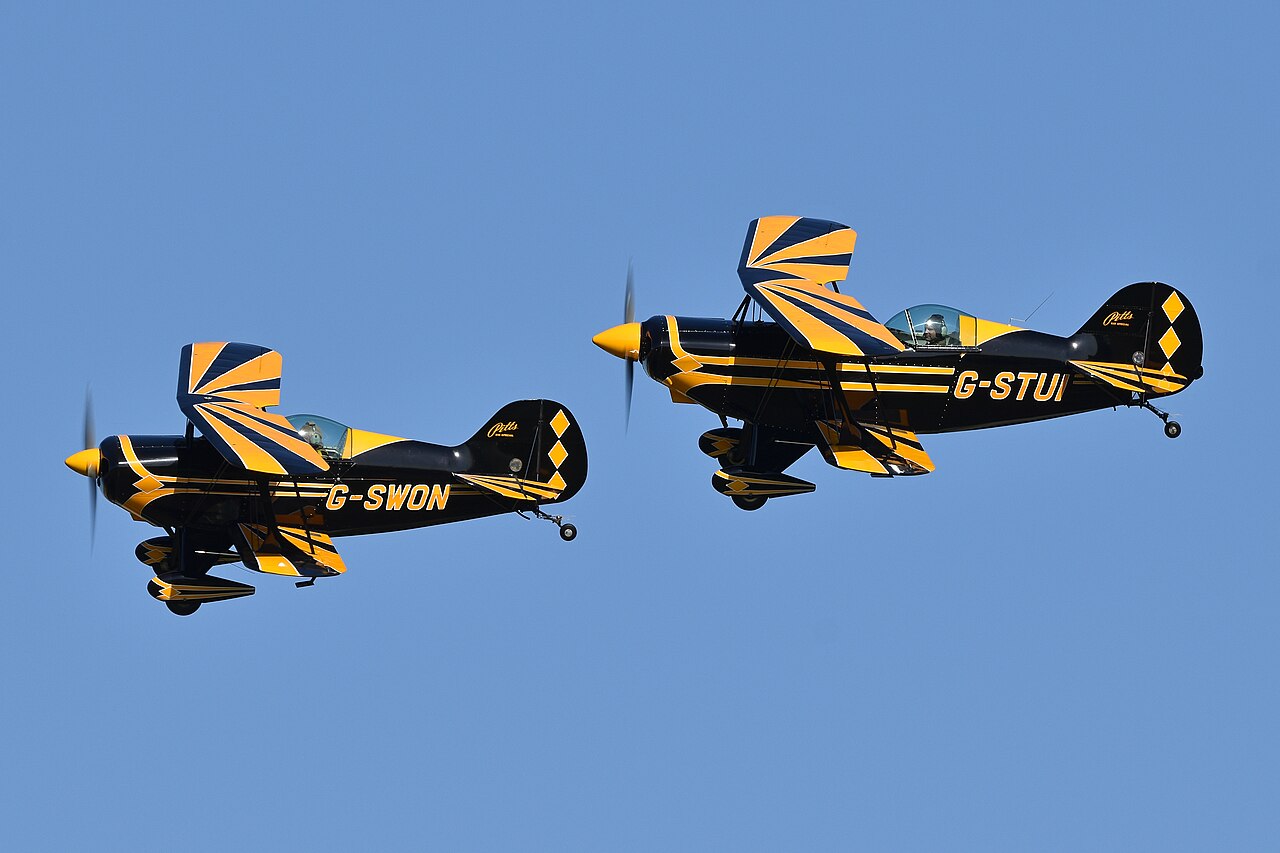
The Pitts Special is a series of small, single- and two-seat aerobatic biplanes designed by Curtis Pitts, first flown in September 1944 and still in production today under Aviat Aircraft. For decades it was the aircraft by which all other aerobatic types were judged, dominating world competition in the 1960s and 1970s and remaining a benchmark for aerobatic training and airshow flying ever since.
The Pitts Special is an American aerobatic biplane family built around company designations S-1 (single-seat) and S-2 (two-seat tandem), designed by Curtis Pitts. It is a light, short-span, high-power-to-weight biplane conceived purely for aerobatics, and it remains in production today built by Aviat Aircraft of Afton, Wyoming, alongside a large homebuilt community supplied with plans and kits by Steen Aero Lab. Its combination of small size, light weight and extreme agility made it revolutionary when introduced and it remains a leading type for competition aerobatics, aerobatic instruction and airshow work.
Curtis Pitts began designing a single-seat aerobatic biplane in 1943-1944, and the prototype first flew in September 1944. Rather than fitting a large radial engine, Pitts built the aircraft around the newer, smaller and lighter horizontally-opposed engines, with a swept wing chosen for centre of gravity and access reasons that also made snap rolls sharper. Several early Pitts aircraft carried a skunk motif and were nicknamed "Stinkers"; the second aircraft Curtis built was bought by aerobatic performer Betty Skelton in August 1948 and named "Little Stinker", and it survives as the oldest known Pitts Special. Only limited numbers were produced through the 1940s and 1950s, but pilots such as Betty Skelton and Caro Bayley used the type to win women's aerobatic titles in the late 1940s and early 1950s, building its reputation. In 1962 Curtis Pitts set up Pitts Enterprises to sell plans of the S-1C to homebuilders, and after the U.S. team's participation with a Pitts Special at the 1966 World Aerobatic Championship in Moscow the design's popularity grew significantly. A two-seat aerobatic trainer version, the S-2, first flew in 1967 and was type certificated in 1971, with factory-built aircraft produced by the Aerotek company at Afton, Wyoming, later joined in production by the factory-built single-seat S-1S from 1973. In 1972 the US Aerobatic Team won the World Championships flying only Pitts biplanes, and most members of that team, including individual World Champions Charlie Hillard and Mary Gaffaney, flew S-1S Pitts Specials; between the late 1960s and 1974 almost all US national men's or women's champions flew an S-1S or S-1C. Ownership of the design changed hands several times: Curtis Pitts sold his interests in the S-1 and S-2 to Doyle Child in 1977, Child sold the rights to Frank Christensen in 1981, who continued production at Afton under Christen Industries, and homebuilt rights passed to Steen Aero Lab in 1994, with the Afton factory and production rights transferring to Aviat. Curtis Pitts died in 2005 at age 89, having been working with Steen on the prototype of a new two-seat Model 14 for unlimited aerobatics powered by a 400-horsepower Vedeneyev M14P radial. Many hundreds of homebuilders have completed and flown Pitts Specials since plans first became available in 1960.
The Pitts Special is a compact single-bay biplane of light construction, originally designed around horizontally-opposed engines in place of a heavier radial, giving it a favourable power-to-weight ratio and short wingspan for its era. Early single-seat S-1 variants used a flat M6 aerofoil section with ailerons on the lower wing only; later developments such as the S-1D and S-1S introduced four ailerons (on all wings) and a round, and later symmetrical, aerofoil section for improved aerobatic performance. The current production Pitts S-2C is a tandem two-seater powered by a Lycoming AEIO-540 engine of 260 hp driving a Hartzell composite constant-speed propeller ("The Claw"), with a length of 17 feet 9 inches, height of 6 feet 5 inches, wing span of 20 feet and wing area of 127.5 square feet. Its empty weight is 1,155 pounds against a maximum gross weight of 1,700 pounds, giving a useful load of 545 lb in the normal category and 470 lb aerobatic; fuel capacity is 29 US gallons (28 usable) including a 5-gallon wing tank. The cabin measures 6 feet 11 inches long, 28 inches wide and 47 inches high. The single-seat S-1S, by comparison, is fitted with a 180 hp Lycoming and a Sensenich 76EM8-0-56 propeller, has a gross weight of 1,150 pounds, an empty weight of around 850 pounds, a length of 15 feet 6 inches and a wing span of 17 feet 4 inches with a wing area of 98.5 square feet. Aviat's current production line offers the S-1 single-seater with engines up to 200 hp and a 17 ft 4 in wingspan, and the S-2 two-seater with a 260 hp flat-six and 20 ft wingspan, though Pitts Specials in general have been built with engines of up to 450 hp.
The Pitts S-2C has a maximum level speed at sea level of 169 knots, a cruise speed of 150 KTAS at 75 percent power with 30 minutes reserve giving a range of 284 statute miles, and a sea-level rate of climb at minimum weight of 2,900 feet per minute. Its aerobatic flight load limits are +6 G/-5 G, stall speed (clean) is 56 KIAS, and never-exceed speed is 185 KIAS; takeoff ground roll is 554 feet and landing ground roll 750 feet, with a maximum demonstrated crosswind component of 17 knots. The single-seat S-1S has a top speed of 176 mph, a maximum cruise of 155 mph, a stall speed of 62 mph, a rate of climb of 2,600 feet per minute, a roll rate of 180 degrees per second, and a range of around 300 miles; Aviat describes its controls as light and highly responsive, with "no slop" and precise handling that lets the pilot "wear" rather than simply fly the airplane. A Pitts S-2B, as fielded by Planes of Fame's "Double Take" example, is quoted with a maximum speed of 209 mph, a cruise speed of 175 mph, a rate of climb of 2,700 feet per minute, a range of 319 miles and a service ceiling of 21,000 feet. The type's extreme agility has also been used to set world aerobatic records: airshow performer Spencer Suderman set the current inverted flat spin world record of 98 consecutive turns on 20 March 2016 flying the Sunbird S-1x, a Lycoming IO-540-powered experimental Pitts S-1 variant, beginning at 24,500 feet and recovering at 2,000 feet AGL over the Yuma Proving Grounds; his earlier record of 81 turns was set in a Pitts S-2B from 23,000 feet over the Naval Air Facility El Centro in 2014.
The S-1 was the basic single-seat Pitts with a flat M6 aerofoil and lower-wing-only ailerons, of which two were built, named Special and Li'l Stinker. The S-1C was the amateur-built single-seat version with a flat-bottom wing and lower ailerons only, designed for 100-180 hp engines and first flown in 1960; it remains available as plans from Steen Aero Lab. The S-1D was an amateur-built S-1C fitted with ailerons on all four wings, broadly similar to the S-1S, while the S-1E was an amateur-built S-1C using factory kits and a symmetrical aerofoil. The S-1S was the Aerotek-built certified competition version with a round aerofoil section and four ailerons, powered by a 180 hp Lycoming AEIO-360-B4A, of which 61 were built; it is also available from Aviat as a plans-built aircraft, alongside the similar S-1SS. The S-2 was the original two-seat "Big Stinker" prototype, leading to the certified S-2A and later the S-2B, which could be flown competitively in unlimited-class competition and became Aviat's most popular model before being superseded, and the current production S-2C, which features a redesigned wingtip shape, flattened belly, revised engine cowling and windshield giving a 15 mph cruise speed improvement over the earlier model. The S-2S was a single-place aircraft similar in size and power to the S-2B, offering superior vertical penetration and high speed, but is no longer in production. The S-1-11B, prototype-named "Super Stinker", and the S-1T were higher-powered single-seat developments; the S-1T is noted for extremely high aileron-roll and snap-roll rates and is used in competition at both national and world level. The Model 11 prototype was the "Super Stinker" and the Model 12 prototype the "Macho Stinker". At the time of his death Curtis Pitts had also been developing the Model 14, a new two-seat biplane for unlimited aerobatics powered by a 400 hp Vedeneyev M14P radial.
The Pitts Special became the standard by which all other aerobatic aircraft were judged, dominating world aerobatic competition through the 1960s and 1970s and remaining competitive in the lower categories today. It was popularised by airshow performers including Betty Skelton and Caro Bayley, both of whom flew Pitts Specials to women's aerobatic championship titles in the late 1940s and early 1950s. Following the US team's use of the type at the 1966 World Aerobatic Championship in Moscow, and its role in the US Aerobatic Team's outright win at the 1972 World Championships flying only Pitts biplanes, the aircraft became closely associated with American national and world aerobatic success; between the late 1960s and 1974 almost all US national champions, men and women, flew an S-1S or S-1C. Beyond competition, the type has long been a fixture of the airshow circuit, and a modified Pitts S-2B named "Bose Double Take", built for stunt pilot Craig Hosking, was purpose-adapted for inverted takeoffs and landings, with the first inverted landing achieved in February 1985. Today the type continues to serve as a widely used platform for aerobatic training, competition flying and sport flying, produced both as factory-built Aviat aircraft and as homebuilt kits and plans through Steen Aero Lab.
Pilots describe the Pitts as an aircraft with light, immediate controls and essentially no slop, responding so directly to input that flying it feels more like wearing the airplane than piloting it. The S-1S is noted for working comfortably out of short strips of around 1,800 feet with clear approaches, and for its particular affinity for grass fields, while its high roll rate of 180 degrees per second and strong rate of climb reward confident, positive control inputs. The larger, more powerful S-2C is noted for exceptional performance in vertical lines, with pilots highlighting its extended "hang time" in vertical maneuvers, precise point rolls achievable at any speed thanks to its wing design, and centring stick forces that make sustained aerobatic sequences more manageable. Aviat's own material suggests that pilots who have trained in slower, less responsive aerobatic types generally find the Pitts requires noticeably less physical effort to fly maneuvers accurately, making it both a demanding competition tool and a rewarding trainer for pilots moving up into advanced aerobatics.