Departure
94%
vs 95% ▼ 1
 MY FS FLIGHTS
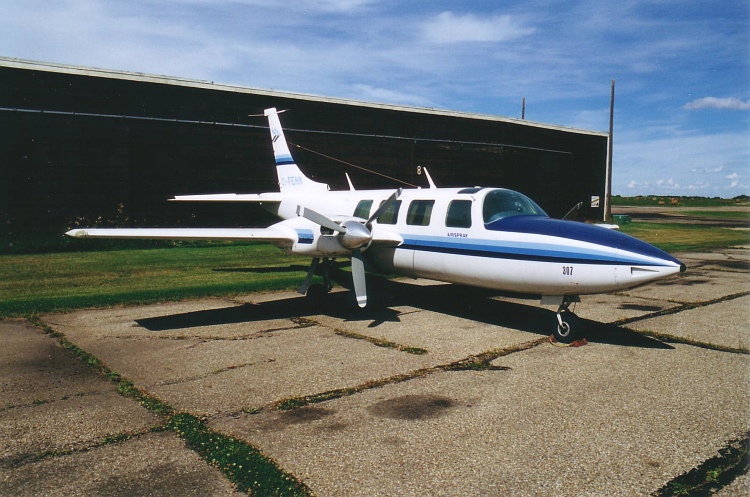
The Piper Aerostar 600 is an American twin-engined executive and light transport aircraft designed by Ted R. Smith, distinguished among piston twins of its era for exceptional speed and a mid-wing, aerodynamically refined airframe. Originally built by the Ted Smith Aircraft Company and later produced by Piper Aircraft Corporation as the PA-60, it became known as one of the fastest six-seat general aviation piston twins ever built, making it a distinctive and demanding type for the simulator pilot interested in high-performance piston aircraft.
The Aerostar 600 is a twin-engined, propeller-driven executive and light transport aircraft designed by Ted R. Smith. It is a mid-wing cantilever monoplane with retractable tricycle landing gear, seating up to six occupants, and was built first by the Ted Smith Aircraft Company and later, after 1978, by the Piper Aircraft Corporation under the designation PA-60. Across its production run from 1967 to 1984, 1,010 examples of the Aerostar family were built, with the type occupying a distinctive niche as a fast, aerodynamically refined piston twin rather than a conventional cabin-class business aircraft.
Ted R. Smith, who had previously designed the Aero Commander and Jet Commander, founded the Ted Smith Aircraft Company in 1963 to develop a new line of aircraft. The first Aerostar prototype, the Model 320, flew in November 1966 with two 160 hp Lycoming IO-320 engines; it was subsequently re-engined with 180 hp Lycoming IO-360s and a more streamlined vertical fin to become the Model 360, then upgraded again with 200 hp IO-360s as the Model 400. The design entered production as the Aerostar 600, powered by two 290 hp Lycoming IO-540-K engines, first flying in December 1967. A turbocharged version, the Aerostar 601, was also produced and became the basis for most later models. Production began at Van Nuys, California, but the company was bought by the American Cement Company in 1968, an acquisition that proved unsuccessful, leading to a sale to Butler Aviation International in 1969. Butler merged the operation with Mooney Aircraft Corporation under the Aerostar Aircraft Corporation name and planned to move production to Mooney's Kerrville, Texas plant, but a dispute with American Cement over alleged corrosion problems, later found groundless by the FAA, caused a two-year production halt and the relocation plan was cancelled. Ted Smith attempted to repurchase the rights in 1971 and considered an all-new design, while the Bellanca Aircraft Company and Chance Vought also expressed interest, but in 1972 Smith successfully reacquired the rights and resumed production under Ted R. Smith and Associates in Santa Maria, California. This period introduced the pressurized Aerostar 601P and the larger Aerostar 700 Superstar. The company was renamed Ted Smith Aerostar Corporation in 1976, the same year Smith died suddenly. The pressurized 601P, introduced in 1974, allowed more convenient high-altitude operation without limiting the airframe's service life, and the 601B of 1977 brought improvements to the turbocharging system along with a wingspan increased by 2.5 feet, improving climb performance. In 1978 the Piper Aircraft Corporation acquired the Aerostar line, continuing production of the 600A and 601B and later reintroducing the 601P, using the PA-60 prefix while retaining Ted Smith's model numbering system. Piper went on to introduce the enhanced 602P, initially marketed as the Sequoya, and put the Superstar into production as the 700P, of which only 25 were built. Non-pressurized models were eventually discontinued, and production moved to Vero Beach, Florida, where the last Aerostar was built in 1984. Smith had also studied jet-powered and turboprop derivatives, and even a single-engine trainer using the same basic airframe, though none of these reached production.
The Aerostar is a mid-wing cantilever monoplane powered by two wing-mounted piston engines, with retractable tricycle landing gear and seating for up to six. It is distinguished from contemporary light twins by its high wing loading, careful attention to aerodynamic detail, its mid-wing layout, and, in early models, the complete absence of cowl flaps, which Smith considered unnecessary given the refined cooling system design; later, however, the 700P adopted cowl flaps because engine cooling on earlier models proved marginal unless the system was rigorously maintained. The engines of early 601 models were turbonormalized, retaining the higher compression ratio typical of a normally aspirated engine while the turbocharger primarily compensated for altitude by boosting pressure as ambient air pressure fell; later models used a redesigned turbo system intended to improve reliability and be more tolerant of improper pilot operation. Distinctive design features include electrically operated remote fuel valves, which avoid the need to run fuel lines into the cockpit, electro-hydraulic nosewheel steering, and a flight control system based on push-pull rods and torque tubes rather than cables, together with unusually thick and stiff wing skins contributing to the type's high wing loading. The airframe was notable for containing only about half as many components as many comparable aircraft, with parts interchangeable across the model range. The Model 600 was powered by two 290 hp Lycoming IO-540-K engines, while the larger Aerostar 700 used two 350 hp Lycomings.
During its production life the Aerostar held the speed record for the fastest twin-engined piston general aviation aircraft, with cruise speeds ranging from 220 knots (410 km/h; 250 mph) on the earliest 600 models up to 261 knots (483 km/h; 300 mph) on the later 700 models. The 601B was noted as the world's fastest six-place general aviation piston twin of its time, reflecting the emphasis Smith placed on aerodynamic refinement and high wing loading throughout the design.
The line began with the Model 600, powered by two normally aspirated 290 hp Lycoming IO-540-K engines, and the turbocharged Model 601, which became the basis for most subsequent variants. The 601P, introduced in 1974, added cabin pressurization, and the larger Aerostar 700 Superstar used two 350 hp Lycomings for greater speed and power. The 601B, introduced in 1977, brought turbocharging improvements and a wingspan extended by 2.5 feet for better climb performance. Under Piper, the line continued as the PA-60, with the 600A and 601B built first, followed by a reintroduced 601P. Piper then introduced the 602P, initially marketed as the Sequoya and notable as the first model with a turbocharger system designed and certified by the engine manufacturer rather than by Ted Smith or Piper, and put the Superstar into production as the 700P, of which only 25 were built before the line was discontinued.
The Aerostar was marketed and flown as an executive and light transport aircraft, valued for its speed relative to other piston twins of similar size and weight. Its production history, spanning ownership by the Ted Smith Aircraft Company, American Cement Company, Butler Aviation International's Aerostar Aircraft Corporation, Ted R. Smith and Associates, the Ted Smith Aerostar Corporation, and finally Piper Aircraft Corporation, reflects a type that remained in continuous but often turbulent production for executive and business flying markets over roughly two decades.