Departure
95%
vs 95%
 MY FS FLIGHTS
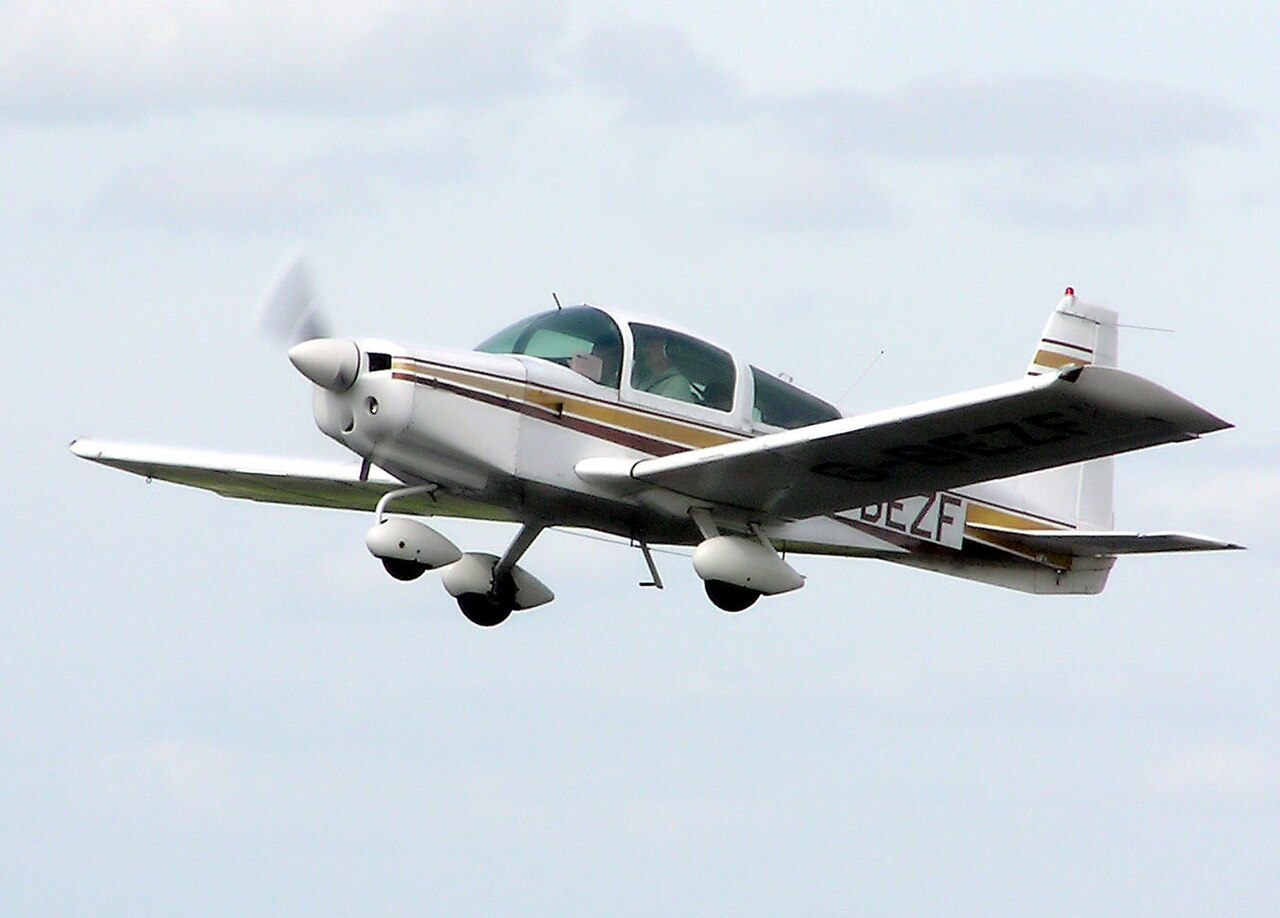
The Grumman American AA-5B Tiger is an American all-metal, four-seat, low-wing light aircraft built for touring and training, developed from the AA-5 Traveler by fitting a more powerful Lycoming engine and aerodynamic refinements. It was the fastest and most successful member of the AA-5 family, prized by owners for its brisk cruise speed, light and responsive controls, and simple fixed-gear, fixed-pitch-propeller operation, and it remains a popular type among private pilots and flight simulator enthusiasts who enjoy its sporty handling.
The AA-5B Tiger is a four-seat, low-wing, single-engine monoplane of all-metal, bonded construction, fitted with tricycle landing gear and certificated in the normal and utility category. It is the final and most capable variant of the Grumman American AA-5 family, a line of touring and training aircraft that traces its design back to the smaller AA-1 Yankee Clipper. The Tiger shares its wings, fuselage and panels with the lower-powered AA-5 Traveler, differing chiefly in its more powerful engine and increased fuel capacity, and it holds the same type certificate as the Traveler.
Following the success of the two-seat AA-1 Yankee Clipper in 1969, American Aviation sought a four-seat aircraft to round out its range. An initial clean-sheet design, the AA-2 Patriot, failed to meet its performance targets and only one example was built, so the company instead enlarged the AA-1 Yankee's external and cabin dimensions to create the four-seat AA-5 Traveler, achieving around two-thirds parts commonality with the earlier design. The Traveler, powered by a 150 hp Lycoming O-320-E2G, entered production in 1971 and was carried forward when American Aviation was sold to Grumman in 1973, becoming Grumman American. A 1974 redesign of the AA-5 produced the aerodynamically cleaned-up AA-5A Cheetah, and the same redesign work, combined with the fitting of a more powerful 180 hp Lycoming O-360-A4K engine, produced the AA-5B Tiger, first built in late 1974 as a 1975 model. Grumman sold its light aircraft division to Gulfstream Aerospace in 1978, forming Gulfstream American, which continued Tiger production until Gulfstream ceased all piston-engine manufacture in 1979, by which point 1,323 Tigers had been delivered. The design then lay dormant for eleven years until American General Aviation Corporation revived it in the late 1980s as the improved AG-5B Tiger, incorporating a new split engine cowling, revised instrument panel, improved exterior lighting, a new fuel quantity system, a 28-volt electrical system in place of the earlier 14-volt system, and improved heating and ventilation. American General closed in 1993 without producing other AA-1 or AA-5 variants. A further revival came in 1999 when Tiger Aircraft was formed in Martinsburg, West Virginia, building the AG-5B Tiger from 2001 until the company ceased operations in November 2006 and filed for bankruptcy in January 2007.
The AA-5B Tiger is of all-metal bonded construction, with wing skins bonded rather than riveted, which Grumman credited with contributing to the type's aerodynamic efficiency, though this bonding made field repairs more challenging if the airframe was damaged. The main wing spar is a steel tube running from wingtip to wingtip. The Tiger retains the Traveler's wings, fuselage and panels but is distinguished by its 180 hp Lycoming O-360-A4K engine, driving a McCauley 75/63 fixed-pitch propeller, against an engine TBO of 2,000 hours. Fuel capacity was increased to 52 US gallons usable maximum (37 US gallons standard), up from the Traveler's 37 to 38 gallons, giving the Tiger considerably better range. Gross weight was raised from the AA-5/AA-5A's 2,200 lb to 2,400 lb. Typical dimensions are a wingspan of 31 ft 5 in, length of 22 ft, and height of 8 ft, with an empty weight of 1,398 lb and a useful payload with standard fuel of 780 lb. Wing loading is quoted at 17.1 lb per square foot and power loading at 13.3 lb per horsepower. The aircraft has a bubble-style canopy configuration typical of the Grumman American line, with tricycle landing gear and fixed main gear fairings refined during the AA-5A redesign.
With its 180 hp Lycoming engine the Tiger offers a cruise speed of 139 knots at 75 percent power at 8,500 ft, with a maximum speed of 148 kts and a stall speed (Vso) of 53 kts. Range at 75 percent power with a 45-minute reserve is given as 554 nm, though other sources quote a range of approximately 680 nautical miles; the Traveler by comparison managed 520 statute miles at the same power setting, so the Tiger's increased fuel capacity gave it markedly better cross-country legs, covering around 650 miles where the Traveler covered 520. Takeoff ground roll is 865 ft, with a distance of 1,550 ft to clear a 50 ft obstacle; landing ground roll is 410 ft, with 1,120 ft needed over a 50 ft obstacle. Rate of climb is 850 fpm and service ceiling is 13,800 ft. The Tiger is noted for its light, quick ailerons, described as the quickest of any non-aerobatic certified single on the market at the time, giving it crisp, responsive handling that has made it popular with pilots who enjoy a sporty feel. The airframe proved tough in service; in one account a Tiger used as an aerial photography platform held a hatch fully open through dozens of air-to-air sessions without issue.
The AA-5 family began with the American Aviation/Grumman American AA-5 Traveler (150 hp Lycoming O-320-E2G, 834 built before 1975), followed by the aerodynamically refined AA-5A Cheetah (also 150 hp, with increased fuel capacity and a larger horizontal tail, 900 built up to 1979 production end). The AA-5B Tiger, the subject of this profile, fitted the 180 hp Lycoming O-360-A4K and increased gross weight, with 1,323 built by Gulfstream American through 1979. After an eleven-year hiatus the design was revived as the American General AG-5B Tiger in the late 1980s with a new split nose cowling, revised panel, improved lighting, new fuel quantity indication, a 28-volt electrical system and improved heating and ventilation, raising optimal cruise speed from 139 to 143 knots TAS. Tiger Aircraft later resumed AG-5B Tiger production from 2001 to 2006 at Martinsburg, West Virginia, without reviving other AA-1 or AA-5 models despite holding the type certificates for the full line.
The Tiger was marketed and used primarily as a touring and personal cross-country aircraft, as well as for flight training, trading on the Grumman American line's reputation for light, responsive handling. Its increased fuel capacity and cruise speed relative to the Traveler and Cheetah gave it genuine practical cross-country range, and it has also seen use in roles such as aerial photography platform work. The type retains a strong following among private owners and pilots, supported by an active type club, and well-maintained examples continue to be bought and sold on the used aircraft market decades after production ended.
Pilots and reviewers consistently highlight the Tiger's quick, light ailerons, described as the sharpest of any non-aerobatic certified single of its era, which gives the type a notably sporty, responsive feel in roll compared with other fixed-gear four-seat singles. Its simple fixed-gear, fixed-pitch-propeller layout keeps systems management straightforward, making it approachable for training while still rewarding more active stick-and-rudder flying. The bonded, all-metal structure and steel tube main spar give the airframe a reputation for toughness, and its useful cruise speed and range make it well suited to cross-country flying scenarios, which together with its affordability and friendly handling have kept it a popular and sought-after light single among owners and enthusiasts.