Departure
96%
vs 96%
 MY FS FLIGHTS
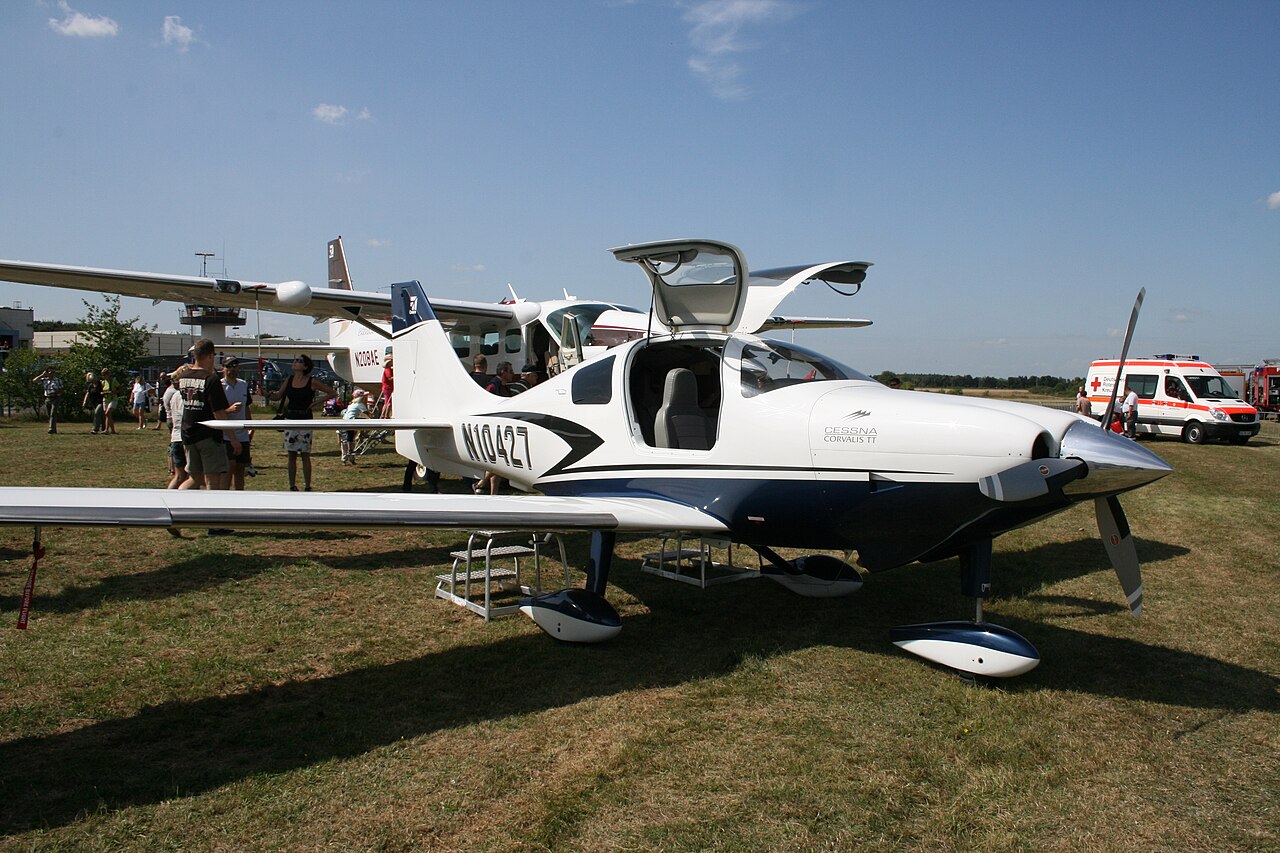
The Cessna 400, marketed as the Corvalis TT and later the Corvalis TTx, is a single-engine, fixed-gear, low-wing four-seater of composite construction. It began life as the Columbia 400 and was built by Cessna from 2007 until production ended in February 2018. Its turbocharged 310 hp engine and glass cockpit give it cruise speeds more usually associated with retractable types, which makes it an appealing high-performance tourer in the sim.
The Cessna 400 is a single-engine, fixed-gear, low-wing general aviation aeroplane built from composite materials. It was designed and first built by Columbia Aircraft as the Columbia 400, and was built by Cessna after the takeover until December 2007 under the Columbia name. Cessna then marketed it as the Cessna 400 Corvalis TT, the TT standing for twin turbocharged, and from 2013 as the Cessna T240 Corvalis TTx. It was aimed at the luxury, technologically advanced four-seat market, with a spacious, car-like cabin and a glass cockpit, and competed with aircraft such as the Cirrus SR22 Turbo.
The 400 descends from the Lancair ES kit aircraft through the normally aspirated Columbia 300; the lineage dates to a first flight in June 2000. The production aircraft was certified by the FAA under FAR 23 on 8 April 2004 as the Model LC41-550FG (Lancair Certified, Model 41, Continental 550 engine, Fixed Gear) and sold as the Columbia 400. In 2005 the company became the Columbia Aircraft Manufacturing Corporation, which Cessna bought in November 2007. Cessna then renamed the Columbia 350 and 400 the Cessna 350 Corvalis and Cessna 400 Corvalis TT, the latter name being announced on 14 January 2009. The name derives from the town of Corvallis, Oregon, west of Bend, Oregon, where the aircraft was built. In April 2009 Cessna announced the closure of the Bend factory and the move of production to Independence, Kansas, with the composite construction moved to Mexico. The Independence line restarted in October 2009 at an initial rate of one aircraft per six months. In December 2010 a Cessna 400 on a production acceptance flight suffered a structural failure when the wing skin disbonded from the upper forward wing spar over about 7 feet. The FAA issued an Emergency Airworthiness Directive covering seven Cessna 400s and one 350, all still on the production line, and deliveries were delayed. In September 2011 the FAA proposed a US$2.4M fine over quality assurance failures in fibreglass production at the Chihuahua plant, where excess humidity had prevented parts from curing correctly. On 29 March 2011 Cessna unveiled the improved TTx at Sun 'n Fun, and 16 had been sold by the end of the show. Deliveries had fallen from 110 in 2008, the first year Cessna produced the model, to 41 in 2009 and seven in 2010. A flight-into-known-icing package was announced as a TTx option at Sun 'n Fun in March 2012. Production ended in February 2018, with only 23 examples sold in 2017.
The airframe is all-composite, with a fixed tricycle undercarriage and a low wing. The engine is a six-cylinder turbocharged Continental TSIO-550-C producing 310 horsepower (230 kW) at 2600 rpm, and it can be operated lean of peak. The nosewheel is not directly steerable, so directional control on the ground is by differential braking on the mainwheels. Optional speedbrakes are mounted on the upper wing surfaces. The Columbia 400 offered an optional ice protection system called E-Vade, which was not certified for flight into known icing. It used heat-conducting graphite foil panels on the wing and tail leading edges, heated by 70 volt, 100 amp power from a dedicated alternator and controlled by a single switch. Early aircraft had a Garmin 430 navigator and communicator tied into an Avidyne primary flight display, while the Cessna-built 400 carried a Garmin G1000 glass cockpit, later incorporated into the 300 to create the Cessna 350. The TTx has a Cessna-designed panel called Intrinzic, based on the Garmin G2000. It has two 14 in (36 cm) wide high-definition displays and an infra-red touchscreen controller. It also has dual AHRS, a GFC 700 autopilot, a Garmin GTS800 traffic system, a Garmin GTX 33ES transponder with ADS-B, and Garmin Electronic Stability Protection, which guards against operation outside the approved envelope. The TTx has no traditional instruments and uses an L-3 Trilogy unit as back-up. It also has a built-in pulse oximeter, a new paint scheme and a new interior.
In flight tests at 11,000 feet, 50 degrees F rich of peak turbine inlet temperature, maximum cruise gave 199 knots (369 km/h) true airspeed at a fuel flow of 24.7 US gallons (93 L) per hour. At the same altitude, 50-75 degrees F lean of peak, the 400 gave 189 knots (350 km/h) TAS on 17.8 US gallons (67 L) per hour (106.8 lb/hr). A magazine pilot report quotes cruise of up to 213 knots at practical altitudes, and describes cruise performance more appropriate to a retractable than to a fixed-gear aeroplane. A cold-weather kit was developed to improve engine oil temperatures in frigid climates, and an inadvertent-icing TKS system was certified for the Corvalis TT. The TTx can be fitted with a flight-into-known-icing package giving up to 2.5 hours of protection.
The Columbia 400 (certified as the LC41-550FG) was the original version, built by Columbia and sold under that name until December 2007. The Cessna 400 followed, marketed from 14 January 2009 as the Corvalis TT. The Cessna T240 Corvalis TTx was announced in March 2011 and built from 2013, with the Intrinzic G2000-based panel, dual AHRS, GFC 700 autopilot, traffic and ADS-B equipment, Electronic Stability Protection, pulse oximeter and a new interior, and with a flight-into-known-icing option added later. The related Cessna 350 Corvalis is the normally aspirated Columbia 300 fitted with the G1000 cockpit.
The Corvalis served as a personal transportation aeroplane for owners wanting a fast, well-equipped four-seater without retractable gear. It was built first by Columbia Aircraft at Bend, Oregon, then by Cessna after its November 2007 acquisition, and finally at Independence, Kansas. It competed with the Cirrus SR22 and sold in far smaller numbers, with 110 delivered in 2008 and 23 in 2017.
A simulated C400 gives the pilot a fast, fixed-gear tourer with a glass panel, a turbocharged engine and optional speedbrakes. The sim aircraft retains the real aircraft's lack of nosewheel steering, so taxiing needs careful differential braking. The engine rewards proper leaning, trading about 10 knots of speed for a large saving in fuel flow at altitude. A payware simulation of the type is supported by a detailed pilot operating handbook covering the Columbia 400 and Cessna Corvalis TT. It suits fast cross-country flights at altitude, and the TTx's G2000-based panel adds modern avionics and protection features to the workload.