Departure
95%
vs 95%
 MY FS FLIGHTS
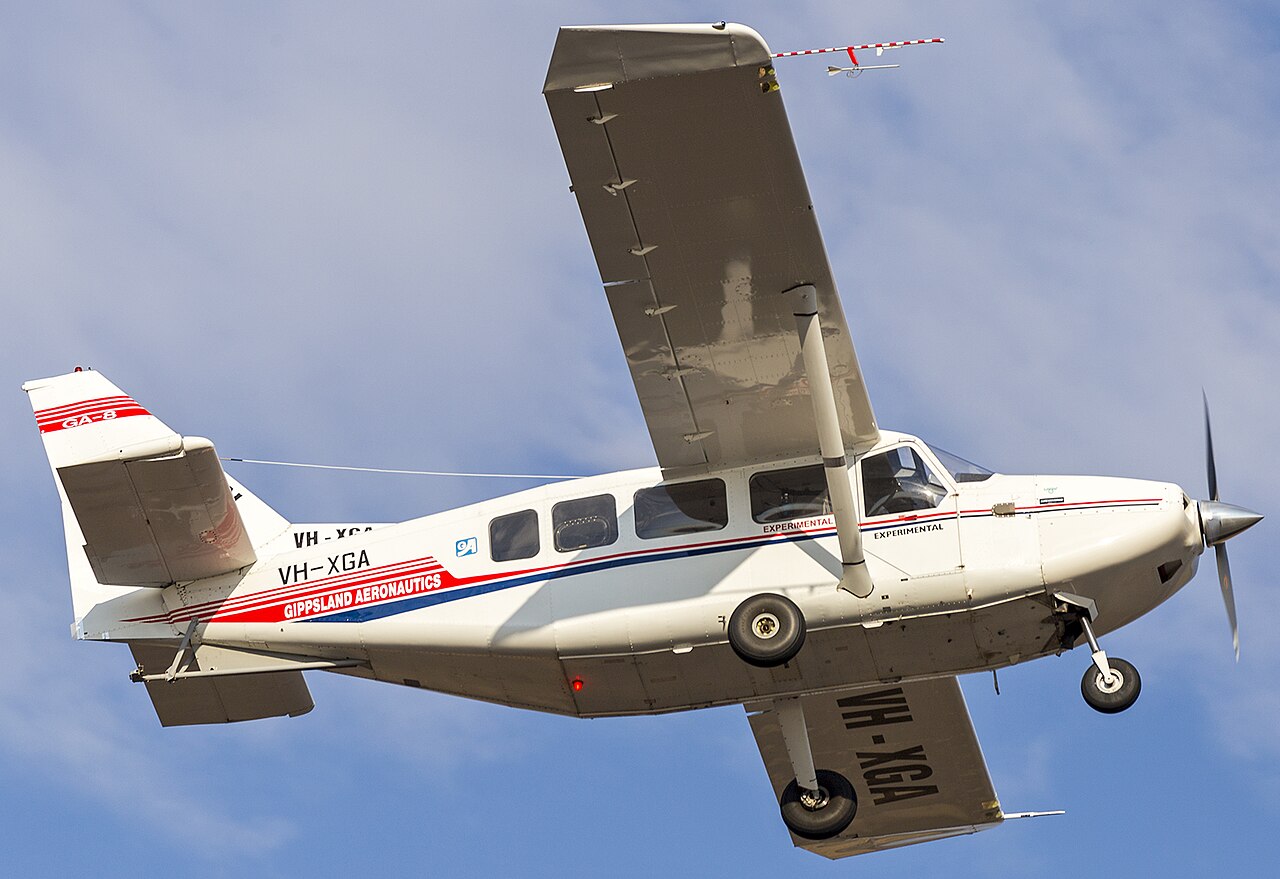
The GippsAero GA8 Airvan is a single-engined, high-wing utility aircraft built by GippsAero (formerly Gippsland Aeronautics) of Victoria, Australia, seating up to eight including the pilot. Designed to fill the gap between the Cessna 206 and the Cessna 208 Caravan, it was conceived from the outset for rugged, austere-strip operations, and has since found favour with passenger, freight, skydiving, surveillance and search-and-rescue operators worldwide, including the United States Civil Air Patrol. Its combination of a large square-section cabin, simple fixed undercarriage and forgiving handling makes it an interesting type for simulator pilots interested in genuine bush and utility flying.
The GA8 Airvan is a single-engine, shoulder-wing utility and transport aircraft manufactured by GippsAero of Victoria, Australia, seating up to eight people including the pilot. It was designed specifically for operation into remote areas and austere airstrips, with an emphasis on ruggedness and ease of use, and sits in the market between the six-seat Cessna 206 and the fourteen-seat Cessna 208 Caravan. For a period from 2014 the type was marketed as the Mahindra Airvan 8 following GippsAero's acquisition by the Indian conglomerate Mahindra Group.
Design work on the Airvan began in early 1994, with the aircraft's design primarily the work of Peter Furlong. The prototype, powered by a 185 kW (250 hp) Textron Lycoming O-540 driving a two-blade propeller, first flew on 3 March 1995 and appeared publicly at the Australian International Airshow and Aerospace Expo at Avalon later that month after only eight flying hours. At that time Gippsland Aeronautics hoped for certification within twelve months, but the programme was set back when the prototype crashed during spinning trials in February 1996. A second prototype, fitted with a 225 kW (300 hp) IO-540 engine, flew in August 1996. The type was certified under FAA Part 23 requirements during the summer of 2004, with dynamic testing and validation of controllability following loss of any primary flight control among the certification requirements. Introduction into service followed in December 2000, and by 2020 some 262 examples had been built. A turbocharged development, the GA8-TC320, began flight testing in October 2006, received a type-certificate amendment from the Australian Civil Aviation Safety Authority in February 2009, and entered delivery that same month; within two years a number had been delivered to customers in Australia and New Zealand. On 8 July 2010 a GA8-TC320, flown by Kenneth Evers and Timothy Pryse, became the first Australian-designed and manufactured aircraft to circumnavigate the globe, a flight recognised by the Federation Aeronautique Internationale and later honoured by Australian Flying as a first in Australian aviation history. At EAA Oshkosh 2014 the aircraft was renamed the Mahindra Airvan 8, reflecting GippsAero's acquisition by the Mahindra Group, and plans were floated for a North American final assembly line. In November 2020 Mahindra Aerospace announced the end of production, citing the financial effects of the COVID-19 pandemic. GippsAero's co-founder George Morgan repurchased the company in November 2023 and announced his intention to resume manufacture; production of new aircraft recommenced in June 2025 with serial number 263, with new-build examples expected to become operational in 2026.
The GA8 is built around a square-sided, large-volume fuselage intended to maximise usable cabin space, fitted with a large sliding freight door on the port side for easy loading. It has a high-mounted, two-spar wing derived from the unit used on the GA-200 agricultural aircraft, and fixed, wide-track landing gear designed specifically for rough-field operation. Production aircraft were powered by a 225 kW (300 hp) Textron Lycoming IO-540-KA5 fuel-injected flat-six driving a three-blade constant-speed propeller, a step up from the O-540 and IO-540 units used on the two prototypes. Dimensions given for the early production aircraft are a wing span of 12.37 m (40 ft 7 in), length of 8.79 m (28 ft 10 in), height of 2.82 m (9 ft 3 in) and wing area of 19.3 sq m (208.0 sq ft). Empty weight was quoted at 862 kg (1,900 lb) against a maximum take-off weight of 1,815 kg (4,000 lb); a Supplemental Type Certificate issued in December 2010 permitted a 200 lb increase in MTOW. The cabin seats the pilot and one passenger side by side up front, with up to six further passengers behind, and the main cabin can alternatively be configured to carry freight. The later turbocharged GA8-TC320 variant is fitted with a 320 hp Lycoming TIO-540-AH1A turbocharged, fuel-injected engine.
Quoted performance for the standard production GA8 includes a maximum cruising speed of 240 km/h (130 kt) and an economical cruising speed of 222 km/h (120 kt), with an initial rate of climb of 750 ft/min and a service ceiling of 20,000 ft. Range with maximum fuel was given as 1,205 km (650 nm), falling to 185 km (100 nm) with maximum payload aboard, reflecting the aircraft's role as a short-range utility hauler rather than a long-range tourer.
The baseline GA8, powered by the 300 hp Lycoming IO-540-KA5, was the original production version. The GA8-TC320 is a turbocharged derivative fitted with a 320 hp Lycoming TIO-540-AH1A engine, certified by CASA in February 2009 and delivered from the same month, offering improved high-altitude and hot-and-high performance. A floatplane version of the GA8 was evaluated during 2005, with the manufacturer announcing in 2011 that it was preparing to put a float-equipped model into production in partnership with the American float manufacturer Wipaire. From 2014 the aircraft line was rebranded as the Mahindra Airvan 8 following GippsAero's acquisition by the Mahindra Group. A larger, stretched ten-seat turboprop derivative, the GippsAero GA10, has also been developed, intended to share as many common parts with the GA8 as possible and powered by a Rolls-Royce 250-B17F/2 turboprop engine.
The GA8 has been flown by a diverse range of operators worldwide in roles including passenger services, freight, sightseeing, parachute operations, observation, intelligence, surveillance and reconnaissance, and search and rescue, generally from remote or austere airstrips for which the type was specifically designed. Its primary user has been the United States Civil Air Patrol. In the civil market, GA8s have been used by air charter companies and skydiving operators, among others. The type's rugged, high-wing, fixed-gear layout has also seen it distributed and supported in North America through appointed dealers and component distributors.
The GA8 Airvan has been recreated for Microsoft Flight Simulator by Simworks Studios, whose add-on features a detailed model spanning four variants of the type, sounds recorded from a real aircraft, and flight handling intended to reflect the genuine aircraft as closely as the simulator platform allows. The add-on also includes persistent, dynamic visual weathering, with the airframe accumulating dirt and mud over time depending on the operating environment, giving the aircraft a lived-in, working-aeroplane character appropriate to its real-world role flying cargo, passengers, skydivers and patrol missions from rough strips around the world.