Departure
100%
vs 95% ▲ 5
 MY FS FLIGHTS
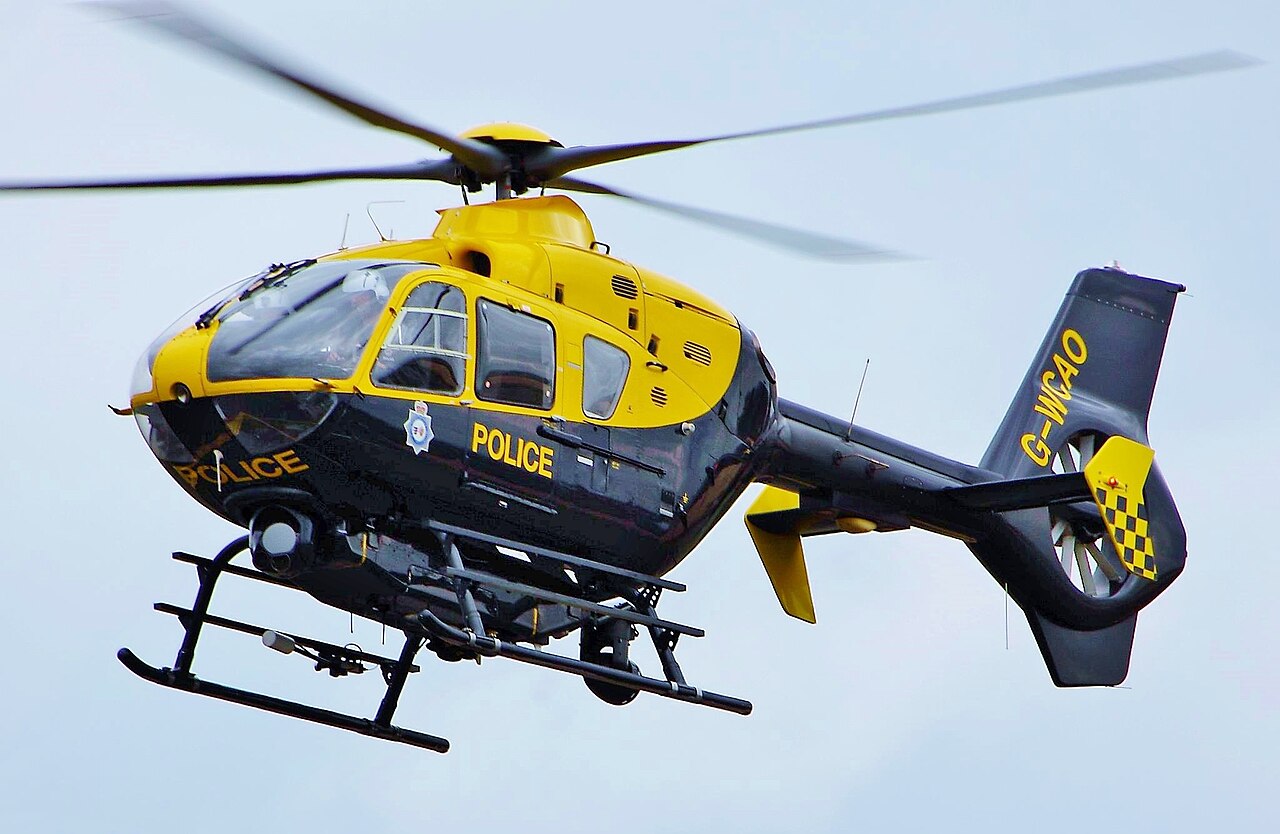
The Eurocopter EC135T1 is the original Turbomeca-powered version of the EC135 light twin helicopter family, developed by Eurocopter (now Airbus Helicopters) from the Messerschmitt-Bolkow-Blohm Bo 108 technology demonstrator. Certified in the mid-1990s and produced from 1997 to 2003, it combined a modern bearingless rotor, Fenestron tail and digital flight controls in a compact airframe aimed at emergency medical, corporate and law enforcement operators, and it remains a familiar type for simulator pilots interested in light twin-engine IFR-capable helicopters.
The EC135T1 is a twin-engine light utility helicopter from the Eurocopter EC135 family, the first production variant to reach customers and the version powered by the Turbomeca Arrius 2B engine (as distinct from the parallel P1 model fitted with Pratt & Whitney Canada PW206B engines). Developed for a broad civil market, it is capable of flight under instrument flight rules and carries a digital automatic flight control system, qualities that made it attractive to air medical, corporate and law enforcement operators from the outset. It sits within a wider family that has since evolved into the Airbus Helicopters H135.
The EC135 lineage began before the formation of Eurocopter, under Messerschmitt-Bolkow-Blohm as the Bo 108 in the 1970s, developed in partnership with Aerospatiale as a technology demonstrator combining attributes of the successful MBB Bo 105 with a new, aerodynamically streamlined design. The first Bo 108 prototype flew on 17 October 1988 powered by two Allison 250-C20R/1 engines, with a second prototype following in June 1991 fitted with two Turbomeca TM319-1B Arrius engines; both early aircraft retained conventional tail rotors. In the late 1990s the design was revised with the introduction of a Fenestron tail rotor system, an advanced bearingless main rotor, composite materials and resonance isolation systems, and the programme was redesignated EC135 to align with the newly formed Eurocopter company. Two pre-production prototypes were built in 1994, one powered by the Turbomeca Arrius 2B and the other by the Pratt & Whitney Canada PW206B, with the type's first flight recorded as 15 February 1994. The EC135 made its public debut at the Heli-Expo convention in Las Vegas in January 1995, where its appearance and performance figures reportedly impressed prospective buyers. European JAA certification was achieved in June 1996, with FAA approval following in July, and the Arrius-powered T1 variant entered production shortly afterwards, continuing in manufacture from 1997 to 2003. Single-pilot instrument flight rules certification followed, granted by Germany's Luftfahrt-Bundesamt in December 1999 and by the United Kingdom's Civil Aviation Authority in December 2000.
The EC135T1 shares the family's compact twin-engine layout, with a hingeless, bearingless main rotor using carbon-fibre-reinforced rotor blades and a Fenestron shrouded tail rotor in place of a conventional open tail rotor. The Fenestron design uses ten moving rotor blades and ten fixed stator blades, which can be arranged with variable angular spacing to reduce noise; this contributed to the EC135 being, for more than fifteen years after launch, the quietest helicopter in its class. The T1 variant is powered by two Turbomeca Arrius turboshaft engines, each delivering close to 650 horsepower, as distinct from the parallel P1 model which used Pratt & Whitney Canada PW206B engines. The aircraft's structure and weight were optimised through extensive use of composite materials, and the type carries a digital automatic flight control system supporting instrument flight operations.
With either of the two engine options available across the EC135 family, the helicopter reaches top speeds of around 300 km/h and service altitudes of more than 6,000 metres. For the T1 variant specifically, a normal cruise speed of 135 knots (155 mph) has been recorded, alongside a maximum operating altitude of 20,000 feet and a seats-full range of around 255 nautical miles (294 statute miles).
The T1 was one of two original production variants of the EC135, distinguished by its Turbomeca Arrius 2B engines, while the parallel P1 model was fitted with Pratt & Whitney Canada PW206B engines; both powerplant options proved successful and were carried forward into later production aircraft. The family was subsequently developed further, with the EC135P2 introduced from 2000 using the uprated Pratt & Whitney Canada PW206B2 for improved single-engine performance and 30-second emergency power, certified in July 2001, and the EC135T2 following in September 2002 with the improved Turbomeca Arrius 2B2 engine, also offering enhanced single-engine performance. A military derivative, the Eurocopter EC635, and later the EC135 ACT/FHS research demonstrator and the Bluecopter technology demonstrator, extended the lineage, which eventually evolved into the Airbus Helicopters H135 and H135M designations.
Although the EC135 family was designed primarily with emergency medical operators in mind, the type had considerable appeal across a wide range of roles, including corporate transport and law enforcement. Early production T1 aircraft entered service with civil operators in the late 1990s, and the design's combination of low noise, compact dimensions and IFR capability suited it to operation in built-up and noise-sensitive environments. More broadly across the EC135 family, roughly 1,400 units had been delivered by September 2020 to around 300 operators in 60 countries, accumulating over five million flight hours, with about half of the fleet in service in Europe and a quarter in North America, spanning medevac, corporate transport, law enforcement, offshore wind support and military flight training roles.