Departure
87%
vs 95% ▼ 9
 MY FS FLIGHTS
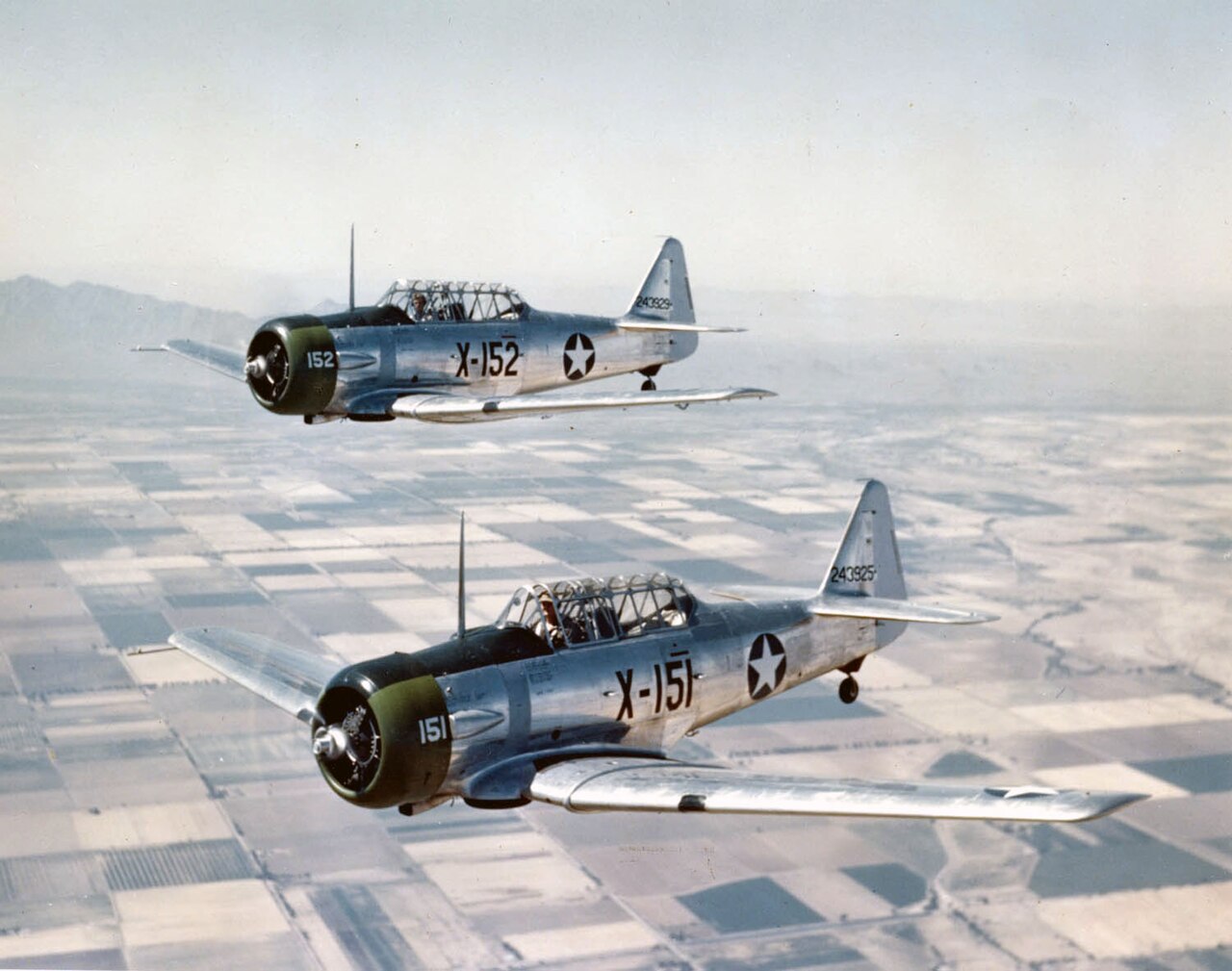
The North American T-6 Texan is an American single-engined advanced trainer aircraft built by North American Aviation, used to prepare pilots of the USAAF, US Navy, Royal Air Force and other Commonwealth air forces for combat during World War II and for decades afterward. Known variously as the AT-6, SNJ or Harvard depending on the operating service, it earned the nickname "the pilot maker" for its role as the final training step before pilots moved on to frontline fighters.
The T-6 Texan is a single-engine, all-metal advanced trainer aircraft designed and built by North American Aviation. It served the United States Army Air Corps, United States Army Air Forces, United States Navy, Royal Air Force, Royal Canadian Air Force and other air forces of the British Commonwealth, and is known by different designations according to the operating service: the USAAC and USAAF called it the AT-6, the US Navy the SNJ, and British Commonwealth forces the Harvard, the name by which it is best known outside the United States. From 1948 the new United States Air Force redesignated it the T-6, a change followed by the US Navy in 1962. A total of 15,495 T-6s of all variants were built, and it remains a popular warbird for airshow demonstrations and static displays, frequently used to represent other historical aircraft, including the Japanese Mitsubishi A6M Zero.
The T-6's ancestry traces back to the North American NA-16 prototype, which first flew on 1 April 1935 and was submitted for the U.S. Army Air Corps Basic Trainer Competition, with North American also targeting the export market. Modified as the NA-26, it was entered into a USAAC Basic Combat Trainer competition in March 1937; based on the NA-18 but with a foot longer wingspan, it was the first of the NA-16 series with retractable gear, similar to the BT-9 but fitted with the larger 550 hp Pratt & Whitney R-1340 Wasp engine and able to mount two .30 in machine guns. With minor alterations, 177 unarmed NA-36s entered service as the BC-1 from 9 June 1937, with roughly 30 modified as BC-1-I instrument trainers. The armed BC-1A (NA-55-1) followed, with 83 built primarily for Air Corps Reserve and National Guard units. The US Navy received 40 NA-28 aircraft (designated NJ-1), plus 16 NA-52 SNJ-1s, 36 NA-65 SNJ-2s and 25 NA-79 SNJ-2s. In March 1937 the Commonwealth Aircraft Corporation of Australia purchased an NA-32 and an NA-33 along with a manufacturing licence, leading to the CAC Wirraway, first flown 27 March 1939, of which 755 were built. In August 1937 Mitsubishi purchased a single NA-16 (NA-37) with manufacturing rights, and a second variant (NA-47) was ordered in December 1937; after evaluation by the Imperial Japanese Navy, Japanese manufacturers largely set the design aside and built 176 of the similar K10W1, given the Allied code name Oak. After the Second World War the Japanese Air Self Defense Force operated 195 Texans and the Japanese Maritime Self Defence Force operated 62. In December 1938 the British Commonwealth began receiving the first of 400 Harvard Mark Is (NA-49), powered by the 600 hp Pratt & Whitney R-1340-S3H1 Wasp, for use at the Central Flying School; in May 1939 the Royal Canadian Air Force ordered 30 Harvard Mark Is (NA-61), and in November 1939 the British Purchasing Commission ordered the first of eventually 1,275 Harvard Mark IIs for the RAF and RCAF. On 23 April 1939 North American received a contract for 251 BT-14s and 94 AT-6s; the BT-14 (NA-58) was a fixed-gear aircraft with a fuselage 14 inches longer than the BT-9, and 27 were later refitted with the 400 hp R-985-11 engine as BT-14A-NAs. In June 1939 the company received an order for 94 AT-6-NAs (NA-59), powered by the R-1340-47 and able to mount two .30 in machine guns. The USAAC AT-6A and Navy SNJ-3, based on the NA-77 and NA-78 designs, followed, with 1,847 AT-6As and 270 SNJ-3s built. Noorduyn of Canada also built 1,500 examples during the war years under the designation AT-16. Production totalled 15,495 aircraft of all variants.
The T-6 is an all-metal, single-engine, two-seat aircraft with tandem front and rear cockpits, designed from the outset as a Basic Combat Trainer able to accommodate armament for gunnery instruction. Early NA-16-series aircraft used the 550 hp Pratt & Whitney R-1340 Wasp, and later British-ordered Harvard Mark Is used the 600 hp R-1340-S3H1 Wasp; other variants used engines including the R-1340-47, R-1340-49, R-1340-38 and R-1340-AN-1 depending on model and operating service. The BC-1 was based on the NA-18 airframe with a wingspan a foot longer than its predecessor and was the first of the NA-16 lineage to feature retractable landing gear, distinguishing it from the fixed-gear BT-9 and BT-14. Armament fitments varied by model: the BC-1A could carry a .30 in machine gun in the nose and a flexible gun in the rear cockpit, while the AT-6B, built specifically for armament training, could mount a .30 in machine gun on the right nose cowl, on the right wing, and in the rear cockpit, plus a light bomb rack. The T-6G, a later production standard, provided for up to three 7.62 mm machine guns.
The T-6G has a maximum speed of 181 knots at 5,000 feet and a cruise speed of 126 knots, with a range of 630 nautical miles, a service ceiling of 24,200 feet, and a climb rate of 1,200 feet per minute. The type was regarded as manoeuvrable and demanding enough to serve as a genuine bridge between basic flying training and frontline fighters, capable of performing rolls, Immelmanns, loops, spins, snaps and vertical rolls, while remaining noted for its safety record and maintenance reliability.
Variants and designations multiplied across the type's long production run and differing operators. The BC-1 (NA-36) was the first major production model, with roughly 30 converted to BC-1-I instrument trainers; the BC-1A (NA-55-1) followed as an armed derivative for Reserve and National Guard use. The fixed-gear BT-14 (NA-58) and its re-engined BT-14A derivative were built alongside the retractable-gear AT-6 (NA-59). The AT-6A (USAAC) and SNJ-3 (US Navy), based on the NA-77 and NA-78 designs, were built in quantities of 1,847 and 270 respectively, while the AT-6B (NA-84) was a dedicated armament trainer of which 400 were built for the USAAC. The AT-6C (NA-88) totalled 2,970 examples. US Navy variants included the NJ-1, SNJ-1, SNJ-2 and later SNJ-3 through SNJ-6, with the SNJ-5C fitted with a tail hook for carrier deck qualification. British Commonwealth aircraft were designated Harvard Mark I, II and later marks, built both by North American and, in Canada, by Noorduyn as the AT-16 (1,500 built). Postwar, the type was reconstructed and redesignated as the T-6G, of which 1,743 were built between 1940 and 1950. Related overseas designs included the CAC Wirraway, built in Australia under licence from the NA-33, and the Mitsubishi/Japanese-influenced but largely divergent K10W1, given the Allied reporting name Oak.
The T-6 Texan trained thousands of pilots for the United States Army Air Forces, United States Navy, Royal Air Force, Royal Canadian Air Force and other British Commonwealth air forces during the Second World War, and continued in the training role into the 1970s. Beyond basic and advanced pilot instruction, it was used for gunnery training and as an observation aircraft, and some operators employed it in the fighter role. During the Korean War, T-6s were pressed into service as forward air control aircraft under the callsign designation T-6 Mosquito, a role in which they also served during the Vietnam War. The Royal Hellenic Air Force employed three squadrons of T-6D and G Texans for close air support, observation and artillery spotting during the Greek Civil War, including at the Battle of Gramos, where Communist guerillas nicknamed the aircraft O Galatas, The Milkman. The Syrian Air Force used AT-6 Texans as early as 1948 during the Israeli War of Independence. The type also served with the French and Portuguese air forces. The South African Air Force was the last known military operator, retiring the Texan as a trainer in 1995, giving it a working service life of roughly 60 years, a span virtually unrivalled by any other aircraft of the World War II period. Postwar, Japan's Air Self Defense Force and Maritime Self Defence Force also operated the type in numbers. Today the T-6 survives widely as a warbird, flown at airshows and in static displays, and it has frequently been used in film and airshow work to stand in for other historical aircraft, most notably the Mitsubishi A6M Zero.
Pilots and museums that fly the T-6 today describe it as a genuine pilot's aeroplane, manoeuvrable and demanding enough to be a proper stepping stone toward wartime fighters while remaining forgiving enough to be flown safely and maintained reliably over decades of service. It is capable of the full aerobatic repertoire, including rolls, Immelmanns, loops, spins, snaps and vertical rolls, and several flying museums, including the American Airpower Museum, use the AT-6D as their primary type for warbird proficiency training and public flight experiences, reflecting its enduring reputation as an accessible yet characterful taildragger trainer.