Departure
94%
vs 95% ▼ 1
 MY FS FLIGHTS
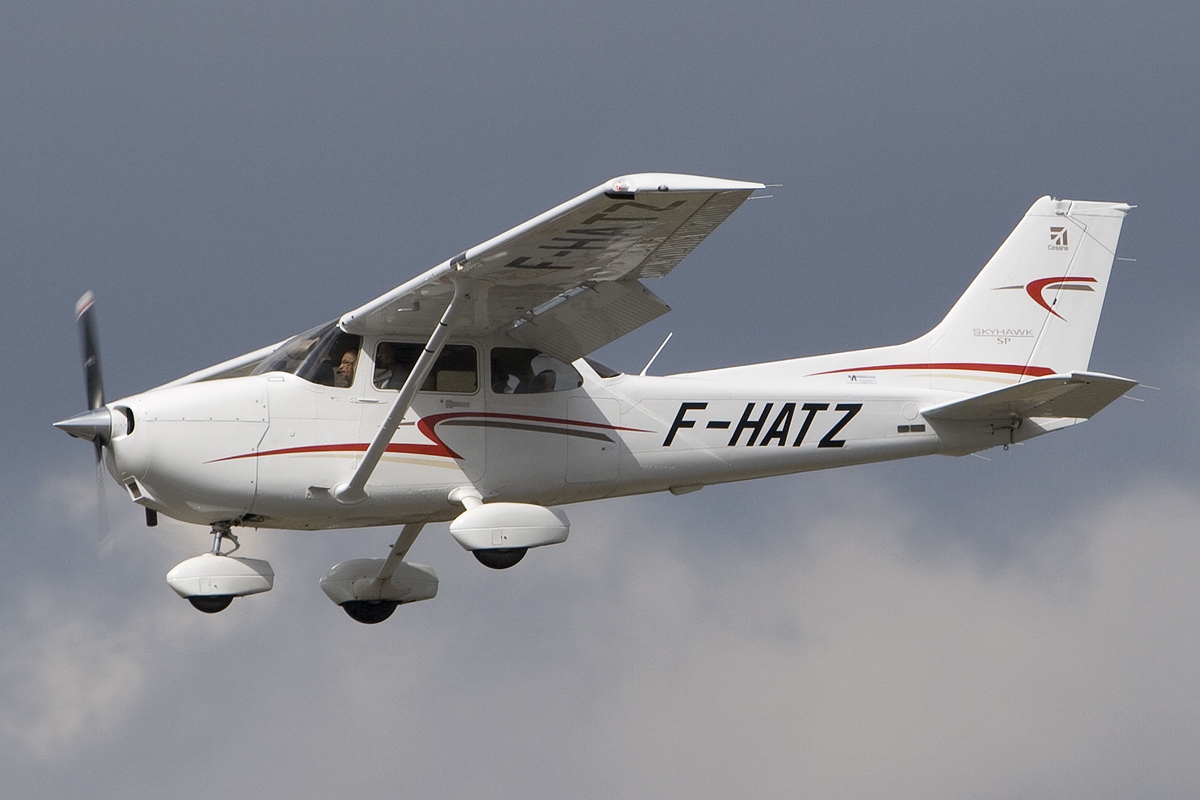
The Cessna 172 Skyhawk is an American four-seat, single-engine, high-wing light aircraft built by the Cessna Aircraft Company and its successor Textron Aviation. First flown in 1955 and developed from the taildragging Cessna 170, it went on to become, by sheer numbers built, the most successful aircraft in aviation history. For the simulator pilot it represents the archetypal trainer and touring aircraft, the type on which a majority of the world's pilots have taken their first lessons.
The Cessna 172 is a four-seat, single-engine, high-wing, fixed-wing civil utility aircraft with tricycle landing gear, produced by the Cessna Aircraft Company (later Textron Aviation) in the United States. It was developed directly from the Cessna 170, itself first manufactured in 1948, by fitting that airframe with a nosewheel undercarriage in place of the 170's conventional tailwheel gear. Marketed for most of its life under the Skyhawk name, the 172 sits at the entry level of general aviation and has long competed with types such as the Beechcraft Musketeer, the Grumman American AA-5 series, the Piper PA-28 Cherokee, the Diamond DA40 Star and the Cirrus SR20, though many of those rivals are no longer in production.
The 172 began life as a modification of the Cessna 170. In January 1955 Cessna flew an improved 170 variant, a Continental O-300-A-powered Cessna 170C with larger elevators and a more angular tailfin. Rather than put this into production as a 170, Cessna fitted it with tricycle landing gear, and the modified aircraft flew again on 12 June 1955. To speed certification the new type was initially added to the Cessna 170 type certificate as the Model 172, before later receiving its own certificate. The 172 was an immediate sales success: more than 1,400 were built in 1956, its first full year of production. Cessna continued to refine the design through the following decades, and for 1968 planned to replace it with a re-engineered 172J featuring a sloping windshield and a strutless cantilever wing, of which a single prototype (registered N3765C) was built before the idea was dropped. Production of the 172 ran continuously from 1956 until 1986, when rising product-liability costs forced Cessna to halt manufacture. The line was revived in 1996 at a new factory in Independence, Kansas, with the 172R Skyhawk, supplemented from 1998 by the more powerful 172S Skyhawk SP. The aircraft was also built under licence in France by Reims Aviation, which marketed enhanced versions as the Reims Rocket. More than 44,000 examples had been built by 2015, a total unmatched by any other aircraft type.
The 172 is a strut-braced, high-wing monoplane with fixed tricycle landing gear that Cessna marketed as the 'Land-O-Matic' gear, paired with 'Para-Lift' flaps. The original 1956 model retained the 170B's 145 hp Continental O-300-A six-cylinder, air-cooled engine and had a maximum gross weight of 2,200 lb. Early aircraft had a 'fastback' rear fuselage with no rear window and a square-shaped tailfin; the 172A of 1960 introduced revised landing gear and the swept-back tailfin still used today, while the 1963 172D and all subsequent models adopted a lowered rear deck with an aft window, which Cessna advertised as 'Omni-Vision'. Later refinements included electric flaps in place of the earlier manual lever, a tubular landing-gear strut for improved robustness, and a drooped-wing leading edge marketed as the 'Camber-Lift' wing to improve low-speed handling and shorten takeoff distances. Engines evolved considerably over the production run, from the original Continental O-300-A through the Lycoming O-320 family at 150 and later 160 hp, to the fuel-injected Lycoming IO-360 fitted to the modern 172R (160 hp) and 172S Skyhawk SP (180 hp). A diesel-powered 172 JT-A variant, introduced in 2014, used a Continental CD-155 engine burning Jet-A fuel. From 2005 the 172S was offered with the Garmin G1000 integrated glass cockpit as standard. The type has also been widely modified through supplemental type certificates, with engine upgrades from 180 up to 210 hp, constant-speed propellers, automobile-gasoline conversions, extra fuel capacity in wingtip tanks or baggage-compartment tanks, wheel fairings to reduce drag, and STOL kits for enhanced short-field performance.
Specific speed, range and ceiling figures for the 172 vary considerably across its many engine and airframe revisions, from the original 145 hp Continental to the 180 hp fuel-injected Lycoming IO-360 in the current 172S. What has remained constant is a docile, forgiving handling character, reflected in pilot accounts describing the type as a natural step up in size and performance from two-seat trainers such as the Cessna 150 and 152, feeling notably larger and more capable by comparison despite its modest power.
The line progressed through a long sequence of model-year variants, from the original 172 through the 172A (1960, swept tailfin and revised gear), 172B, 172C (autopilot and adjustable seats), 172D (Omni-Vision rear window), 172F (electric flaps, and the basis for the military T-41 Mescalero trainer), 172I (first Lycoming O-320 engine), 172L (tubular gear strut), 172M (Camber-Lift wing), 172N and 172P (uprated and more reliable Lycoming O-320 variants with improved corrosion resistance). The Skyhawk name, first used from 1963 for a deluxe trim package, was eventually applied to the whole standard-production range, while other upgraded versions were sold as the Cutlass, Powermatic and Hawk XP. Aircraft built under licence in France by Reims Aviation were marketed as the Reims Rocket. The T-41 Mescalero was a military training derivative. Modern production comprises the fuel-injected 172R (from 1996) and the more powerful 172S Skyhawk SP (from 1998), the latter later offered with the Garmin G1000 glass cockpit, plus the diesel-powered 172 JT-A. Related but separately certificated variants marketed under the Cessna 172 name but built on the Cessna 175 type certificate are covered under the Cessna R172 designation.
The 172 has been used across the full range of light general-aviation roles: flight training, personal transportation, and aerial patrol work. Civil flying schools have relied on it as a primary trainer for decades, and government agencies and other operators have flown it for search-and-rescue, pipeline inspection and law-enforcement observation duties. Its ruggedness and endurance were demonstrated dramatically between December 1958 and February 1959, when Robert Timm and John Cook flew a 172 registered N9172B non-stop for 64 days, 22 hours, 19 minutes and 5 seconds, covering an estimated 150,000 miles in a refuelled endurance flight from and to McCarran Field in Las Vegas as part of a fund-raising effort for the Damon Runyon Cancer Fund; that aircraft is now on display at the airport. For many pilots the 172 has also served as the natural step-up aircraft from two-seat trainers, and a long line of pilots progressed through it while building certificates and ratings before moving on to higher-performance types.
Because so many real-world pilots learned to fly on the 172, it occupies an equivalent benchmark position in flight simulation, serving as the default light trainer and touring aircraft for newcomers to general aviation flying. Its long production run and many variants, from early fastback models with the Continental O-300 through to the glass-cockpit 172S with the Garmin G1000, give simulator pilots a wide spread of eras and panel configurations to fly, from simple analogue gauges to fully integrated digital avionics. The type's reputation for docile, forgiving handling, and its established role as the aircraft on which a large share of pilots cut their teeth, make it a natural choice for anyone using a simulator to learn or practise the fundamentals of light aircraft flying.