Departure
99%
vs 95% ▲ 3
 MY FS FLIGHTS
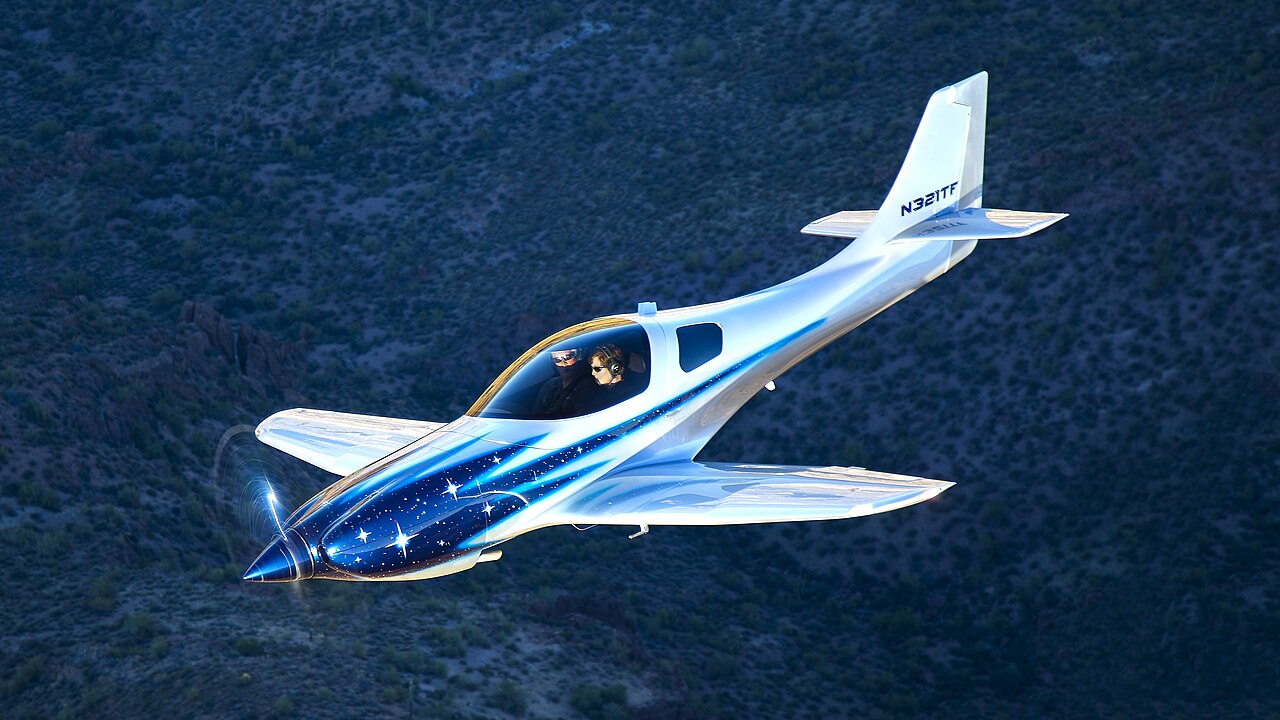
The Lancair Legacy is a two-seat, high-performance composite kit aircraft developed by the American company Lancair as a modernised, enlarged successor to the Lancair 320/360 line. Offered in fixed and retractable-gear forms, it is prized by homebuilders and pilots for its speed, efficient laminar-flow wing and crisp handling, and it has repeatedly won the Grand Champion Kit Built award at EAA AirVenture. For a simulator pilot it represents the archetype of the fast, slippery composite homebuilt single, demanding respect on approach in exchange for genuine cross-country speed.
The Lancair Legacy is a low-wing, two-seat, single-engine composite monoplane built and sold in kit form by Lancair, with side-by-side seating under a bubble canopy. It evolved directly from the earlier Lancair 235/320 series, retaining the family's cantilever low-wing layout and tractor engine configuration but with a larger fuselage and more power. It is available with either fixed landing gear (Legacy FG) or retractable tricycle gear (Legacy RG), and sits firmly in the high-performance end of the homebuilt/experimental amateur-built category.
The Legacy traces its lineage to the Lancair 200 of 1985, an aircraft significant enough to be preserved in the Experimental Aircraft Association museum collection, and to the subsequent Lancair 320/360, a design considered striking enough to be displayed in New York's Metropolitan Museum of Art. Around fifteen years after the original Lancair 200, the Legacy was introduced as the culmination of more than a decade of research, testing and builder feedback, redesigned from the tail forward with a new wing planform, larger cabin and more powerful engine options. Four Legacy aircraft went on to win the Grand Champion Kit Built award at EAA AirVenture, in 2012, 2013, 2014 and 2016. In May 2016 Lancair announced it was ending production of new Legacy kits owing to the investment that would have been needed to continue manufacturing, and in 2017 sold the product line to Mark and Conrad Huffstutler, who continue to build the design as Lancair International, LLC, in Uvalde, Texas, which still supports existing aircraft with parts and technical assistance.
The Legacy is of vacuum-formed composite sandwich construction, with a cantilever low wing spanning 25 ft 6 in (7.77 m) and an area of 82.5 sq ft (7.66 m2), giving an aspect ratio of 7.95. The wing employs a Cole CG10 airfoil at the root and a Cole GC11 airfoil at the tip, with a unique double-taper planform designed to maximise lift distribution from root to tip and to eliminate washout, producing extensive laminar flow across more than half the wing surface. Fowler flaps are fitted to enhance maximum lift coefficient and low-speed handling. Fuel is carried in integral wing tanks with a standard capacity of up to 66 gallons (65 US gallons per the retractable-gear specification), each tank incorporating a slosh bay to prevent fuel unporting during uncoordinated manoeuvres such as slips; on Continental-engined aircraft the fuel valve also returns vapour fuel to the tank in use. The cabin is a generous 43.5 inches wide and 44.5 inches high, allowing pilot and passenger to sit upright with headroom to spare, and the wings can be detached while the aircraft remains on its landing gear, to ease trailering. Landing gear sits three inches taller than on the 320/360 for extra ground and propeller clearance, using premium air/oleo struts with 5.00 x 5 main tyres, and the nose gear uses an internally damped air/oleo strut with viscous shimmy damping in place of external scissor links. The aircraft is designed to accept engines from 200 to 310 hp (149 to 231 kW); the standard powerplant is the 310 hp (231 kW) Continental IO-550-N six-cylinder four-stroke driving a three-bladed constant-speed propeller, while the FG version can also be fitted with the 200 hp (149 kW) Lycoming IO-360 or IO-390. Empty weight for the Legacy RG is 1,500 lb (680 kg) against a gross weight of 2,200 lb (998 kg), giving a wing loading of 23 lb/sq ft (110 kg/m2). Length is 22 ft 0 in (6.71 m).
The retractable-gear Legacy RG cruises at 276 mph (444 km/h, 240 kn) at 8,000 ft, with a maximum speed of 295 mph (475 km/h, 256 kn) and a stall speed of 65 mph (105 km/h, 56 kn) flaps down. Range is 1,150 mi (1,850 km, 1,000 nmi) at 8,000 ft with reserves, service ceiling is 18,000 ft (5,500 m), and rate of climb at gross weight is 2,000 ft/min (10 m/s), with the manufacturer separately quoting a climb rate of 2,200 fpm at gross weight. Structural limits are +4.4/-2.2 g in the utility category and +3.8/-2.0 g in the normal category. The fixed-gear Legacy FG-390 cruises at 215 mph with a range of 1,075 sm and a climb rate of 1,000 ft/min at gross weight. Lancair's own figures for the Legacy RG describe cruise at 280 mph at 10,000 ft. Roll control is deliberately light, snappy and balanced in keeping with the earlier 320, with a roll rate of around 150 degrees per second at high speed, while at the low-speed end of the envelope the wing was tuned to give remarkable roll authority and straight-ahead stall behaviour, translating into safer, slower approaches and shorter landing distances.
The Legacy RG is the retractable-gear model, typically fitted with the 310 hp Continental IO-550. The Legacy FG covers the fixed-gear family, offered as the FG-390 with the Lycoming IO-390 and the FG-550 (and FGC-550) with the Continental IO-550; a turbine-powered FG-550 Turbine version has also existed. A single Legacy Turboprop was built under the project name Turbulence. The Lancair Synergy is a modified Legacy FG developed for the Colombian Air Force with 15 percent more wing area than the standard FG wing, leading-edge cuffs, a ventral fin and a reshaped vertical tail and rudder to improve stability and low-speed handling; it first flew in September 2010. A licence-built military version, the CIAC T-90 Calima, has been produced in Colombia by CIAC for the Colombian Air Force.
The Legacy has been operated primarily by private owner-builders as a high-performance cross-country and sport aircraft, valued for its speed and efficiency. In 2009 the Colombian Air Force ordered 25 modified Legacy FGs, delivered as kits for local assembly and known as the Lancair Synergy, for use as basic trainers; this military application was subsequently developed into the licence-built CIAC T-90 Calima. Within the homebuilt community the type has an established competitive pedigree, with Legacy examples winning the Grand Champion Kit Built award at EAA AirVenture on four occasions.
The Lancair Legacy has been modelled as a payware add-on for desktop simulation, including a Legacy RG version produced by Aerobask, reflecting its standing as a benchmark high-performance homebuilt among simmers who enjoy fast, demanding piston singles. Its real-world character, a wing tuned for light, snappy and balanced roll control at speed combined with remarkable low-speed roll authority and a straight-ahead stall, gives the type a distinctive handling profile to reproduce: quick and responsive in cruise and manoeuvring flight, yet needing a disciplined, accurate approach given its clean airframe, retractable gear on the RG model, and comparatively high wing loading. Its combination of a 295 mph maximum speed, brisk climb performance and busy retractable-gear systems make it a satisfying type for simulator pilots seeking a fast, close-coupled composite single rather than a docile trainer.