Departure
97%
vs 95% ▲ 1
 MY FS FLIGHTS
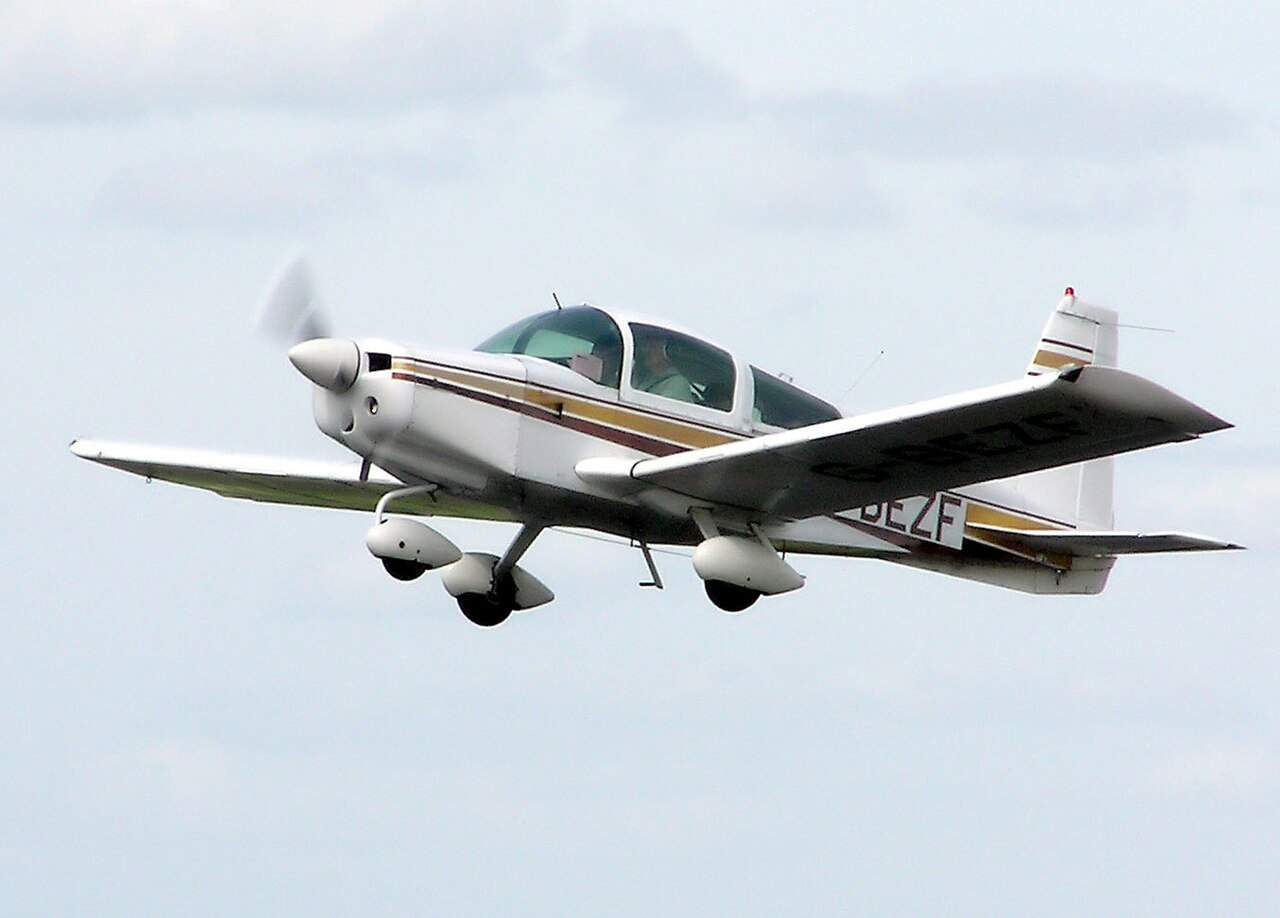
The Grumman American AA-5A Cheetah is an American all-metal, four-seat, fixed-gear light aircraft built by Grumman American and later Gulfstream American between 1976 and 1979, as the aerodynamically refined successor to the AA-5 Traveler. It is a touring and training machine descended from the AA-1 Yankee family, and its clean handling and brisk cruise performance for a 150 hp single make it a type of continuing interest to sim pilots exploring classic American light aircraft.
The AA-5A Cheetah is a four-seat, single-engine, fixed-gear cabin monoplane of all-metal construction, built by Grumman American and then Gulfstream American from 1976 to 1979. It sits within the Grumman American AA-5 family, a line of touring and training aircraft derived from the earlier two-seat AA-1 Yankee, and occupies the mid-point between the original AA-5 Traveler and the more powerful AA-5B Tiger.
The AA-5 line traces back to American Aviation's success with the AA-1 Yankee Clipper two-seat light aircraft in 1969, which prompted the company to develop a four-seat companion. An all-new design, the American Aviation AA-2 Patriot, failed to meet its performance goals in testing and only one was built, so the company instead enlarged the external and cabin dimensions of the AA-1 Yankee to create a four-seater, retaining about two-thirds parts commonality with the two-seat design and saving development time and cost. This became the American Aviation AA-5 Traveler, powered by a Lycoming O-320-E2G of 150 hp, which entered production in 1971 and was certified under US FAR Part 23. American Aviation was sold to Grumman in 1973, forming the Grumman American division, which continued Traveler production; 834 Travelers were built before the model ceased production in 1975. A redesign undertaken in 1974 produced a cleaned-up 1975 model Traveler with revised engine cowling and main gear fairings, raising cruise speed to 127 knots, though the tail section was unchanged. Grumman's engineers believed the airframe had further speed potential, and a more extensive aerodynamic redesign followed: the engine cowling and baffling were reworked to reduce cooling drag, the exhaust system was redesigned, the main landing gear fairings were further refined, the ventral fin was eliminated, and the horizontal tail was enlarged to widen the permissible centre of gravity range. Fuel capacity was increased from the Traveler's 37 US gallons to 52 gallons, with optional long-range tanks. This revised variant was named the AA-5A Cheetah and introduced as a 1976 model in late 1975, superseding the Traveler in production. Because it looked very similar to the Traveler externally, Grumman's marketing department created a "leaping cheetah" emblem to distinguish it. Grumman sold its light aircraft division to Gulfstream Aerospace in 1978, after which it was renamed Gulfstream American, and Gulfstream continued Cheetah production until 1979, by which time 900 had been built.
The Cheetah is an all-metal, four-seat, fixed-gear single engine aircraft powered by a Lycoming O-320-E2G producing 150 hp at 2,700 rpm, fitted with a McCauley fixed-pitch propeller of 73/59 diameter and pitch. It has a wingspan of 31 ft 5 in, a length of 22 ft, and a height of 8 ft. Empty weight is 1,286 lb against a gross weight of 2,200 lb, giving a useful payload with standard fuel of 692 lb. Usable fuel is 37 US gallons standard, with a maximum of 51 US gallons available, an increase over the earlier Traveler's 37-gallon tankage intended to extend range. Wing loading is 15.7 lb per square foot and power loading is 14.7 lb per horsepower. The engine has a TBO of 2,000 hours.
Compared with the Traveler, the Cheetah was about six knots (seven mph) faster despite sharing the same 150 hp powerplant, a result of the aerodynamic cleanup applied to the cowling, exhaust, landing gear fairings and tail. Published performance figures give a maximum speed of 136 kts and a 75 percent power cruise speed of 128 kts at 8,500 ft. Stall speed (Vso) is 53 kts. Takeoff ground roll is 880 ft, with a distance of 1,600 ft to clear a 50 ft obstacle; landing ground roll is 380 ft, with 1,100 ft required over a 50 ft obstacle. Initial rate of climb is 660 fpm and service ceiling is 12,650 ft. Range with 45 minutes reserve is quoted at 657 nm.
The AA-5A Cheetah sits within the broader AA-5 family. The original American Aviation/Grumman American AA-5 Traveler, powered by the same 150 hp Lycoming O-320-E2G, preceded it, with 834 built up to 1975; a 1975-model-year refresh of the Traveler improved cruise speed to 127 knots before the Cheetah took over production. The AA-5B Tiger was developed from the same redesign effort but fitted with a 180 hp Lycoming O-360-A4K, raising gross weight from 2,200 lb to 2,400 lb and cruise speed to 139 knots; 1,323 Tigers were built before Gulfstream ceased all piston production in 1979. After an eleven-year hiatus, the Tiger design was revived by American General Aviation Corporation as the AG-5B Tiger, incorporating a new split nose cowling, revised instrument panel, improved exterior lighting, a new fuel quantity system, a 28-volt electrical system replacing the earlier 14-volt system, a new throttle quadrant and improved heating and ventilation; the Tiger name was later continued by Tiger Aircraft.
The AA-5 series, including the Cheetah, was produced and sold primarily for private touring and flight training use, building on the market identity already established by the AA-1 Yankee family. A total of 3,282 aircraft were built across the AA-5/AG-5 series over a production run from 1971 to 2006, with 900 Cheetahs produced specifically between 1976 and 1979 under Grumman American and then Gulfstream American ownership before Gulfstream exited the piston aircraft business.
For a sim pilot the AA-5A Cheetah represents a light, fixed-gear four-seat single with brisk performance for its 150 hp engine, the product of deliberate aerodynamic refinement over the earlier Traveler. Its enlarged horizontal tail and widened centre of gravity range, together with short field figures such as an 880 ft takeoff ground roll and 380 ft landing roll, point to responsive, forgiving handling typical of the Grumman American line, making it a suitable type for practising touring and training profiles.