Departure
74%
vs 95% ▼ 21
 MY FS FLIGHTS
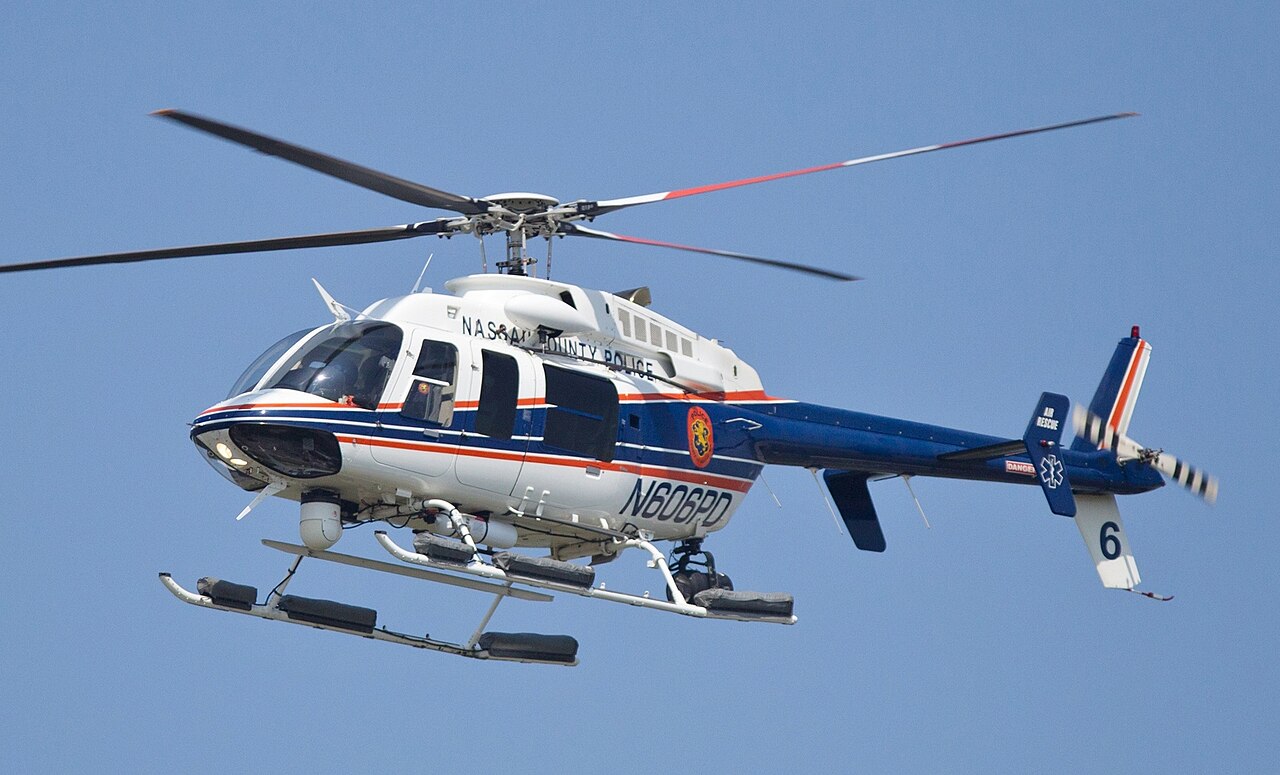
The Bell 407 is a single-engine, four-blade civil utility helicopter built by Bell Helicopter (now Bell Textron), developed in the 1990s as a derivative of the Bell 206L-4 LongRanger. It combines the wider LongRanger fuselage with the four-blade, soft-in-plane composite rotor system developed for the US Army's OH-58D Kiowa Warrior, and has gone on to serve in roles ranging from corporate transport and air ambulance work to law enforcement, utility lift and armed military reconnaissance.
The Bell 407 is a four-blade, single-engine, civil utility helicopter manufactured by Bell Helicopter in the United States and Canada. It is a direct derivative of the Bell 206L-4 LongRanger, retaining much of that aircraft's fuselage while replacing its two-blade, semi-rigid, teetering rotor with the four-blade, soft-in-plane rotor and composite hub developed for the US Army's OH-58D Kiowa Warrior. Standard seating is for two crew and five passengers, and the type has found use across public safety, HEMS, utility, corporate and military markets, including an armed multi-role variant, the 407M.
Bell began development of what it called the New Light Aircraft in 1993 as an intended replacement for its Model 206 series, and the resulting programme became the 407, a development of the LongRanger. A Bell 206L-3 LongRanger was modified as the 407 demonstrator, fitted with 407 hardware and moulded fairings representing the new, wider fuselage then under development; this demonstrator first flew in 1994, and the 407 programme was publicly announced at Heli-Expo in Las Vegas in January 1995. The first 407 prototype, C-GFOS, made its maiden flight on 29 June 1995, followed by the second prototype, C-FORS, on 13 July 1995. The first production aircraft, C-FWQY/N407BT, flew on 10 November 1995 after a short development programme. Transport Canada certified the 407 on 9 February 1996, with FAA certification following on 23 February 1996. Full production began in 1996 at Bell's Mirabel, Quebec plant, and 140 airframes were produced in 1997 to satisfy initial orders. Bell delivered the first production 407 at Heli-Expo in Dallas, Texas, in February 1996, with launch customers Petroleum Helicopters International (PHI), Niagara Helicopters and Greenland Air. The 1,000th 407 was delivered on 15 June 2010, with production passing 1,400 airframes by December 2017 and exceeding 1,600 by February 2023. In 1995 Bell trialled a shrouded tail rotor on the 407 but did not pursue it, and it also studied a twin-engine 407T before instead developing the essentially all-new, twin-Pratt & Whitney PW206D-powered Bell 427. The military ARH-70 Arapaho armed reconnaissance helicopter, based on the 407, was developed for the US Army but cancelled on 16 October 2008. A related civil variant, the Bell 417, first flew on 8 June 2006 powered by a Honeywell HTS900 turboshaft producing 970 shp with full FADEC, seating five passengers in club configuration alongside a crew of two; it was cancelled at Heli-Expo 2007 in Orlando. On 4 March 2013 Bell unveiled the armed 407GT, based on the 407GX and incorporating the Garmin G1000H flight deck along with the Universal Weapons Pylon derived from the OH-58 Kiowa, capable of carrying machine guns, rockets and anti-armour missiles. As of October 2025, Bell Textron was working with Mumbai-based Max AeroSpace and Aviation to establish an assembly line for the 407 in Nagpur, India, tied to Bell's memorandum of understanding with the Government of Maharashtra and the aircraft's offer against the AW109 Trekker, HAL Light Utility Helicopter and Airbus H125 for an Indian reconnaissance and surveillance helicopter tender covering 200 aircraft for the Indian Army and Air Force.
The 407 is built around the wider LongRanger fuselage, 8 inches wider than the 206L-4 it derives from, with main cabin windows 35 percent larger, giving increased internal cabin space; current specifications quote a cabin volume of 85 cubic feet plus a 16 cubic foot (0.5 cubic metre) aft baggage compartment, entered via what Bell describes as the widest cabin door in its class. Standard seating is 1+6. At the heart of the design is a four-blade main rotor derived from the OH-58D (Model 406), with blades and hub of composite construction offering unlimited service life, improved performance and a smoother ride than the two-blade teetering rotor of the 206L. The current production 407GXi is powered by a Rolls-Royce Model 250-C47E/4 turboshaft with dual digital FADEC, rated at 862 shp for takeoff and 761 shp maximum continuous; earlier aircraft used the Rolls-Royce/Allison 250-C47, chosen for its ability to sustain a higher maximum takeoff weight and better hot-and-high performance than the LongRanger's powerplant. Base empty weight for the 407GXi is 2,700 lb (1,224 kg). Maximum internal gross weight is 5,000 lb (2,268 kg) standard, or 5,250 lb (2,381 kg) with the optional gross weight increase, and maximum gross weight with an external load is 6,000 lb (2,722 kg). Useful load is 2,300 lb (1,043 kg) internal standard or 2,550 lb (1,156 kg) with the optional specification, and the cargo hook is rated at 3,100 lb (1,406 kg). Standard fuel capacity is 127.8 US gallons (482.8 litres), with an auxiliary tank adding 19 US gallons (71.9 litres). The cockpit is built around the Garmin G1000H NXi integrated flight deck with synthetic vision and terrain awareness warning, wireless connectivity via Flight Stream 510 for syncing flight plans and databases, and a multi-pane multifunction display that can host the moving map, freeing the MFD for flight planning tasks.
Current Bell figures for the 407GXi give a hover ceiling in ground effect of 13,550 ft and out of ground effect of 11,940 ft. Maximum cruise speed is quoted at 133 kt (246 km/h), with a range at Vlrc of 337 nm (624 km) and maximum endurance of 4.0 hours, all figures based on standard maximum gross weight, ISA conditions and standard fuel with no reserve at sea level. The more powerful engine fitted compared with the LongRanger was specifically intended to improve performance at higher temperatures and altitudes, and the type is marketed as IFR-capable, able to operate through low cloud ceilings. Bell describes the 407M military variant as offering responsive handling suited to close air support and close combat attack missions, and the aircraft is generally presented as a steady, stable platform capable of quick, smooth landings even in unpredictable conditions, a characteristic exploited in its widespread use for air ambulance work.
The baseline Bell 407 was followed by the 407GX and current-production 407GXi, both built around the Garmin glass cockpit. The 407GT, unveiled on 4 March 2013, is an armed derivative incorporating the Garmin G1000H flight deck, infrared cameras and the Universal Weapons Pylon derived from the OH-58 Kiowa, able to mount machine guns, rockets and anti-armour missiles for roles including armed transport, search and rescue, reconnaissance and medical evacuation. The Bell 407M is a further military multi-role development, equipped with a scalable weapons management system, EO/IR sensor, an ordnance mounting system supporting two to four weapons stations with an optional sixth station endcap missile mount, survivability features such as armoured pilot seats, ballistic-tolerant main rotor blades, a self-sealing fuel system and infrared suppression, plus multi-band FM, UHF, VHF, SATCOM and HF radios for command-and-control missions. The US Army's ARH-70 Arapaho armed reconnaissance helicopter was based on the 407 but was cancelled in October 2008, and the closely related civil Bell 417, powered by a Honeywell HTS900 engine, was cancelled in 2007 without entering production. The twin-engine Bell 427 was developed out of the 407 programme after Bell abandoned a proposed twin-engine 407T. The Northrop Grumman MQ-8C Fire Scout, an unmanned aircraft, was also developed from the 407.
Bell delivered the first production 407 at Heli-Expo in Dallas, Texas, in February 1996, with Petroleum Helicopters International, Niagara Helicopters and Greenland Air as launch customers. The type has since been widely operated in public safety roles, including with the Nassau County Police Department, as well as in helicopter emergency medical services, where its bi-fold doors are cited as speeding patient loading, corporate transport, utility work such as external-load lifting, electronic news gathering, and pilot training. On 23 May 2007, Colin Bodill and Jennifer Murray completed a pole-to-pole around-the-world flight in a standard Bell 407, named Polar First, departing Bell's Fort Worth Alliance Airport facility on 5 December 2006 and covering about 36,000 miles (58,000 km) over 189 days and 300 flight hours through 34 countries, in partnership with the Royal Geographical Society and as a fundraiser for SOS Children's Villages. Militarily, the Iraqi Air Force ordered three armed-scout Bell 407s in 2009, similar to the cancelled ARH-70, followed by a contract that April for 24 additional aircraft with an option for 26 more, with the US Army managing modification and installation of military equipment; Iraqi Army Aviation Command operated T-407 trainers from 2011.
Flying the 407 in the simulator should reflect a helicopter designed to be noticeably smoother than its two-blade LongRanger forebear, a result of the four-blade, soft-in-plane rotor system and composite hub carried over from the OH-58D programme; this rotor was chosen specifically to give improved performance and a smoother ride. The type is presented as a steady, stable platform able to make quick, smooth approaches and landings even in unpredictable conditions, which underlies its widespread real-world use in air ambulance work, and Bell describes the armed 407M as offering responsive handling for demanding tactical manoeuvring. Modern variants are built around the Garmin G1000H NXi glass cockpit with synthetic vision and terrain awareness, giving a pilot strong situational awareness in instrument conditions, and the IFR-capable systems mean the aircraft is intended to be flown confidently through cloud rather than restricted to clear-weather operation.