Departure
98%
vs 95% ▲ 3
 MY FS FLIGHTS
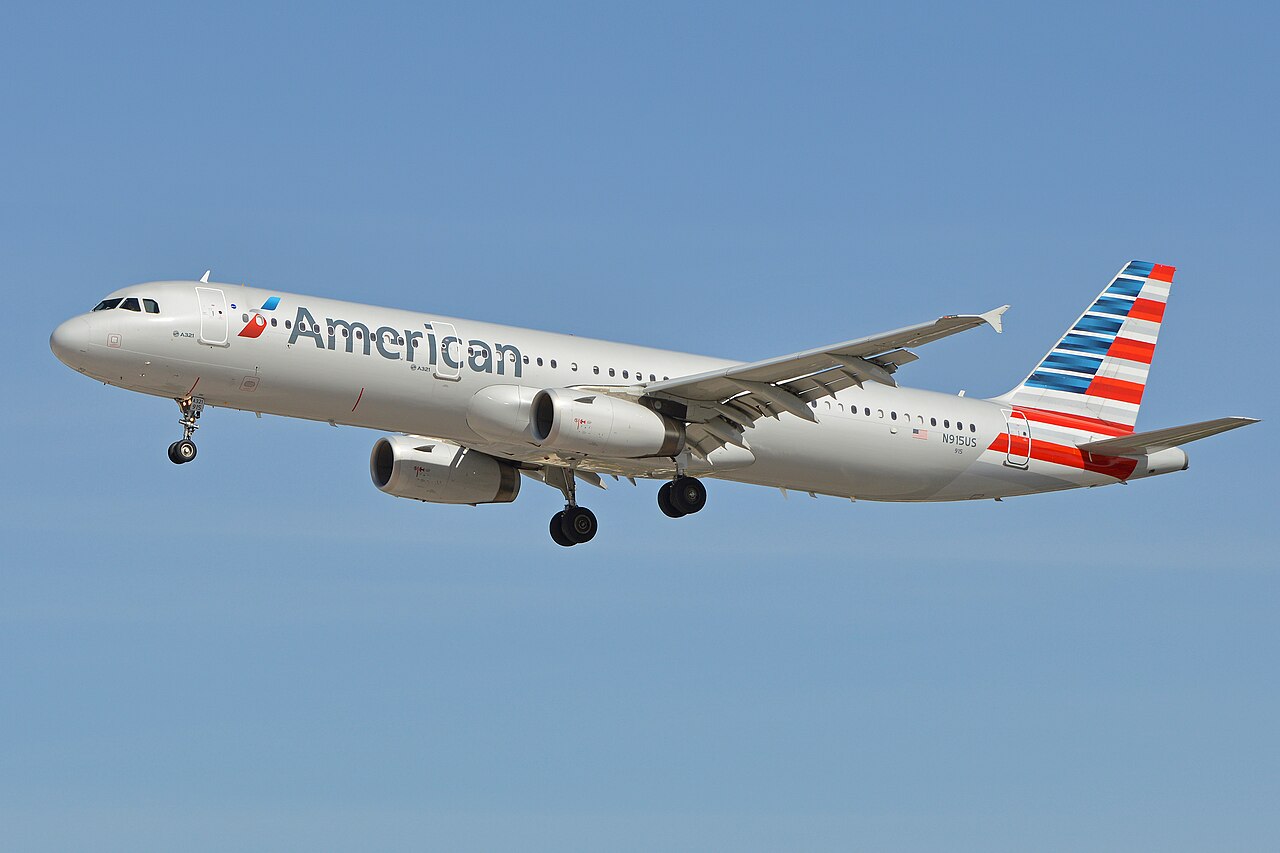
The Airbus A321ceo is the stretched, largest member of Airbus's A320 narrow-body family, built by Airbus to carry between 185 and 239 passengers on short to medium-range routes. First flown in 1993 and introduced with Lufthansa in January 1994, it became a mainstay of single-aisle fleets worldwide and, for the simulator pilot, offers the familiar A320-family fly-by-wire experience in a longer, heavier airframe with its own handling quirks.
The A321ceo (Current Engine Option) is a narrow-body, single-aisle twin-engine jet airliner produced by Airbus as the stretched derivative of the A320. It is a low-wing cantilever monoplane with a conventional tail unit, a single vertical stabiliser and rudder, and retractable tricycle landing gear, powered by two wing pylon-mounted turbofans. As the longest-fuselage member of the best-selling A320 Family, it typically seats 170 to 210 passengers in a standard two-class cabin, up to 220 in a high-density layout, and as many as 239 according to some figures. It shares a common type rating with the A318, A319 and A320, meaning pilots qualified on any A320-family variant can fly the A321 without further training.
The A321 was the first derivative of the A320, at various points referred to as the Stretched A320, A320-500 and A325. It was launched on 24 November 1988, not long after the A320 itself entered service, once commitments for 183 aircraft from 10 customers had been secured. The prototype, registration F-WWIA, made its maiden flight on 11 March 1993 fitted with IAE V2500 engines; a second prototype with CFM56-5B turbofans flew in May 1993. Lufthansa and Alitalia were the launch customers, ordering 20 and 40 aircraft respectively. Lufthansa took delivery of the first V2500-A5-powered A321 on 27 January 1994, and the type entered service with the airline that same month; Alitalia received its first CFM56-5B-powered aircraft on 22 March 1994. Final assembly was carried out in Germany, a first for any Airbus programme, following a dispute between French and German partners over the cost and productivity implications of establishing a second assembly line in Hamburg, which later also built the smaller A318 and A319. To help fund development, Airbus entered the bond market for the first time, raising $480 million (€475 million), with a further $180 million (€175 million) borrowed from the European Investment Bank and private investors. By 2019 some 4,200 A321s of all types had been ordered, representing a quarter of all Airbus single-aisle orders. The A321ceo was eventually succeeded by the re-engined A321neo, announced in December 2010 and first flown on 9 February 2016, which entered service with Virgin America in May 2017.
The A321 retains the A320's fuselage cross-section and wingspan but is substantially longer, achieved by adding a 4.27 m plug ahead of the wing and a 2.67 m plug behind it, making the A321 6.94 m longer than the A320. This length increase meant the A320's overwing window exits had to be converted into door exits repositioned in front of and behind the wing. To preserve performance with the added length and weight, Airbus fitted double-slotted flaps and made minor trailing-edge modifications, increasing wing area from 124 m2 to 128 m2. The centre fuselage and undercarriage were reinforced to accommodate a 9,600 kg increase in maximum takeoff weight, taking early examples to 83,000 kg, with the -200 later raised to around 93,000-93,900 kg. Two engine types were offered: the CFM International CFM56-5B and the International Aero Engines V2500-A5, both in the 133-147 kN (30,000-33,000 lbf) thrust class. According to Airbus manufacturer figures, the A321ceo has an overall length of 44.51 m, cabin length of 34.44 m, fuselage width of 3.95 m, maximum cabin width of 3.70 m, a wingspan of 35.80 m with Sharklets, a height of 11.76 m, a wheel track of 7.59 m and a wheelbase of 16.90 m. Maximum ramp weight is given as 93.90 tonnes, maximum take-off weight as 93.50 tonnes, maximum landing weight as 77.80 tonnes, and maximum zero fuel weight as 73.80 tonnes, with a maximum fuel capacity of 30,030 litres. Underfloor cargo capacity is listed as 10 LD3-45W containers or 10 pallets, with a water volume of 59 m3.
Airbus quotes a range of 5,950 km (about 3,200 nautical miles) with Sharklets fitted, and a maximum operating Mach number (Mmo) of M0.82. The original A321-100 had a more limited range of around 2,300 nmi, and the extended-range A321-200 added higher-thrust engines and an additional fuel tank, increasing range by some 350 nautical miles over the -100, while looking externally identical to it. Some later-production A321ceo aircraft were fitted with Sharklet wingtip devices to further improve fuel efficiency and range. As the largest and heaviest of the A320-family variants at the time, the A321 flies with the same fly-by-wire flight control laws and cockpit as its smaller siblings, but its greater length affects ground handling, particularly during rotation and in crosswinds, and its higher weights shift the balance of climb performance and field length requirements relative to the A319 and A320.
The principal A321ceo variants are the A321-100 and the A321-200. The A321-100 was the original model, offered by Airbus with only one fuel configuration. The A321-200 followed as an extended-range version, adding higher-thrust engines and an extra fuel tank to extend range by roughly 350 nautical miles over the -100; externally the two models are identical. Both were available with either CFM International CFM56-5B or International Aero Engines V2500-A5 engines. Some later A321ceo aircraft were delivered with Sharklet wingtip devices, a feature that later became standard on the re-engined A321neo. The A321ceo family was eventually superseded by the A321neo, which itself spawned longer-range derivatives including the A321LR and A321XLR.
The A321ceo has been operated widely as a short- to medium-haul and, in extended-range form, transcontinental airliner, valued for its combination of A320-family commonality with greater passenger and cargo capacity. Lufthansa and Alitalia were the launch operators, and the type went on to be adopted by a broad range of major airlines worldwide as a natural upgauge from the A320 on high-demand routes, and as a competitor to the Boeing 757 in markets requiring more capacity than a standard narrow-body but without the cost of a widebody. A cargo-converted variant, the A321F, has also been developed for freight operations. Across the wider A321 programme (ceo and neo combined), a total of 3,536 aircraft had been delivered as of June 2025, of which 3,453 remained in service, with American Airlines the largest single operator with 302 examples.
For simulator pilots already familiar with the A320 or A319, the A321ceo offers the same Airbus fly-by-wire cockpit, systems logic and type-rating commonality, but with the added feel of a longer fuselage that changes the sight picture on approach and landing, and demands more attention to tail clearance during rotation. Its higher weights and the extended-range -200's additional fuel tank make it well suited to simulated medium- and long-haul narrow-body operations, including transcontinental sectors, while retaining the docile, protected flight-envelope handling characteristics that define the A320 family. The type is a popular subject for detailed add-on packages that model its distinct door and exit configuration, double-slotted flaps and, on later-production examples, Sharklet wingtips.