Departure
74%
vs 95% ▼ 21
 MY FS FLIGHTS
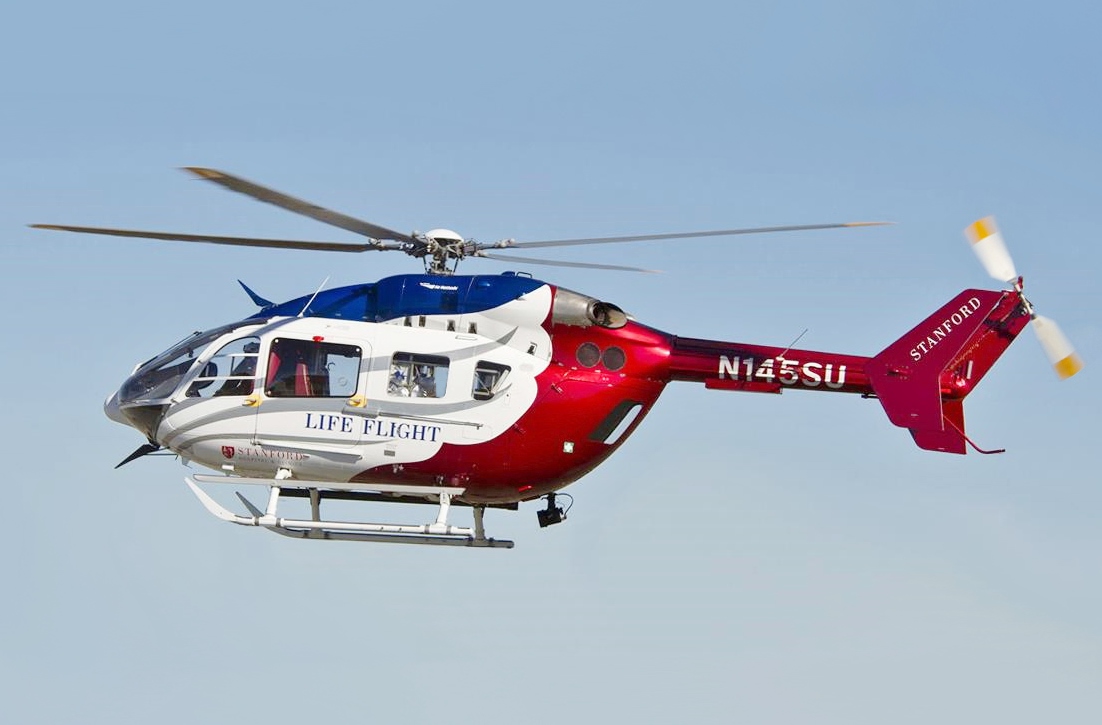
The Airbus H145 is a twin-engine, four-tonne-class light utility helicopter built by Airbus Helicopters as the latest evolution of the long-running BK117/EC145 family. Flown worldwide in emergency medical services, law enforcement, search and rescue, offshore transport, corporate and military roles, it combines a compact airframe with a spacious cabin and class-leading high-altitude performance. Its Fenestron tail rotor, Helionix avionics and four-axis autopilot make it a technically rich type for any pilot studying modern twin-engine rotorcraft.
The H145 is a twin-engine light utility helicopter manufactured by Airbus Helicopters, sitting in the four-tonne class and marketed for an unusually wide spread of missions: emergency medical services, law enforcement, search and rescue, offshore transport, passenger and corporate transport, and militarised variants. It is the latest member of the BK117/EC145 lineage, tracing its ancestry back to the MBB/Kawasaki BK 117, and has become one of the most widely operated helicopters in its class, with more than 2,150 delivered and over 8.5 million flight hours accumulated across the H145 family.
The type originated as the BK 117 C2, a joint development between Messerschmitt-Bolkow-Blohm (subsequently Eurocopter) and Kawasaki Heavy Industries, building on their earlier BK 117 C1. Rather than a clean-sheet design, the new helicopter combined the forward cockpit and modern avionics of Eurocopter's EC135 with the proven rear section of the BK 117, described by Flight International as being 90 percent a combination of the two aircraft. The first EC145 flew at Donauworth, Germany, on 12 June 1999, and Eurocopter gave the type a major publicity push at the US Helicopter Association International Show in February 2000. German certification came from the Luftfahrt-Bundesamt in December 2000, with FAA certification following in January 2002. An early and significant order came in December 1997, when the French Defense and Civil Guard selected the type to replace its ageing Alouette III fleet, ordering 31 EC145s in a deal worth 170 million dollars. Eurocopter and Kawasaki agreed to manufacture and market the helicopter independently while collaborating on development, with Eurocopter holding a 60 percent production workshare and Kawasaki 40 percent; Kawasaki continued to sell the aircraft in Asia under the BK 117 C2 designation. In 2011 Eurocopter launched the upgraded EC145 T2 at Heli Expo, introducing new Arriel 2E engines with dual-digital FADEC, a Fenestron shrouded tail rotor, upgraded gearboxes and a sophisticated four-axis autopilot. EASA certification for the EC145 T2 was granted in April 2014 and FAA certification in October 2014. The type was rebranded as the H145 in 2015. In March 2019 Airbus Helicopters announced, in cooperation with Kawasaki, an upgraded model featuring a new bearingless five-bladed main rotor incorporating the Blue Edge rotor blade, with testing having begun in April 2018; this five-bladed version entered service in 2020. On 25 September 2019 an Airbus H145 landed on the summit of Aconcagua at 6,962 metres (22,840 feet), the highest mountain in the Southern Hemisphere, flown by Airbus experimental test pilot Alexander Neuhaus and flight test engineer Antoine van Gent, demonstrating the type's power reserve at extreme altitude.
The H145 is powered by two Safran Arriel 2E turboshaft engines, each controlled by a dual full-authority digital engine control (FADEC) system, driving an advanced bearingless main rotor and an upgraded tail rotor system. The five-bladed main rotor, introduced in 2020 and incorporating Blue Edge blade technology, increased useful load by 150 kg and gave the type a class-leading 50 percent useful load-to-weight ratio, along with a reduced footprint (D-value) that allows landings in confined spaces. In place of a conventional tail rotor, the aircraft uses Airbus's shrouded Fenestron anti-torque device, which improves flight and ground safety, sharpens anti-torque control, reduces power demand in forward flight and lowers noise and vibration. Redundancy is built in throughout: a fully separated fuel supply system, a duplex hydraulic system, a dual electrical system and redundant lubrication for the main transmission. The cockpit uses Airbus's Helionix avionics suite paired with an advanced dual-duplex four-axis autopilot offering high flight stability and precision, envelope protection, automated take-off, and fully coupled approaches to hover. A wireless airborne communication server (wACS) enables secure wireless data exchange with ground stations for maintenance and flight-management purposes. The airframe and rotor system are designed for low maintenance, with a simplified bearingless main rotor with fewer parts, an enhanced main gearbox, and an optional health and usage monitoring system (HUMS). The cabin can be configured for up to nine or ten passengers depending on layout, and more than 400 interchangeable equipment options support its multi-mission role.
The H145 cruises at 241 km/h and is the only rotorcraft in its class able to take off and land at 20,000 feet, a capability confirmed in September 2019 with a flight over Aconcagua in the Andes at 22,840 feet, where it demonstrated substantial power reserve at extreme altitude. The two Arriel 2E engines with dual FADEC provide strong all-engines-operative performance together with vital reserves in one-engine-inoperative scenarios, making the type well suited to hot-and-high operating environments. It is noted as the quietest helicopter in its class, with a low-downwash rotor system that suits operations in densely populated or environmentally protected areas, and is certified for 50 percent sustainable aviation fuel with a target of 100 percent by 2030.
The type began life as the BK 117 C2, marketed by Eurocopter as the EC145 and by Kawasaki under the BK 117 C2 designation for the Asian market. The EC145 T2, launched in 2011, introduced Arriel 2E engines, dual FADEC, the Fenestron tail rotor and a four-axis autopilot, and was renamed H145 in 2015. A further upgrade introduced a bearingless five-bladed main rotor with Blue Edge blades, entering service in 2020. The H145M is the militarised variant, adapted for training, reconnaissance, special forces and light attack missions; the German Bundeswehr has ordered up to 82 H145M LKH (Leichter Kampfhubschrauber, or light combat helicopter) aircraft. In the United States, the type is operated as the UH-72 Lakota, with the National Guard alone flying nearly 500 examples for training, logistics, medical evacuation and reconnaissance. Corporate variants are marketed under the Airbus Corporate Helicopters brand as the ACH145, offered in the ACH145 Line and the ACH145 Editions product line, the latter retaining the Mercedes-Benz Style name. Eurocopter also began developing an optionally piloted vehicle (OPV) variant of the type from 2011.
The type's civil operational history began with the French Defense and Civil Guard, which ordered 31 EC145s in 1997 to replace its Alouette III fleet for air rescue duties. In Japan, Kawasaki has produced and sold the aircraft as the BK 117 C2, which became the only civil helicopter in production in Japan following the end of Mitsubishi Heavy Industries' MH2000 in November 2004. In the United States, the UH-72 Lakota variant serves in large numbers with the Army National Guard. In Germany, the H145M is used by the armed forces for search and rescue and special operations, while the Bavarian police force operates an H145 considered among the most advanced police helicopters in service, with technologies developed for that law-enforcement role increasingly transferred to military applications. Saudi Arabia agreed in 2015 to purchase 23 H145s in a deal worth 500 million dollars. Known operators of the type include Norwegian Air Ambulance, the Swiss air rescue organisation Rega, and the Las Vegas Metropolitan Police Department, and the type has recorded an average availability rate of 94 percent. Worldwide, the H145 operates from Hong Kong's urban helipads, alpine rescue bases across Europe, and offshore platforms in the Americas, reflecting its broad suitability for emergency medical services, law enforcement, offshore transport and passenger work.
For a pilot studying the type, the H145's defining characteristics are its high degree of automation and its built-in flight envelope protection. The dual-duplex four-axis autopilot is capable of automated take-off and fully coupled approaches down to a hover, features that are particularly relevant to instrument approaches, offshore work and demanding rescue profiles. The Fenestron anti-torque system and bearingless main rotor are noted for reducing vibration and lowering the power demand in forward flight, contributing to a comparatively smooth and quiet handling character. Its demonstrated ability to take off and land at 20,000 feet, proven on Aconcagua, makes it a useful reference type for exploring hot-and-high performance limits and one-engine-inoperative power margins in a twin-turbine helicopter.