Departure
97%
vs 96% ▲ 1
 MY FS FLIGHTS
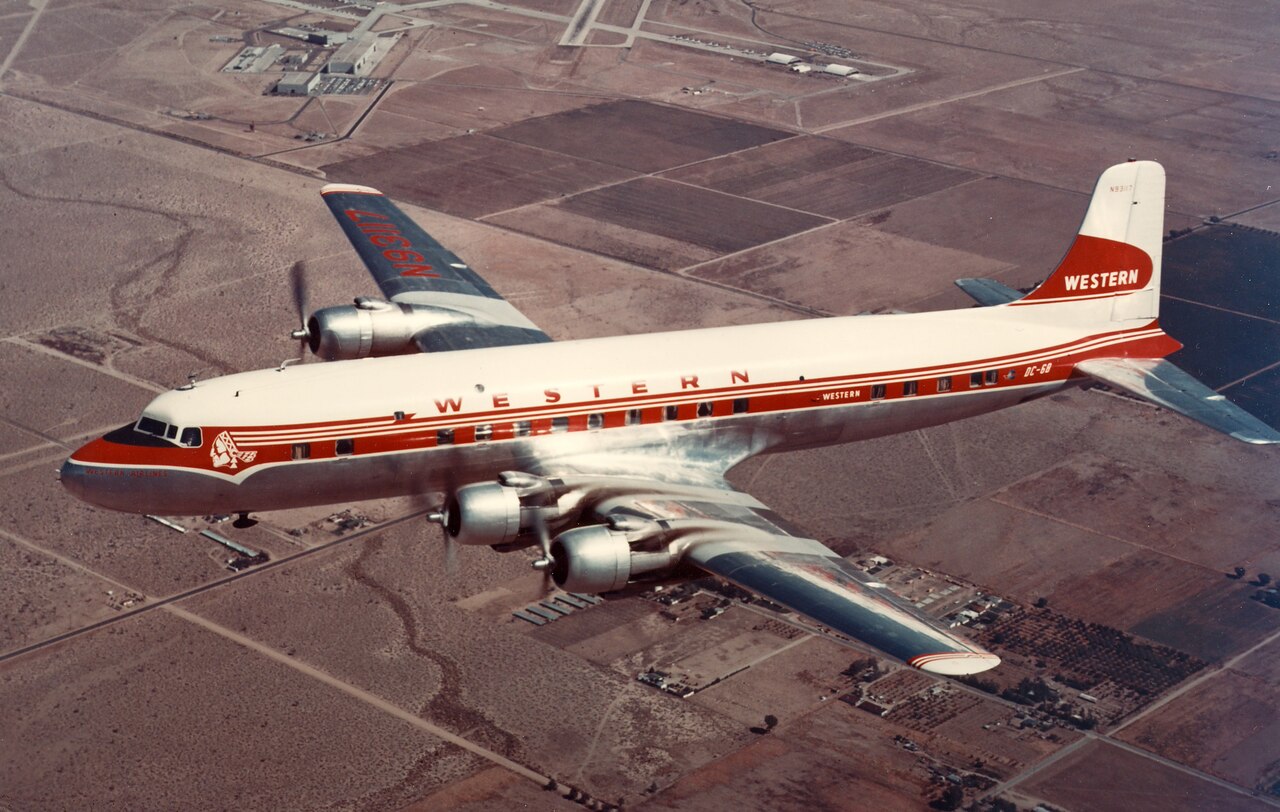
The Douglas DC-6B is the passenger-carrying, stretched development of the DC-6, a four-engined piston airliner built by the Douglas Aircraft Company. It first flew in 1951 and was regarded as the ultimate piston-engined airliner for ruggedness, reliability, economy and handling. For a sim pilot it offers long-range radial-engined airliner flying, from transatlantic services to the Flying Bulls' immaculate example.
The DC-6B is a long-range, pressurised, low-wing monoplane airliner with four Pratt & Whitney Double Wasp radial engines and a retractable nosewheel undercarriage. It was the passenger version of the stretched DC-6 family, which grew out of the DC-4 and its military C-54 Skymaster relative. Douglas reworked the design after the war to compete with the Lockheed Constellation in the long-range commercial market. The DC-6B was regarded as the ultimate piston-engined airliner from the standpoint of ruggedness, reliability, economical operation and handling qualities. Many have since served as freighters, and the type outlived the later DC-7, which was less economical.
The DC-6 began as a military requirement. In 1944 the US Army Air Forces commissioned the project as the XC-112, a lengthened, pressurised, more powerful development of the DC-4-based C-54. Launch orders from US airlines were placed in September 1944. By the time the prototype XC-112A flew on 15 February 1946 the war was over and the requirement had been rescinded, so Douglas continued the type as a long-range airliner. The civilian DC-6 first flew on 29 June 1946, and the first airline deliveries went to American Airlines and United Airlines. Airline service began in 1947. Early service was troubled: in 1947 a series of in-flight fires, one fatal (United Airlines Flight 608), grounded the fleet for four months. The cause was fuel venting near the cabin heater and cooling intake, and all aircraft were modified. More powerful R-2800 engines with water/methanol injection led Douglas to the further stretched DC-6A freighter (first flight 29 September 1949) and the passenger DC-6B (first flight 2 February 1951). The DC-6B entered service in April 1951. Korean War demand brought large military orders for C-118 and R6D aircraft. Total DC-6 series production was 704 including military versions, and the line ended in 1958. One published breakdown lists 288 DC-6Bs.
The DC-6B is an all-metal, aluminium-alloy stressed-skin aircraft with a pressurised fuselage. It has a tapered multi-cellular wing with flush-riveted skin and Fowler flaps. The engines and main gear are attached to the wing, and the fuel tanks are in the wings. Power comes from four Pratt & Whitney R-2800 Double Wasp 18-cylinder, twin-row radials, specified as R-2800-CB17s of 1,685 kW (2,500 hp) each. Another published figure gives 2,400 hp normal rating and 2,500 hp for take-off. The propellers are Hamilton Standard 43E60 three-bladed, constant-speed, reversing units of 4.20 m diameter. Wingspan is 35.81 m (117 ft 6 in), length 32.18 m (105 ft 7 in), height 8.66 m (28 ft 5 in) and wing area 135.9 sq m (1,463 sq ft). The DC-6B is about 60 in (150 cm) longer than the basic DC-6. Empty weight is 25,110 kg (55,357 lb) and maximum take-off weight 48,534 kg (107,000 lb). Estimated total fuel capacity is about 20,867 litres. The flight crew is three. Passenger accommodation is typically 54, with a maximum of 102, and other layouts range from about 60 to 107 seats. The DC-6B has open overhead luggage storage, unlike the early DC-6, which had overhead sleeper berths.
Cruising speed is 507 km/h (274 kt), and maximum continuous speed is 576 km/h at 4,000 m. Service ceiling is 25,000 ft (7,620 m). Range with maximum payload is 4,835 km (2,610 nm), and with maximum fuel 7,595 km (4,100 nm). Economical cruise at 62 per cent power at 6,280 m burns about 1,261 kg of fuel per hour. The Pan Am DC-6Bs that began transatlantic tourist-class flights in 1952 could gross 107,000 lb, with engines rated at 2,500 hp on 108/135 octane fuel. The DC-6B could often fly nonstop from the eastern US to Europe, but westbound it needed to refuel at Goose Bay, Labrador, or Gander, Newfoundland, because of the prevailing westerlies.
Douglas designed four DC-6 variants. The basic DC-6 is the original-length passenger aircraft, powered by R-2800-CA15 engines of 1,800 hp (2,400 hp with water injection). The DC-6A is a longer, higher-gross-weight freighter with a cargo floor and cargo doors forward and aft of the wing on the left side. The DC-6B is the passenger version of the stretched airframe, with passenger doors only and a lighter floor. The DC-6C is the convertible, with the two cargo doors and removable passenger seats. The military equivalents were the USAF C-118 Liftmaster and the US Navy R6D, the latter using the more powerful R-2800-CB17 engines that were later used on the DC-6B. The USAF and Navy ordered 167 C-118/R6D aircraft, and the Navy aircraft were later redesignated C-118. Harry Truman's first presidential aircraft, VC-118 The Independence, was a short-fuselage USAF DC-6. It is preserved at the National Museum of the United States Air Force in Dayton, Ohio.
By April 1949 DC-6s were flying with United, American, Delta, National and Braniff in the US, and on transatlantic, South American and Pacific routes with airlines including KLM, SAS, Sabena, Panagra and BCPA. Pan Am used DC-6Bs to start transatlantic tourist-class services in 1952. Other DC-6B users included Western Airlines, Northwest Orient (which also brought its -6As up to B standard), KLM, Olympic Airways and Swissair. Around 200 DC-6Bs were still in airline service in 1967. Frontline intercontinental passenger work passed to the Boeing 707 and Douglas DC-8, but the DC-6 continued in cargo, military and wildfire roles. In the 1980s Conair of Abbotsford, Canada, used several DC-6Bs as fire-retardant tankers, and Douglas sold its last aircraft to Everts Air Cargo of Fairbanks, Alaska, in the late 2000s. Two DC-6s were used as educational television transmitter platforms from Purdue University in the 1960s. The Flying Bulls operate a 1958-built DC-6B, once with JAT and later registered in Namibia as V5-NCF, with a new interior, four new engines and modern electronics. It is now Austria's only DC-6B.
The DC-6B suits pilots who enjoy classic long-range piston airliner flying. It has four big radials driving constant-speed, reversing propellers, a three-person flight crew and a cruise of about 274 kt. Its reputation for forgiving handling and ruggedness makes it a rewarding type for 1950s airline operations. Typical sim flying includes transatlantic sectors with westbound fuel stops at Gander or Goose Bay, regional passenger routes, freight work, and sightseeing in the retro paint of operators such as the Flying Bulls.