Departure
97%
vs 95% ▲ 2
 MY FS FLIGHTS
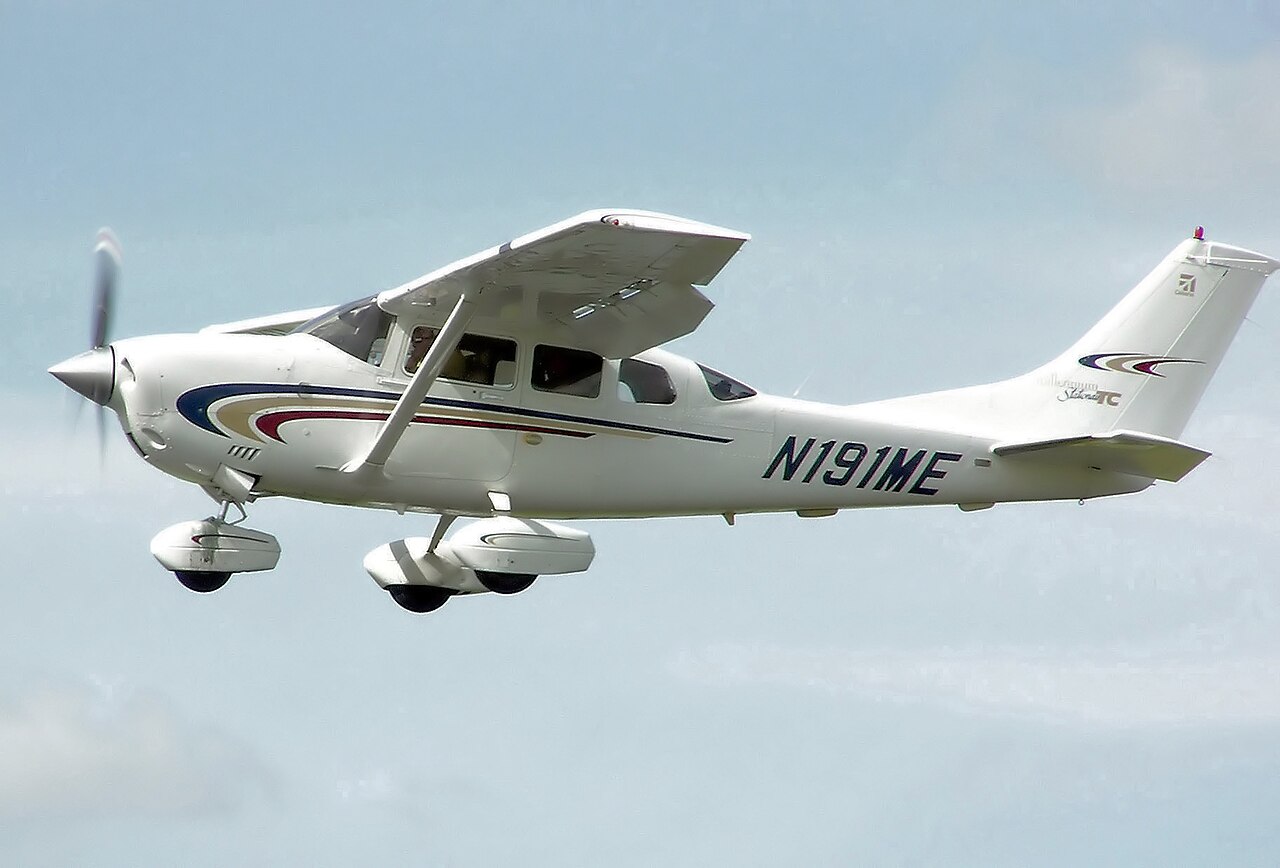
The Cessna CT206G is the turbocharged Stationair variant of Cessna's long-running 206 family, a rugged six-seat, single-engined utility aircraft built for hauling people, cargo or skydivers in and out of rough strips. Produced between 1979 and 1986 as part of the broader 205/206/207 lineage, it earned a reputation as a flying pickup truck thanks to its powerful engine, large cabin and clamshell cargo doors, and it has since become a popular subject for flight simulation.
The Cessna CT206G is a member of the Cessna 205/206/207 family, marketed primarily as the Stationair, a single-engined, fixed-gear general aviation aircraft produced by the Cessna Aircraft Company. The family occupies the heavier end of Cessna's piston singles, combining a powerful engine, rugged airframe and large cabin to serve as a load-hauling utility machine rather than a simple touring aircraft. Cessna itself has described the 206 line as the sport-utility vehicle of the air, and the turbocharged TU206G variant, sold under the designation CT206G, became known as a flying pickup truck for its ability to carry people, cargo or equipment into and out of unpaved backcountry strips.
The 206 lineage traces back to the Cessna 205, introduced late in 1962 as a 1963 model and essentially a fixed-gear Cessna 210 with revised crew and passenger doors, officially designated by Cessna as the Model 210-5. Only 576 Cessna 205s were built across the 1963 and 1964 model years before the design evolved into the six-seat Model 206, introduced for 1964 and produced continuously until 1986, when Cessna halted its entire single-engined piston line. Within this run, the utility-door U206 and turbocharged TU206 variants progressed through numerous engine and equipment updates, with sub-variants designated U206 through U206G. The CT206G corresponds to the TU206G Stationair, produced from 1979 to 1986. Total Model 206 production between 1964 and 2004 reached 6,581 aircraft, and across the full 205, 206 and 207 family Cessna built 8,509 aircraft from 1962 to 2006. Cessna later resumed 206 production in 1998 with the FAR Part 23-certified 206H.
The TU206G retains the utility-door configuration pioneered by the U206, with a pilot-side entry door and a large double clamshell rear door serving the middle and rear seats, allowing straightforward loading of bulky cargo or the removal of doors entirely for parachute operations. By the TU206G era the turbocharged engine was the Continental TSIO-520-M, rated at 310 hp (230 kW), an evolution from the original TU206's Continental TSIO-520-C of 285 hp (213 kW) and the later TSIO-520-F of 300 hp (220 kW). Turbocharging allowed the aircraft to maintain power at altitude, though the large propeller diameter meant higher engine speeds pushed propeller tips toward transonic speeds, requiring correspondingly more power. The aircraft can be fitted with floats, amphibious floats or skis, reflecting its design as a multi-role utility platform, and cabin trim on later Stationairs has included hand-stitched leather seating with shoulder-belt airbags.
Pilot accounts of the related T206H Turbo Stationair note a commanding view from the raised seating position, with deep side windows extending forward to the panel giving generous visibility that improves further when the seat is slid forward for full rudder travel. The type's long fuselage relative to four-seat Cessna singles requires pilots to take care when manoeuvring on the ramp, though rearward visibility through the passenger windows makes judging tail clearance straightforward.
The Stationair family encompasses the Cessna 205 (Model 210-5), the normally aspirated and turbocharged U206 and TU206 utility-door models progressing through sub-variants U206 to U206G, the passenger-door P206 and turbocharged TP206 Super Skylane variants from P206 to P206E, and the later FAR Part 23-certified 206H and turbocharged T206H introduced in 1998. The CT206G corresponds to the TU206G Stationair built between 1979 and 1986, distinguished from earlier turbo models by its Continental TSIO-520-M engine of 310 hp. The U206 was marketed as the Super Skywagon from 1964 to 1969 and as the Stationair from 1970 onward, while the P206 carried the Super Skylane name.
The combination of a powerful engine, rugged construction and large cabin has made the Stationair family popular as bush planes, used across commercial air service and private ownership alike. Typical roles include aerial photography, skydiving operations, utility and cargo hauling, and operation from unpaved backcountry airstrips, with the clamshell rear door allowing the aircraft to fly without its doors fitted for dropping parachutists. Float, amphibious float and ski fitments extend its use into seaplane and remote operations, while some examples see service in roles such as aerial firefighting support.
The CT206G has been modelled for Microsoft Flight Simulator 2024 by Carenado as a turbocharged, six-seat utility aircraft offering a wide range of configurations, including clickable fairings, a toggleable cargo pod, animated doors and mud effects for off-airport operations, alongside twenty-seven liveries plus a blank scheme. The cockpit uses a classic analogue six-pack instrument panel paired with hot-swappable avionics via an electronic flight bag, letting users switch between default Garmin GNS 530+430 units and third-party GTN 750+650 units. Carenado's RealXperience technology adds dynamic vibrations across panels, needles and the airframe together with a high-fidelity sound environment, aimed at reinforcing the aircraft's reputation as a rugged, versatile workhorse suited to backcountry, seaplane and skydiving operations in the simulator.