Departure
99%
vs 95% ▲ 4
 MY FS FLIGHTS
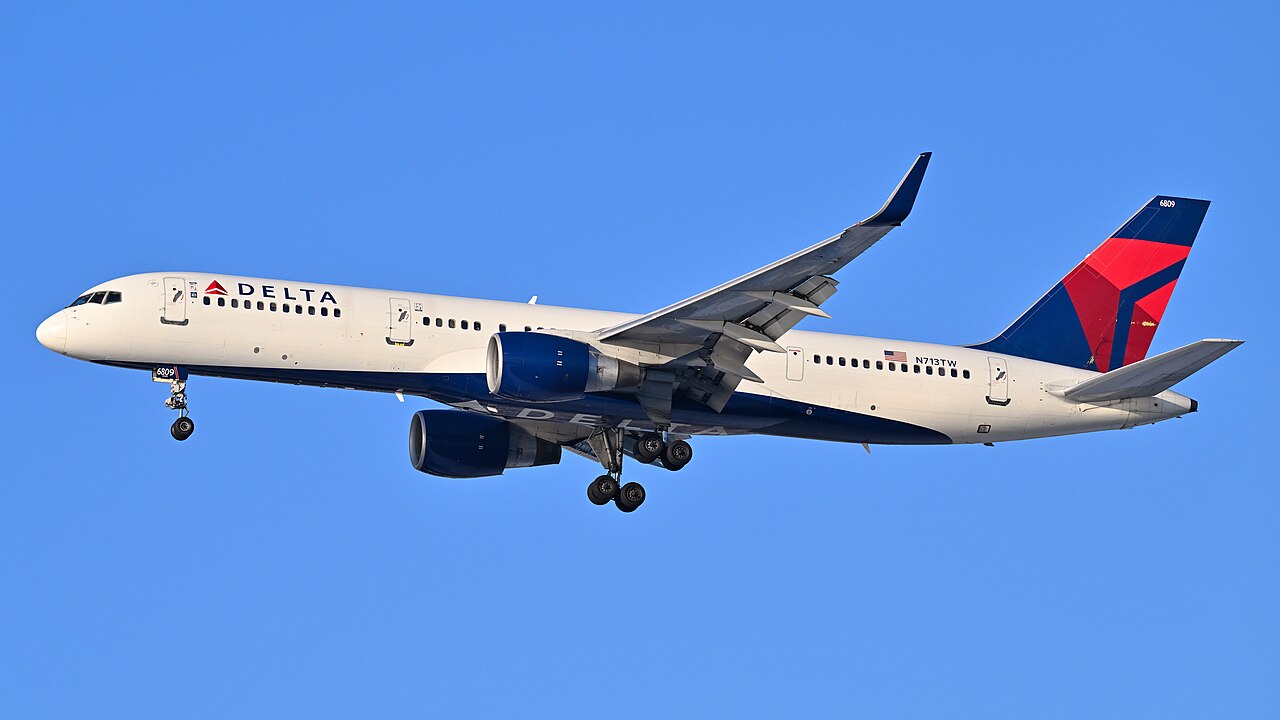
The Boeing 757-200 is an American narrow-body twinjet airliner built by Boeing Commercial Airplanes as a twin-engine successor to the trijet 727. Designed for short and medium-haul routes but capable of transoceanic ETOPS flying, it combined a 707-width, six-abreast fuselage with a new supercritical wing and a two-crew glass cockpit shared with the 767. With 913 of the type built, it became the most popular 757 variant and remains a familiar sight with major US carriers and cargo operators, making it a popular, powerful-feeling type among simulator pilots.
The 757-200 is a narrow-body, twin-engine jet airliner manufactured by Boeing Commercial Airplanes, originally developed under the internal designation 7N7 as a twinjet replacement for the trijet 727. It retains the fuselage cross-section and six-abreast seating of the 707/727 family but introduces a new supercritical wing, underwing turbofans, and a two-crew glass cockpit that shares a common type rating with the wide-body 767. Of the 1,050 Boeing 757s built in total, 913 were -200 series aircraft, making it by far the most numerous version of the family and a mainstay of US domestic, transcontinental, charter and cargo operations from the 1980s onward.
In the early 1970s, following the launch of the 747, Boeing began studying successors to its 727, which was the best-selling jetliner of the 1960s and a mainstay of the US domestic market. Two paths were explored: a stretched 727-300 using existing technology, and an all-new twinjet code-named 7N7 incorporating new materials and propulsion advances. Airlines proved more interested in the 7N7's high-bypass turbofans, new flight-deck technology, lower weight and improved aerodynamics, and by 1978 development had settled on two sizes, a 160-seat 7N7-100 and a 180-plus seat 7N7-200, while retaining the 727's forward fuselage, cockpit layout and T-tail concept initially. On August 31, 1978, Eastern Air Lines and British Airways became the first carriers to publicly commit to the 7N7-200, ordering 40 aircraft between them; these orders were formally signed in March 1979, when Boeing designated the aircraft the 757. The shorter 757-100 never attracted orders and was dropped, with the 737 later filling that role. As development progressed the aircraft increasingly adopted elements from the parallel 767 programme, which was several months further along. Rolls-Royce RB211-535 engines were selected at launch, marking the first time a Boeing airliner had been launched with non-US engines; Pratt & Whitney subsequently offered the PW2037, which Delta Air Lines launched with an order for 60 aircraft in November 1980, while General Electric's proposed CF6-32 was eventually withdrawn for lack of demand. During development, exit doors were fitted with dual-spring mechanisms for easier operation and the fuselage was strengthened for greater bird-strike resistance; the production aircraft ended up 3,600 pounds lighter than originally specified and burned three percent less fuel than expected, extending range by 200 nautical miles. The prototype first flew on February 19, 1982, was certified by the FAA on December 21, 1982, and entered commercial service with Eastern Air Lines on January 1, 1983. A package freighter variant followed in September 1987 and a combi model in September 1988. Production of the 757 family ended in October 2004, after 1,050 aircraft had been built for 54 customers, as Boeing positioned the largest 737 Next Generation variants as the -200's successor.
The 757-200 uses a 2,000 sq ft (185.25 m squared) supercritical wing for reduced aerodynamic drag, mated to a conventional tail and retaining the 707/727 fuselage cross-section with six-abreast seating. The two-crew glass cockpit shares a common type rating with the 767. External dimensions include a wingspan of 38.05 m (124 ft 10 in), overall length of 47.33 m (155 ft 3 in), fuselage length of 46.97 m (154 ft 1 in), tailplane span of 15.22 m (49 ft 11 in), tail height of 13.59-13.74 m (44 ft 6 in to 45 ft 1 in) depending on configuration, wheel track of 7.32 m (24 ft) and wheelbase of 18.29 m (60 ft). The fuselage measures 4.01 m (158 in) vertically and 3.76 m (148 in) horizontally on the exterior. Underfloor cargo volume totals 19.8 cubic metres forward and 27.5 cubic metres aft, with total cargo space of 226.5 cubic metres. The type was offered with Pratt & Whitney PW2037 (36,600 lbf) and PW2040 (40,100 lbf) turbofans, or Rolls-Royce RB211-535C (37,400 lbf), RB211-535E4 (40,200 lbf) and RB211-535E4-B (43,500 lbf) engines. Fuel capacity is 42,680 litres (11,276 US gallons) with PW2037/RB211-535E4 engines or 43,490 litres (11,489 US gallons) with PW2040/RB211-535E4-B engines. Operating empty weight ranges from about 58,440-59,160 kg with Pratt & Whitney engines to 58,570-59,300 kg with Rolls-Royce engines. Maximum take-off weight is 99,790 kg (220,000 lb) with PW2037 or RB211-535E4 engines, rising to 115,665 kg (255,000 lb) with PW2040 or RB211-535E4-B engines, with corresponding maximum landing weights of 89,810 kg (198,000 lb) and 95,250 kg (210,000 lb). Standard cabin layouts seated between 178 passengers in a two-class arrangement and up to 239 in an all-tourist configuration, with a flight deck crew of two and provision for an observer.
The 757-200 has a maximum operating speed of Mach 0.86 and a typical cruising speed of Mach 0.80. Cruising altitude varies with engine fit, from about 10,760 m (35,300 ft) with the PW2040 up to 11,800 m (38,700 ft) with the RB211-535E4. Take-off field length ranges from 1,660 m (5,450 ft) with RB211-535E4 engines to 2,360 m (7,750 ft) with PW2040 engines, while landing field length ranges from about 1,420 m (4,660 ft) to 1,550 m (5,100 ft) depending on engine type. Approach speeds are quoted at 132 knots for PW2037/RB211-535E4-powered aircraft and 137 knots for PW2040/RB211-535E4-B-powered aircraft. Range varies significantly by engine: PW2037-powered aircraft are credited with 4,550 km (2,460 nm), while PW2040-powered aircraft can reach 7,250 km (3,915 nm); RB211-535E4-powered aircraft achieve 4,240 km (2,290 nm), extending to 6,825 km (3,685 nm) with the uprated RB211-535E4-B. In commercial use, the 757-200 is typically credited with a range around 3,915 nautical miles (7,250 km) in its highest-performance passenger configuration. ETOPS approval was granted in 1986, enabling the type to fly extended overwater intercontinental routes, and later-delivered Delta aircraft with ETOPS certification could fly up to 4,520 miles, roughly nine hours and fifteen minutes of flight time.
The baseline 757-200 was the initial production passenger version and the most numerous, with 913 built. Freighter derivatives followed, including a 757-200 Freighter developed by Pemco Aeroplex as a conversion of existing passenger aircraft, and the 757-200PF package freighter developed specifically for UPS, which entered service in September 1987. A combi version, the 757-200M, carried both passengers and cargo and was delivered in only one example, to Royal Nepal Airlines, entering service in September 1988. Passenger aircraft have also been modified after the fact into the 757-200SF Special Freighter and the Precision Converted Freighter (PCF) for cargo operators. An extended-range 757-200X variant offered more than 1,000 km of additional range over the standard model. The military VC-32A, four of which were built for the United States Air Force as the C-32, serves as a VIP transport. The 757 family was later complemented by the stretched 757-300, launched in September 1996 following an order from charter carrier Condor and entering service in March 1999, though with 55 built it remained a far less numerous sibling to the -200.
Eastern Air Lines was the launch operator, placing the 757-200 into commercial service on January 1, 1983, shortly after British Airways' parallel launch order. The type went on to become a core aircraft for US mainline carriers, European charter airlines and cargo integrators. It was commonly used for short- and medium-range domestic routes, shuttle services, and transcontinental flights across the United States, and after ETOPS certification in 1986 it was also deployed on intercontinental routes, including transatlantic services. Delta Air Lines built up a large and varied 757-200 fleet, including original orders alongside aircraft inherited from Northwest Airlines, TWA, Singapore Airlines and Shanghai Airlines, and used the type on its low-cost Song brand between 2003 and 2006 before folding those aircraft back into mainline two-class configurations. Cargo operators including UPS and FedEx made extensive use of freighter and converted-freighter 757-200s. Government and private operators have also used the type as a VIP transport, most notably the US military's VC-32A/C-32. By July 2017 there were 665 Boeing 757s in commercial service, with Delta Air Lines the largest operator, flying 127 examples, and the type as a whole has recorded ten hull-loss accidents as of August 2023.
For simulator pilots, the 757-200's appeal lies largely in the combination of a relatively light, narrow-body airframe with engines rated as high as 43,500 lbf, giving it markedly strong thrust-to-weight characteristics for a six-abreast single-aisle jet, reflected in its comparatively short take-off field lengths of as little as 1,660 m against a maximum take-off weight of up to 255,000 lb. Its two-crew glass cockpit, shared in type rating with the 767, reflects Boeing's late-1970s shift to modern flight-deck technology and made the type attractive to operators running mixed 757/767 fleets. ETOPS clearance from 1986 and the long-range figures recorded with PW2040 engines, up to 3,915 nautical miles, meant the -200 could be flown convincingly on everything from short domestic hops to long transatlantic sectors, giving the type a broad operational envelope that continues to make it a popular study aircraft among enthusiasts of 1980s- and 1990s-era Boeing airliners.