Departure
94%
vs 95% ▼ 2
 MY FS FLIGHTS
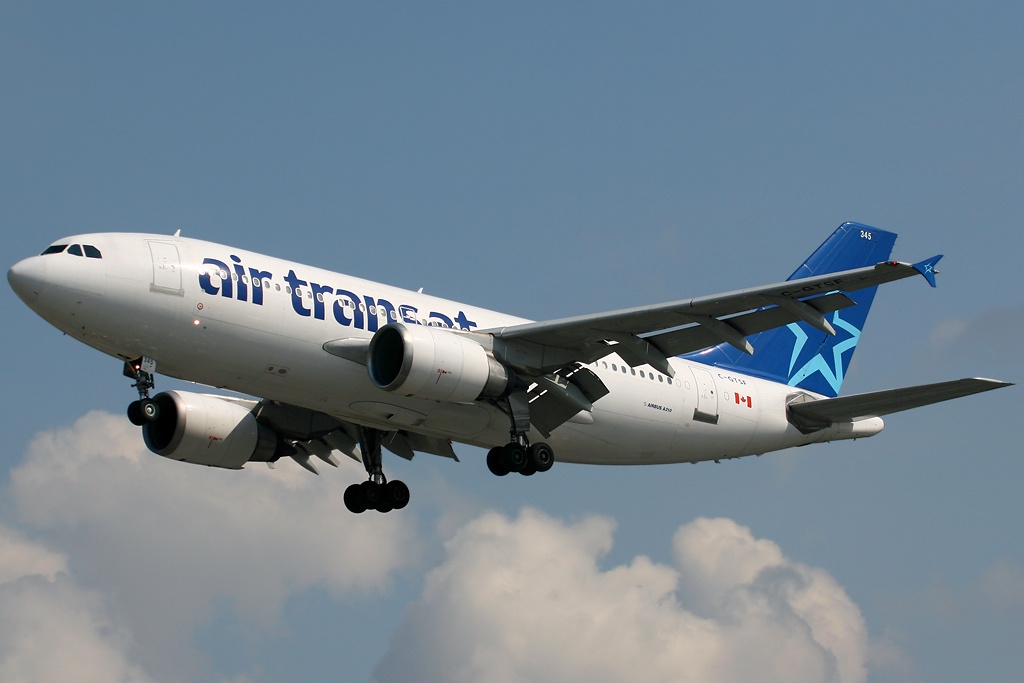
The Airbus A310-300 is the extended-range version of Airbus's short-fuselage derivative of the A300, developed to give airlines a smaller widebody twinjet capable of true intercontinental sectors. Built by the European Airbus consortium and first flown in 1985, it introduced additional fuel capacity, wingtip fences and a higher maximum takeoff weight over the original A310-200, becoming the definitive production version of the family. For a simulator pilot it offers an early Airbus glass-cockpit widebody with genuinely long-range capability packed into a relatively compact twin-aisle airframe.
The A310-300 is a wide-body, twin-engine airliner manufactured by Airbus Industrie GIE, a consortium of European aerospace manufacturers, and is the longer-range production variant of the Airbus A310 family. It is a shrunken derivative of the Airbus A300, the first twin-jet wide-body airliner, sharing the same eight-abreast fuselage cross-section but with a shortened fuselage and a smaller, higher aspect ratio wing. Alongside its role in mainline passenger service, the airframe went on to serve in cargo conversion and government/military transport roles, including as the basis for the Airbus CC-150 Polaris operated by the Royal Canadian Air Force.
The A310 originated from Airbus's search for a smaller companion to the A300, following recognition that some operators did not have enough traffic to justify the larger aircraft while others wanted greater frequency at lower aircraft-distance cost. The programme, initially referred to as the A300B10 and internally as the A300B10MC (Minimum Change), was launched on 7 July 1978 with orders from Swissair and Lufthansa. The first prototype conducted its maiden flight on 3 April 1982, and the aircraft received its type certificate on 11 March 1983, entering revenue service with Swissair in April 1983 (Lufthansa is also cited as the launch service operator). Two versions were originally planned: the regional A310-100 and the transcontinental A310-200; the A310-100 was ultimately not built as a separate production version. The A310-300, developed as a longer-range version of the base A310-200, first flew and entered production from 1985, and from that point onward became the standard production variant, with A310-200 output winding down as the -300 took over the Toulouse assembly line. The A310-300 introduced wingtip fences, which reduced vortex drag and improved cruise fuel consumption by over 1.5 percent, along with a limited number of tail unit alterations including smaller horizontal tail surfaces. Production of the A310 family ran from 1981 to 1998, with 255 aircraft built in total and the final delivery made in June 1998; the type was ultimately succeeded by the larger Airbus A330-200.
The A310-300 retains the same eight-abreast, twin-aisle cabin cross-section as the A300 but on a fuselage 6.95 m (22 ft 10 in) shorter, with a smaller wing reduced from 260 to 219 m2 (2,800 to 2,360 sq ft) and a wing span of 43.89 m (144 ft 0 in). Overall length is 46.66 m (153 ft 1 in) and tail height is 15.80 to 15.87 m (51 ft 10 in to 52 ft 1 in). Cabin dimensions are given as 17 ft 4 in (5.28 m) wide, 7 ft 8 in (2.33 m) high and 109 ft 1 in (33.24 m) long, with a fuselage diameter of 18 ft 4 in (5.60 m). The aircraft introduced a two-crew glass cockpit with EFIS displays, later carried across to the A300-600 under a common type rating, along with fly-by-wire outboard spoilers and new, smaller horizontal tail surfaces compared with the A300. The A310-300 is distinguished from the -200 by carrying up to 7,000 kg (15,430 lb) of additional fuel in the tailplane, plus wingtip fences fitted from 1985 onward. Engine options included the Pratt & Whitney JT9D-7R4E1 and later PW4000 series, and the General Electric CF6-80A3 and later CF6-80C2 series, with thrust ratings cited up to around 262.4 kN (59,000 lb) for the CF6-80C2A8 and up to 249.1 kN (56,000 lb) for the PW4156. Operating empty weight with CF6-80C2A8 engines is given as 81,205 kg (179,025 lb), with maximum takeoff weight of 150,000 kg (330,695 lb) standard, rising through higher gross weight options to 164,000 kg (361,560 lb). Fuel capacity is cited at around 61,100 litres (16,150 US gal), and maximum payload at around 34,800 kg (76,500 lb). Cargo holds in the fore and aft underfloor compartments can accommodate 2.44 x 3.17 m (88 x 125 in) pallets or up to 14 LD3 containers, with baggage volume cited at 112.2 cubic metres (3,962 cubic feet).
Maximum cruising speed is quoted at 897 km/h (484 kt), with a long-range cruise speed of 850 km/h (459 kt); other sources cite maximum cruise around 893 km/h (482 kt) and typical cruise near 470 kt (870 km/h). Approach speed is given as 139 kt (257 km/h). Service ceiling is listed at 41,000 ft (12,500 m), with a rate of climb around 2,500 ft/min (13 m/s). Range at typical operating weight with 218 passengers, baggage and reserves is quoted as 7,982 km (4,310 nm) for the CF6-powered A310-300, extending to 9,580 km (5,170 nm) for the high gross weight A310-300 with CF6 engines; the type's overall design range is cited at up to 5,150 nautical miles (9,540 km). Typical takeoff distance is cited at around 7,500 ft (2,290 m) and landing distance around 4,900 ft (1,490 m). Its longer range and ETOPS certification, enabled by high-bypass CF6-80C2 and PW4000 turbofans supporting 180-minute ETOPS approval, allowed the A310-300 to be operated on transatlantic and other long-haul overwater routes.
The A310 family comprises two basic production versions: the medium-range A310-200, the first version developed, and the longer-range A310-300, which entered production from 1985 and became the standard production version as A310-200 output wound down. The A310-300 differs from the -200 chiefly through its tailplane fuel tank carrying up to 7,000 kg (15,430 lb) of extra fuel, wingtip fences fitted from 1985, and a higher maximum takeoff weight. Freighter derivatives included the A310-200F, available new-build or as a conversion, with 13 A310s converted to freighters for Federal Express, and the A310-300F, a passenger-to-freighter conversion of the -300 with no factory-built freighter version ever produced; conversions featured a large hydraulically operated main deck cargo door, reinforced main deck floor and cargo handling/restraint systems. A convertible passenger/freighter version, the A310-200C, first entered service with Dutch operator Martinair in 1984. Military derivatives included the A310 MRT (multi-role transport), further developed into the A310 MRTT (multi-role tanker transport), and the Airbus CC-150 Polaris operated by the Royal Canadian Air Force, converted from civilian A310-300s originally owned by Wardair and subsequently Canadian Airlines International.
The A310-300 entered airline service in the mid-1980s, competing directly with the Boeing 767-200, and its long range combined with ETOPS certification made it well suited to transatlantic and other extended overwater routes. Airlines that operated the type included Swissair, and it went on to serve numerous carriers worldwide before many aircraft were converted to freighter configuration. In cargo roles, FedEx served as launch customer for A310-300F conversions, and Emirates SkyCargo later contracted for the conversion of ex-Aeroflot A310-300 passenger aircraft into freighters. The type also found military and government transport applications, notably as the CC-150 Polaris with the Royal Canadian Air Force. In its later operational life, the type has remained in limited service, with operators including Mahan Air, ULS Airlines Cargo, Iran Air and Ariana Afghan Airlines cited among primary users of the A310 family.
The A310-300 offers a simulator pilot an early Airbus twin-aisle type combining a two-crew glass cockpit with EFIS instrumentation, common in philosophy to the later A300-600, and fly-by-wire outboard spoilers alongside otherwise conventional flight controls of its era. Its compact widebody proportions, long-range fuel provisions in the tailplane and wingtip fences give it distinctive handling and range characteristics compared with both its A300 parent and contemporary twinjets such as the Boeing 767-200, making it an interesting type for pilots interested in long-haul operations from a smaller widebody airframe.