Departure
81%
vs 95% ▼ 14
 MY FS FLIGHTS
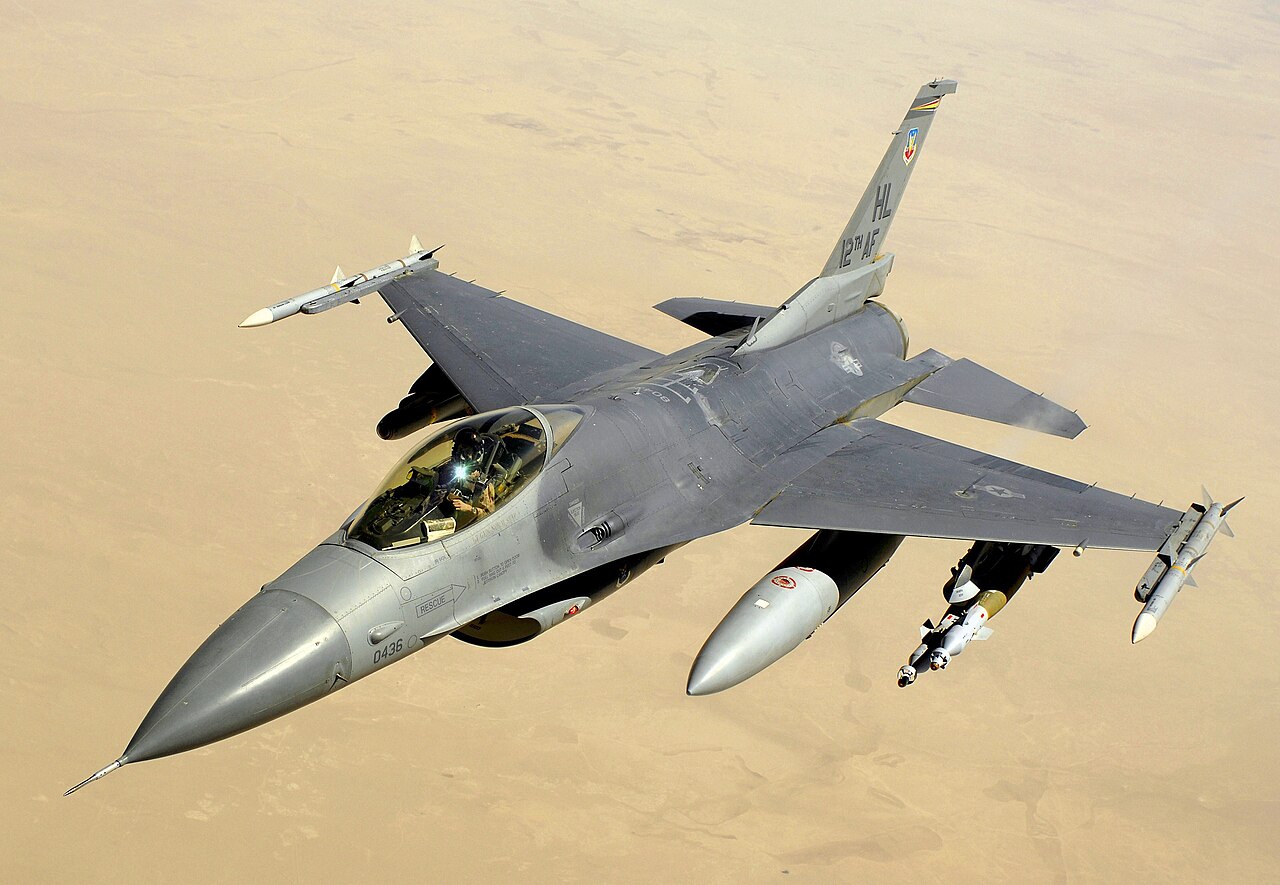
The General Dynamics (now Lockheed Martin) F-16 Fighting Falcon is a single-engine, supersonic, fourth-generation multirole fighter that has served as the backbone of the United States Air Force's tactical airpower since 1978 and equips the air forces of more than two dozen other nations. Known to its crews as the "Viper", it was the first production combat aircraft to be deliberately built aerodynamically unstable and flown entirely through fly-by-wire, giving it exceptional agility. For a simulator pilot it represents one of the most consequential fighter designs of the modern era, combining a small, lightweight airframe with an evolving suite of sensors and weapons that took it from day fighter to all-weather multirole warplane.
The F-16 Fighting Falcon is an American single-engine, supersonic, multirole fourth-generation fighter aircraft, originally developed by General Dynamics and produced since by Lockheed Corporation and then Lockheed Martin, with additional manufacture undertaken by SABCA, Fokker, KAI and TUSAS. Designed from the outset as an air superiority day fighter, it evolved into a highly successful all-weather multirole aircraft, with more than 4,600 built since 1976. Although the original production lines have closed, improved Lockheed Martin F-16V Viper variants continue to be built and upgraded for export. It remains, by a wide margin, the world's most common fixed-wing aircraft in military service, with over 2,100 examples operational and comprising a significant share of all active combat aircraft worldwide.
The F-16 emerged from the Lightweight Fighter program, a reaction to the U.S. Air Force's Vietnam War experience, which exposed the need for genuine air superiority fighters and better air-to-air training. Colonel John Boyd, drawing on his Korean War experience and work as a fighter tactics instructor, developed the energy-maneuverability theory with mathematician Thomas Christie to model fighter performance in combat, calling for a small, lightweight aircraft with a high thrust-to-weight ratio that could maneuver with minimal energy loss. Boyd assembled a group of like-minded reformers known as the Fighter Mafia, and in 1969 secured Department of Defense funding for General Dynamics and Northrop to study design concepts based on the theory. Although Air Force F-X proponents opposed the concept as a threat to the F-15 program, Deputy Secretary of Defense David Packard's support for competitive prototyping led to the creation of the Air Force Prototype Study Group in May 1971, with Boyd a key member. A request for proposals issued on 6 January 1972 called for a 20,000-pound class air-to-air day fighter optimised for combat at speeds of Mach 0.6 to 1.6 and altitudes of 30,000 to 40,000 feet, with an anticipated flyaway cost of around 3 million dollars. The General Dynamics YF-16 competed against the Northrop YF-17 in a 1975 fly-off and was selected on the basis of cost, range and turning performance. The aircraft's unplanned first flight came on 20 January 1974, with the official first flight following on 2 February 1974. The production-standard F-16A first flew on 7 August 1978, with USAF delivery accepted on 6 January 1979, and the type entered operational service with the 34th Tactical Fighter Squadron, 388th Tactical Fighter Wing, at Hill AFB, Utah, on 1 October 1980. The name "Fighting Falcon" was formally given on 21 July 1980.
The F-16 is built around a small, lightweight airframe with a blended wing-body fuselage that flares out at its junction with the aluminium-alloy wings, giving greater lift and stability at steep angles of attack. Its most distinctive cockpit features are a frameless bubble canopy for maximum visibility, a side-stick controller to ease control during high-g manoeuvring, and an ejection seat reclined 30 degrees from vertical to reduce the effect of g-forces on the pilot. The type was the first production fighter to combine relaxed static stability with a fly-by-wire flight control system, meaning the airframe is deliberately unstable and only remains controllable because a flight control computer makes continuous corrections through electronic rather than mechanical linkages to the control surfaces; this trade of natural stability for agility became a template followed by later fighter designs. Power comes from a single turbofan engine, either a Pratt & Whitney or a General Electric unit, producing between 23,000 and 29,000 pounds of thrust with afterburner. Armament centres on an internal M61 Vulcan 20mm rotary cannon, supplemented by 11 hardpoints under the wings and fuselage capable of carrying a wide range of bombs and missiles. With a typical combat load the aircraft weighs approximately 23,000 pounds, less than half the weight of the F-4 Phantom II it succeeded. Later production standards such as the Block 70/72 carry the Northrop Grumman APG-83 AESA radar, giving fifth-generation radar capability derived from hardware and software common to the F-22 and F-35, and feature an extended structural service life of 12,000 hours, more than 50 percent beyond earlier production aircraft, supporting at least 40 years of service for most operators.
With afterburner engaged the F-16's single turbofan can accelerate the aircraft to more than twice the speed of sound. All F-16s delivered since November 1981 carry built-in structural, wiring and systems provisions that permit multi-role flexibility, including precision strike, night attack and beyond-visual-range interception missions, supported by an AN/APG-66/68 series radar, an accurate inertial navigation system, UHF/VHF radios, an instrument landing system and modular countermeasure pods. The aircraft's combat radius, the distance it can fly to reach air combat, engage and return, exceeds that of most contemporary fighters. According to U.S. Air Force statistics, controlled flight into terrain accounts for 26 percent of aircraft losses and a striking 75 percent of all F-16 pilot fatalities, underlining how demanding low-level and high-g handling of the type can be.
The F-16A is the original single-seat production model, while the F-16B is a two-seat variant used for training, with student and instructor pilots seated in tandem. The General Dynamics F-16XL was an experimental cranked-arrow-wing derivative, and the type's fly-by-wire lineage continued into the General Dynamics X-62 VISTA testbed. A navalised derivative was studied as the Vought Model 1600, while Japan's licence-derived Mitsubishi F-2 grew directly out of the F-16 design. Continuing production and upgrade work centres on the Lockheed Martin F-16V Viper family, exemplified by the Block 70/72 standard with its AESA radar and extended-life airframe.
Since entering USAF service in 1978, the F-16 became the mainstay of American tactical airpower, replacing the F-105 Thunderchief, A-7 Corsair II and F-4 Phantom II. It took over the suppression of enemy air defenses role from the F-4G Wild Weasel by 1996 and has performed strike, air superiority, tactical reconnaissance and close air support missions throughout its career. Beyond front-line U.S. Air Force, Air National Guard and Air Force Reserve Command units, the type equips the USAF Thunderbirds aerial demonstration team and the Air Combat Command F-16 Viper Demonstration Team, and serves the U.S. Navy in an adversary and aggressor training role, simulating current threat aircraft in fighter combat training. It has been procured by the air forces of 25 other nations and has flown combat missions with U.S.-led coalitions in the Gulf War, over Bosnia and Yugoslavia, in Afghanistan, Libya, and Iraq and Syria. Israel, Pakistan and Ukraine have all made extensive combat use of the type. Since 1982 the F-16 has served as a Dual Capable Aircraft platform for U.S. nuclear weapons based in Europe. A number of operators are now transitioning to the Lockheed Martin F-35 Lightning II or to the upgraded F-16V Viper, though older F-16 versions remain in widespread service.
The features that define the F-16 in the cockpit are the same ones a simulator pilot will notice first: the frameless bubble canopy gives an unusually open, all-round view, the side-stick controller is intended to ease handling under high-g manoeuvring rather than requiring a conventional centre stick, and the reclined ejection seat is designed specifically to reduce the toll of sustained g-forces during hard turns. Because the airframe is deliberately unstable and relies entirely on its fly-by-wire computer to remain controllable, the aircraft rewards an understanding of that underlying philosophy: it is an agile, energy-efficient fighter built around the same maneuvering theory that drove its original design, rather than a conventionally stable aircraft with agility bolted on afterward.