Departure
81%
vs 95% ▼ 14
 MY FS FLIGHTS
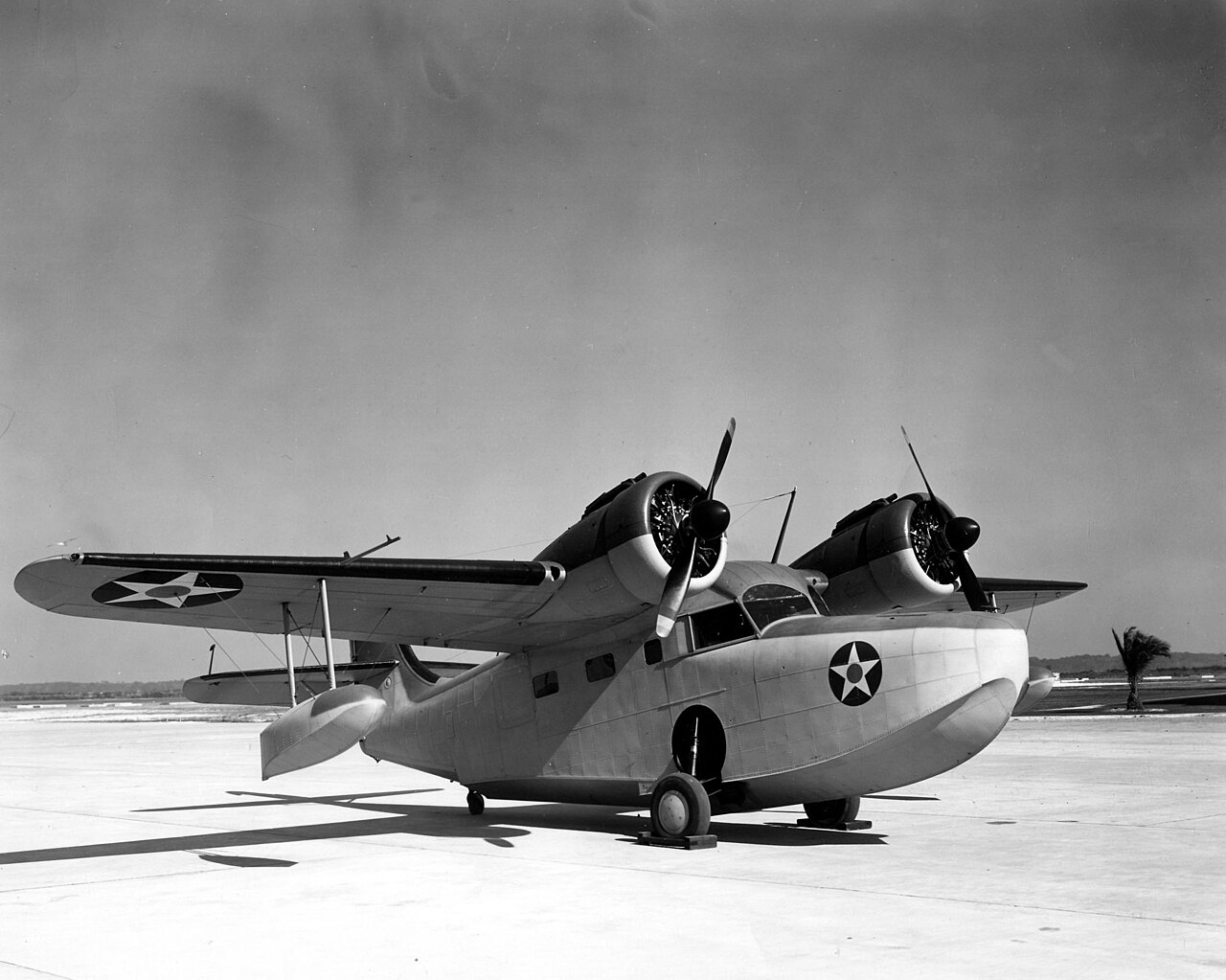
The Grumman G-21 Goose is an eight-seat, twin-engine amphibious flying boat designed in 1936 for wealthy Long Island commuters and first flown on 29 May 1937, becoming Grumman's first monoplane, first twin-engined aircraft and first commercial airliner. What began as a private air yacht for Manhattan businessmen became a rugged wartime transport and postwar bush and island workhorse, and it remains prized today as a go-anywhere classic amphibian.
The G-21 Goose is a high-wing, twin-engine amphibious flying boat built by the Grumman Aircraft Engineering Corporation of Bethpage, New York. It was conceived as a light amphibious transport for private and corporate use, with a deep, boat-hulled fuselage and hand-cranked retractable landing gear allowing operation from land or water. It held a distinguished place in Grumman's history as the company's first monoplane to fly, its first twin-engined design, and its first aircraft to enter commercial airline service, and it went on to serve in large numbers with military and civil operators worldwide.
The Goose originated in 1936 when a syndicate of wealthy Long Island residents, including Wilton Lloyd-Smith and E. Roland Harriman, sought a replacement for the Loening Air Yacht they used to commute from their Long Island homes to Manhattan. Grover Loening, whom they first approached, declined the commission but recommended the Grumman Aircraft Engineering Corporation, which he consulted for and had helped finance. Leroy Grumman took on the project with designer and co-founder William Schwendler and hydrodynamicist Ralston Stalb, producing the Model G-21, a light amphibious transport of almost all-metal construction. The prototype first flew on 29 May 1937, and the first production G-21A was sold to Lloyd-Smith the following month for around 60,000 dollars, a price that limited early sales to the wealthiest buyers. Although designed as a civil executive transport, the Goose quickly attracted military interest: the US Army Air Corps purchased it as the OA-9 in 1938, and the US Navy became the largest customer, buying more than 200 during the Second World War. A total of 345 Goose aircraft were built between 1937 and 1945. After the war the type found continued commercial employment with small operators from Alaska to Catalina and the Caribbean. From the late 1950s, McKinnon Enterprises of Sandy, Oregon, developed extensive modification programmes, holding 21 supplemental type certificates for the G-21 and separately certificating four McKinnon variants, including piston re-engining and later a turboprop conversion. In November 2007 Antilles Seaplanes of Gibsonville, North Carolina, announced plans to resume production of the turbine McKinnon design as the Antilles G-21G Super Goose, but by 2009 the company's manufacturing centre had been foreclosed and sold at auction, leaving the future of new-build Goose production unresolved.
The Goose is a high-wing monoplane of almost all-metal construction, though the trailing half of the wing and all flight control surfaces except the flaps were fabric-covered. Its deep fuselage doubles as the hull, with hand-cranked retractable landing gear allowing amphibious operation. Power was provided by two Pratt & Whitney R-985 Wasp Junior nine-cylinder, air-cooled radial engines of 450 horsepower (340 kW) each, mounted on the wing leading edges; on the JRF-5 these were the R-985-AN-6 variant, a supercharged design with a single-speed, gear-driven General Electric centrifugal supercharger driving three-bladed variable-pitch propellers, while the G-21A used two-bladed Hartzell constant-speed propellers. Dimensions were a wingspan of 49 ft 0 in (14.94 m), a length of 38 ft 6 in (11.74 m), and a tail height of 16 ft 2 in (4.93 m), with a fuselage diameter of 4 ft 9 in (1.45 m) and, on the JRF-5, a wing area of 34.8 square metres. Weights varied by variant: an empty weight of around 5,425 lb is recorded, with the G-21A rated at a gross weight of 8,000 lb (3,600 kg), a maximum payload of 2,600 lb (1,150 kg), and fuel capacity of 220 US gallons (800 L). Armed export and patrol variants carried a .30 in (7.62 mm) machine gun in bow and dorsal hatches, plus underwing ordnance such as two 100 lb bombs or, in patrol configuration, two 325 lb depth charges or two 250 lb general-purpose bombs.
Published figures give a top speed of 201 mph and a maximum cruise speed of 175 knots (201 mph, 324 km/h), with a cruise speed of 166 knots at 5,000 ft also recorded for the JRF-5. Some accounts cite a more modest cruising speed of around 180 mph and a range of up to 800 miles, while other published range figures give 560 nautical miles (640 mi, 1,040 km). Approach speed was around 65 knots (75 mph). The aircraft had a service ceiling of 21,300 ft and a rate of climb of 1,100 ft/min, with a takeoff distance of around 1,000 ft and a landing distance of about 1,500 ft, figures consistent with a robust, short-field-capable utility amphibian.
The original G-21 was powered by two 450 hp Pratt & Whitney Wasp Junior SB engines at a 7,500 lb gross weight with six-passenger capacity; 12 were built, all later converted to G-21A standard. The G-21A introduced an increased gross weight of 8,000 lb and two-bladed Hartzell constant-speed propellers, with 30 built. The G-21B was an armed export coastal patrol flying boat carrying a .30 in machine gun and underwing bombs, of which 12 were built for Portuguese Naval Aviation. The JRF-5 was the major US Navy production variant, with 184 built, carrying up to three crew and five to seven passengers. The G-21C was a McKinnon Enterprises conversion re-engined with four 340 hp Lycoming GSO-480-B2D6 flat-six engines, fitted with retractable wingtip floats, a fibreglass radar nose, a one-piece wraparound windshield and enlarged cabin windows, with gross weight raised to 12,499 lb; two were converted in 1958-1959. McKinnon also produced the turbine-powered G-21G Turbo Goose, fitted with 680 shp Pratt & Whitney Canada PT6A-27 turboprops. In 2007 Antilles Seaplanes proposed a new-production version of this design, the Antilles G-21G Super Goose, with PT6A-34 turboprops flat-rated to 680 shp and modern glass-panel avionics, though this programme did not reach series production.
Although conceived as a private and corporate air yacht for wealthy owners, the Goose became primarily a military type once war loomed. The US Army Air Corps adopted it as the OA-9 from 1938, with impressed civilian examples later designated OA-13A. The US Navy was the largest operator, procuring the type as the JRF and buying more than 200 during the Second World War; the US Coast Guard also flew the type. The Royal Canadian Air Force used the Goose for transport, reconnaissance, rescue and training duties throughout the war, while the Royal Air Force's Fleet Air Arm assigned it the name
-1958 in service with US Coast Guard operations, includingring red-response for stranded aircraft and delivering storm warnings to remote coastal communities. Postwar the Goose founduedueded continued civil use in demanding environments, flying with small carriers linking Alaska, Catalina Island and the Caribbbean; operators recrecorded include Alaska Airlines, which called its turboprop-converted examples the Turbo Goose, along with the US Fish and Wildlife Service, the bureau of Land Management, and Merpati Nusantara Airlines, which leased an example from the Indonesian Air Force. A single aircraft also served briefly with No. 1 Air Ambulance Unit of the Royal Australian Air Force in the Mediterranean. Of the 345 built, around 30 are believed to remain airworthy today, with roughly 60 still on civil registries, many now in private ownership and some operating in modified McKinnon or turboprop forms.The Goose's amphibious versatility and rugged construction have kept it flying in remote coastal, island and bush environments for over eight decades, a role that suits its origins as a machine built to go, in the words of its early promoters, just about anywhere.