Departure
78%
vs 95% ▼ 17
 MY FS FLIGHTS
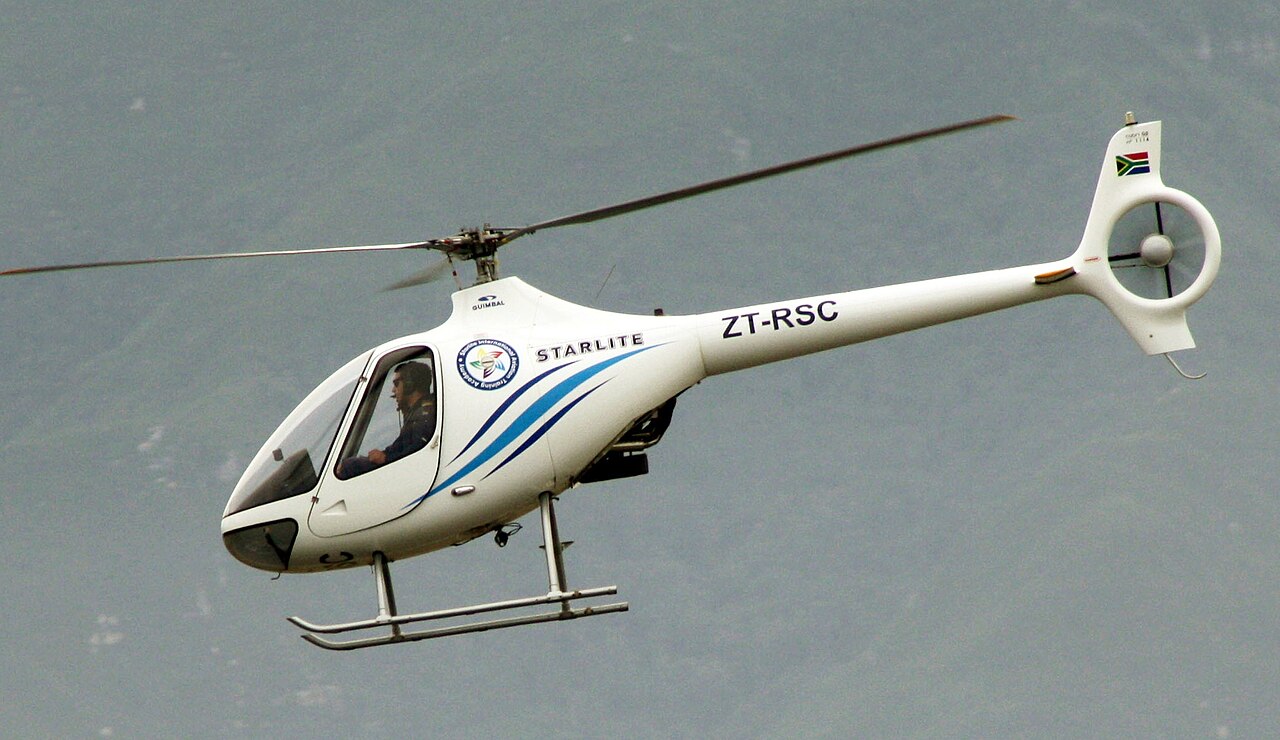
The Guimbal Cabri G2 is a two-seat, piston-engined light helicopter designed by former Eurocopter engineer Bruno Guimbal and built by Helicopteres Guimbal in Aix-en-Provence, France. Conceived from the outset to bring turbine-helicopter safety technology, such as a Fenestron tail rotor and an energy-absorbing crash-resistant structure, down into the piston training class, it has become a widely used primary trainer and personal helicopter. For a sim pilot it represents a compact, modern alternative to the Robinson R22 and R44, with a shrouded tail rotor and a glass-panel cockpit rather than conventional gauges.
The Cabri G2 is a two-seat light helicopter powered by a reciprocating engine, manufactured by Helicopteres Guimbal of France and designed by Bruno Guimbal, a former Eurocopter engineer. It occupies the light piston training and personal-use segment long dominated by Robinson types, but distinguishes itself with a Fenestron shrouded tail rotor, a fully composite fuselage and a design philosophy built around occupant protection from the outset. Introduced commercially in 2008, it has since become established as a primary helicopter trainer and personal aircraft, with around 300 built by July 2022.
Bruno Guimbal began independent development of a two-seat piston helicopter during the 1980s while working at Eurocopter on the AS365 Dauphin and EC120 Colibri programmes, intending to bring safety-related and technological advances typical of larger turbine rotorcraft, such as the Fenestron anti-torque system and Spheriflex main rotor, plus a composite fuselage, into a small reciprocating-engine machine. Eurocopter sponsored the programme from the early 1990s and provided technical assistance during testing. The first prototype, Cabri G2-01, made its maiden flight in April 1992, lasting 45 minutes, and in 1996 this aircraft set a world distance record for helicopters under 500 kg of 481.32 km. In 2000, Guimbal left Eurocopter to found Helicopteres Guimbal at Aix-en-Provence Aerodrome to certify and produce the type commercially, having originally hoped for certification in 2003. The first production-standard Cabri flew on 31 March 2005, piloted by test pilot Olivier Gensse. Following a six-year development programme and 300 hours of flight testing, the Cabri G2 received EASA type certification in December 2007, making it the first twin-seat reciprocating-engine helicopter certified in over 30 years. The French operator IXAIR received the first series-production Cabri G2 in September 2008. Production was planned to ramp up to one per month through 2009 and two per month in 2010; by 2014, 28 Cabris had been built, rising to 44 delivered in 2015 with 56 projected for 2016. The 100th aircraft was delivered on 18 May 2015, and the 200th was delivered to UK distributor HeliGroup on 19 May 2017, bringing the UK fleet to 28 aircraft, then the largest national Cabri fleet in the world. Guimbal deliberately delayed pursuing the North American market until FAA certification was secured, which was granted in February 2015; by February 2016 the type had been certified in 24 countries, and by 2022 around 300 had been built.
The Cabri G2 has a three-bladed, semi-articulated main rotor with composite blades that are damage-tolerant and have no set life span, turning clockwise when viewed from above, and a Fenestron-type shrouded tail rotor with fail-safe injected plastic blades. The fuselage is of all-composite monocoque construction, built around a main structure of autoclaved carbon fibre and epoxy honeycomb sandwich, chosen to reduce weight and maintenance while increasing strength. It uses skid landing gear, with the skids attached to the fuselage via elastomeric mounts rather than being bolted directly on, reducing ground resonance and providing greater articulation. Seating is side-by-side for a pilot and passenger, well suited to training, with removable dual flight controls and a removable left-hand passenger seat to free up cabin space. Practical features include an externally accessible 200-litre baggage compartment, power sockets in the cabin, leather seating and under-seat storage. Safety is a core design driver: the aircraft has a crash-resistant fuel cell and energy-absorbing crash-resistant seats, developed and tested for vertical impacts, and it is described as the only piston helicopter certified to EASA CS-27 and FAR 27 regulations, which apply to helicopters below 3,175 kg/7,000 lb maximum take-off weight. Certified crash testing demonstrated that occupants could survive a 2000 ft/min vertical impact, equivalent to a 5-metre free fall, said to be 8 to 15 times more protective than competitor aircraft. The cockpit uses an electronic power management (EPM) system with three monitors displaying power settings, engine and rotor speed, fuel level, flight time and sensor data, with backup systems provided in case of EPM failure. Optional equipment includes a Cristal Panel, air conditioning, bear paws, emergency pop-out floats, a cargo hook and a multifunction chin mount.
Guimbal quotes a cruise speed of 100 knots, an endurance of 4.5 hours and a payload of 270 kg for the Cabri G2. The Fenestron shrouded tail rotor has been credited with making the aircraft noticeably quieter than competing piston rotorcraft such as the Sikorsky S-300 (Schweizer 300), as well as contributing to favourable handling and manoeuvrability. The high-inertia rotor system is noted by training operators as giving students and instructors additional time to react to mistakes, an attribute valued in the primary training role.
The baseline production model is the Cabri G2 itself, offered with a range of optional equipment packages such as the Cristal Panel avionics upgrade, air conditioning, bear paws, emergency pop-out floats, a cargo hook and a multifunction chin mount, allowing configuration for training, personal or utility use. Development of unmanned variants began in 2003 through a project called Orka 1200, a vertical take-off and landing UAV for military use, developed jointly by Eurocopter and Helicopteres Guimbal. In June 2005 the two companies formed a joint venture, Vertivision, to develop, market and produce unmanned derivatives of the Cabri G2, using an advanced autopilot system derived from the Eurocopter EC725. This work fed into the Airbus Helicopters VSR700 naval UAV, powered by a 155-hp Continental CD-155, which was planned to fly as a prototype in 2018 ahead of a 2021 introduction.
The Cabri G2 is used across general aviation, personal ownership and, predominantly, flight training; around 70 percent of all Cabris sold have gone for training purposes, reflecting Bruno Guimbal's stated aim to design 'the best trainer that you can imagine'. By early 2015 the type was in service with 32 operators worldwide, with orders on the books for around 100 more aircraft. Its safety record has been affected by at least two serious accidents: a mid-air collision between a Cessna 152 and a Cabri G2 on 17 November 2017 in the UK caused four fatalities, and on 8 November 2020 two Cabri G2s from the same helicopter club collided in mid-air near Kuala Lumpur, Malaysia, with one crashing and killing two people while the other crash-landed safely. The type has since achieved widespread certification, including from EASA, the FAA, and civil aviation authorities in Australia, New Zealand, South Africa, Vietnam, China, Brazil, Canada, Chile, Malaysia, the United Kingdom, Mongolia, Israel, Argentina and Thailand.
Pilots and instructors highlight the Cabri G2's high-inertia rotor system as giving a forgiving margin for student error during training, allowing an instructor time to react before a mistake becomes serious, which underlines its design intent as a primary helicopter trainer. Its side-by-side seating, all-round cockpit visibility and electronic power management display with clear engine and rotor information are noted as reducing pilot workload compared with older piston helicopter designs. Owners and training operators value the type for its blend of modern safety features, such as the crash-resistant fuel cell and energy-absorbing seats, with genuine light-helicopter performance, making it a natural step before transitioning to turbine types.