Departure
88%
vs 95% ▼ 7
 MY FS FLIGHTS
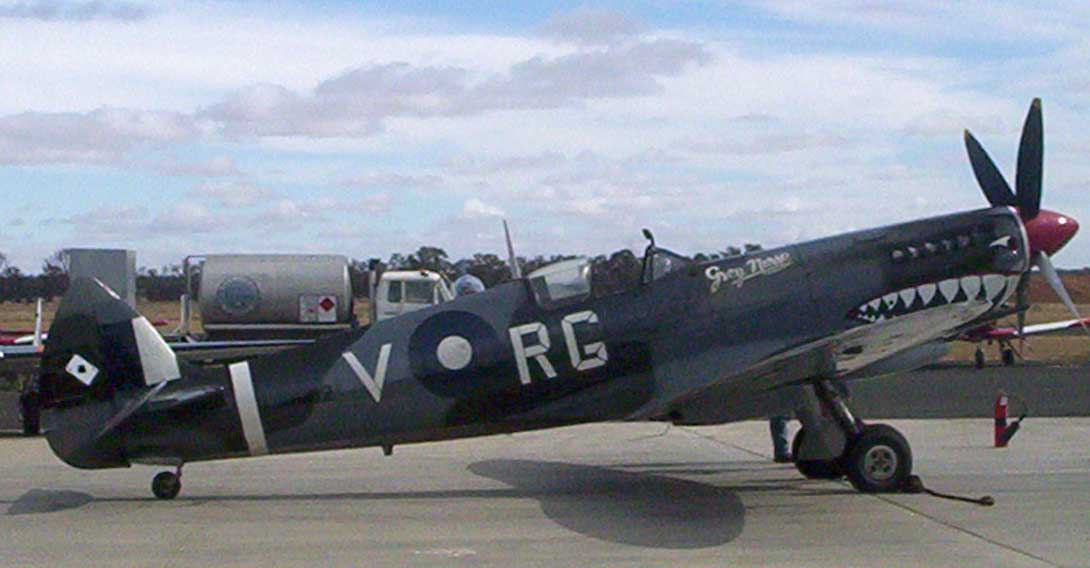
The Supermarine Spitfire Mk IX was the definitive mid-war variant of Britain's most famous fighter, rushed into service as a stopgap to counter the Focke-Wulf Fw 190 and going on to become the most numerous of all Spitfire marks. Combining the two-stage supercharged Merlin 61/63/66 engines with the existing Mk Vc airframe, it restored parity with the Luftwaffe's best fighters and served across every theatre in which the RAF operated, from Normandy to North Africa and Burma.
The Spitfire Mk IX was a single-seat, single-engine interceptor and fighter-bomber built by Supermarine, designed by R. J. Mitchell and developed under his successor Joseph Smith. It was one of the late Merlin-powered Spitfire variants, distinguished by its two-stage supercharged engine, and became the most widely produced version of the Spitfire family, serving with the Royal Air Force and a broad range of Allied air arms including the Royal Canadian Air Force, Royal Australian Air Force, Free French Air Force and the USAAF.
By mid-1942 the Spitfire Mk Vb was struggling against the newly introduced Focke-Wulf Fw 190, and Rolls-Royce engineers were already developing a version of the Merlin with a two-stage supercharger. Rather than wait for the fully redesigned Mk VIII airframe, which would take time to bring into production, Supermarine and the RAF opted for an interim solution: fitting the new Merlin 61 engine into the existing Mk Vc fuselage with as few changes as possible. The first test aircraft flew on 26 February 1942, and the results were successful enough that the type was ordered straight into full production, entering service in July 1942 with No. 64 Squadron at Hornchurch. The standard F Mk IX used the Merlin 61 and remained the only version produced until early 1943, when it was joined by aircraft powered by the Merlin 66, optimised for lower altitudes and designated LF Mk IX; production of the Merlin 61/63-powered F Mk IX ceased in late 1943 in favour of the LF Mk IX, which went on to become the most numerous Spitfire IX sub-type, with over 4,000 built. In the Mediterranean, No. 81 Squadron RAF received the first urgently needed Spitfire IXs at the end of January 1943, and by the invasion of Sicily in July the Mk VIII had begun arriving alongside growing numbers of the Mk IX. By D-Day nearly all first-line RAF Spitfire squadrons had converted to the Mk IX. In total 1,255 F Mk IXs were built before the LF Mk IX took over; overall, 284 Spitfire IXs were converted from older marks, 557 were built by Supermarine around Southampton, and a further 5,117 were produced at Castle Bromwich, with total Mk IX production cited at 5,665 or 5,739 depending on the source, making it the most numerous of all Spitfire variants alongside the closely related Mk XVI.
The Mk IX married the Rolls-Royce Merlin 61, 63 or 66 two-stage, two-speed supercharged V-12 engine to a strengthened Mk Vc-type fuselage, representing the minimum-change route to restoring performance parity with the Fw 190. Introduction of the two-stage Merlin required the radiators to be split to accommodate an intercooler radiator: the radiator under the starboard wing was halved in size, with the intercooler radiator fitted alongside it. Many Mk IXs used the new C-type 'universal wing', which had redesigned undercarriage mountings, bowed undercarriage doors that let the legs sit lower in the wells and eliminated the upper-wing blisters over the wheel wells, and undercarriage legs raked two inches further forward for greater ground stability. During production of the Mk VIII and Mk IX a new undercarriage leg with external V-shaped scissor-links was introduced, slightly altering the shape of the undercarriage bay and leg fairings. The Hispano Mk II cannon used the French Chatellerault belt-feed system with disintegrating-link belts, allowing up to 120 rounds per gun; early Mk IXs retained the large blistered gun-bay doors first seen on the Mk Vc, while later aircraft had smaller, more streamlined blisters. Armament fits varied: a typical Mk IXe carried two 20 mm cannon, one in each wing, plus two 0.50 calibre Browning machine guns, one in each wing, and could carry up to 1,000 lb of bombs, comprising two 250 lb bombs under the wings and one 500 lb bomb on a fuselage centreline rack. A representative Mk IXe example had a length of 31 ft 1 in, a wingspan of 32 ft 7 in, an empty weight of 5,634 lb and a loaded weight of 9,500 lb, powered by a single Rolls-Royce Merlin 66 producing 1,720 hp.
With the Merlin 66 rated at 1,720 hp, a representative Spitfire Mk IX (LF variant) achieved a maximum speed of 416 mph and a cruising speed of 324 mph, with a service ceiling of 42,500 ft and an initial rate of climb of 3,200 ft per minute. Range was quoted at 434 miles. Notably, a Spitfire Mk IX flown by Pilot Officer Emmanuel Galitzine set an unofficial altitude record of 51,550 ft in 1943 during high-altitude interception trials, underlining the exceptional high-altitude capability given by the two-stage supercharged Merlin. The LF Mk IX, tuned for lower altitudes with the Merlin 66 and its injection-type carburettor, resolved earlier fuel-flow problems during zero-G manoeuvres and inverted flight that had affected float-carburettor Merlins, and offered an especially strong rate of climb while retaining the handling qualities of the earlier Spitfire lineage.
The definitive early production version was the F Mk IX, powered by the Merlin 61 and later the Merlin 63, optimised for high-altitude interception; 1,255 F Mk IXs were built before production shifted to the Merlin 66-engined LF Mk IX from early 1943, tuned for low-altitude performance and eventually becoming the most numerous Spitfire IX sub-type with over 4,000 built. Armament fits varied between the B-type wing, with two 0.303 in machine guns and two 20 mm cannon, and later the E-type wing armament of two 20 mm Hispano cannon plus two 0.50 in Browning machine guns, the latter fit sometimes referred to informally as the Mk IXb or Mk IXe and standardised for 2nd Tactical Air Force fighters and fighter-bombers after D-Day. Some Mk IXs were converted from older Mk V airframes rather than built new. Two-seat trainer conversions, designated Mk IX UTI and later T Mk IX, were produced post-war by converting old Mk IX airframes with a second, raised bubble-canopy cockpit; examples of this trainer variant were supplied to the Indian Air Force, the Irish Air Corps, the Royal Netherlands Air Force and the Royal Egyptian Air Force.
The Mk IX entered RAF service in July 1942 with No. 64 Squadron at Hornchurch and quickly restored parity with the Fw 190 that the Mk V had lost. In the Mediterranean theatre, No. 81 Squadron RAF received the first Mk IXs at the end of January 1943, and the type supported the campaigns in North Africa, Sicily and Italy alongside the Mk VIII. By D-Day in June 1944, nearly all first-line RAF Spitfire squadrons in Britain had converted to the Mk IX, and from June 1944 Mk IXs of the 2nd Tactical Air Force began operating in the fighter-bomber role, carrying bomb loads under new modification standards. The type served across every theatre in which the RAF operated, including home defence, the European campaign following D-Day, the Mediterranean, North Africa and the China-Burma-India theatre, and was flown by the Royal Air Force, Royal Canadian Air Force, Royal Australian Air Force, Free French Air Force, USAAF and Soviet Air Force. One well-documented individual aircraft, MJ730, built at Castle Bromwich and test-flown by Alex Henshaw in December 1943, flew more than 100 combat missions, including defending the Anzio beachhead with No. 417 Squadron RCAF, supporting the invasion of southern France with No. 154 Squadron RAF, and later operating over the Balkans with No. 32 and No. 94 Squadrons RAF from bases in Greece; after the war it served with the re-established Italian Air Force and then the nascent Israeli Air Force before being recovered to Britain for restoration.
The Spitfire LF Mk IX is often regarded as combining the manoeuvrability of the earlier Merlin-powered Spitfire lineage with a markedly improved rate of climb, giving it a strong all-round balance between turning performance and the boom-and-zoom tactics made possible by its later engine. Its armament of two 20 mm cannon and two 0.50 in machine guns, while effective, is comparatively modest in damage output next to some contemporaries, and its single 250 lb bomb option for the fighter-bomber role is limited compared to later types. As the last of the Merlin-engined Spitfires before the switch to the Griffon-powered marks, it represents the point at which the classic Spitfire flying qualities were paired with genuinely competitive performance against the best German fighters of the period, and it remains a favourite among warbird operators and airshow performers, with aircraft such as MH434 still flying regularly in its wartime markings.