Departure
98%
vs 95% ▲ 2
 MY FS FLIGHTS
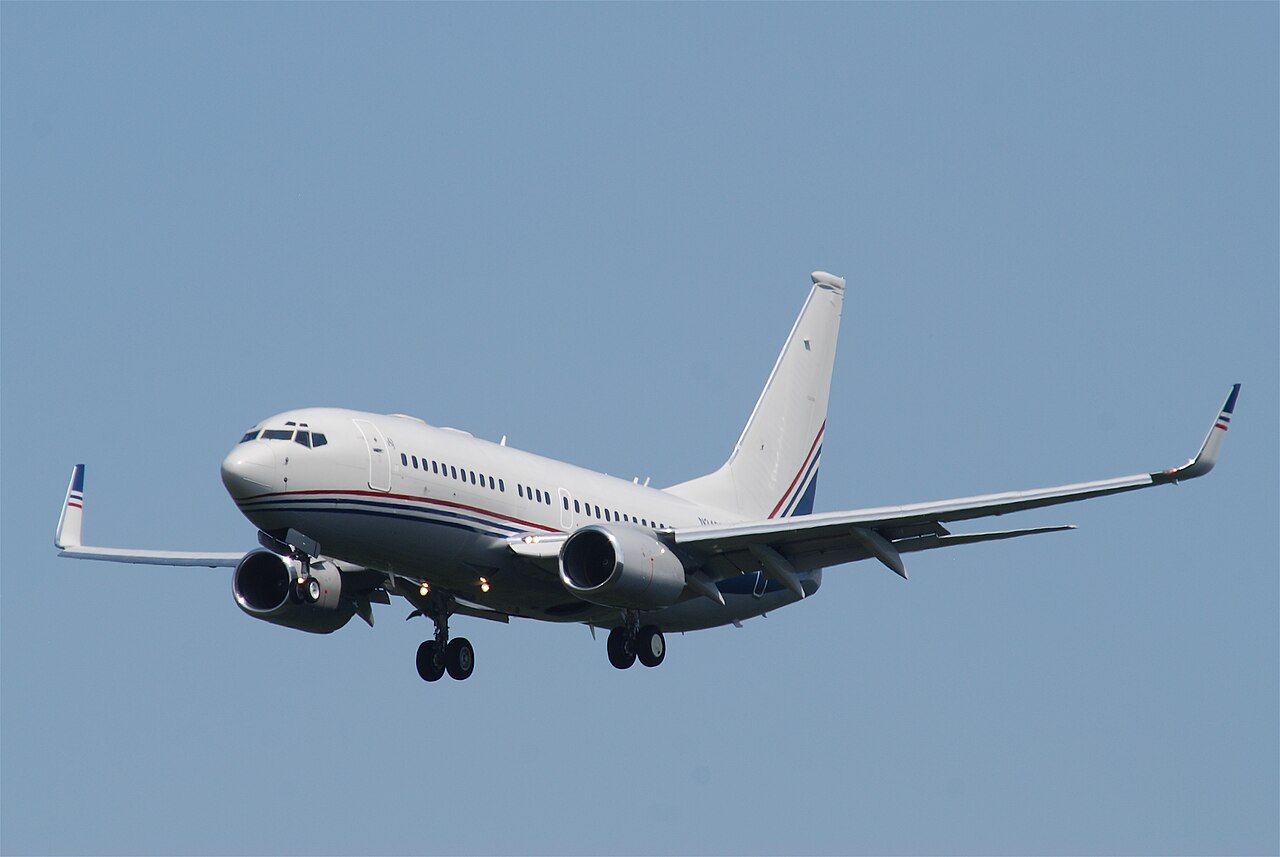
The Boeing Business Jet (BBJ) is a corporate and VIP derivative of the Boeing 737, built by Boeing Commercial Airplanes as a 50/50 partnership with General Electric and first flown in September 1998. It takes the familiar 737 airframe and re-engineers it for private, head-of-state and corporate use, offering long-range capability and a cavernous cabin compared with purpose-built business jets. For a simulator pilot it represents the executive-transport face of the world's most widely flown airliner family, combining the familiar 737 flight deck and systems with auxiliary fuel tankage and VIP cabin fit-outs.
The Boeing Business Jet is a business-jet variant of the Boeing 737 airliner, developed by Boeing Commercial Airplanes and marketed under the Boeing Business Jets brand. Rather than being a clean-sheet design, it takes a standard 737 airframe and modifies it with strengthened structure, extra fuel tankage and a VIP interior to serve the private, corporate and head-of-state transport market. The BBJ name began with a single model based on the 737-700 and grew into a full family spanning the 737 Next Generation and, later, the 737 MAX, with Boeing subsequently extending the BBJ brand to wide-body types such as the 787, 777X and 747-8.
The original BBJ was conceived in 1996 as a high-performance derivative of the Boeing 737 Next Generation, designed by Borge Boeskov at the request of Boeing president Phil Condit and General Electric chairman and CEO Jack Welch, with the programme structured as a 50/50 partnership between Boeing Commercial Airplanes and GE. The first aircraft, based on the 737-700 and later retroactively designated the BBJ1, rolled out on 26 July 1998 and made its first flight on 4 September 1998, entering service in 1999. Boeing launched the larger BBJ2, based on the 737-800, on 11 October 1999, followed in 2005 by the announcement of the even larger BBJ3, based on the 737-900ER. Across roughly two decades of production, 143 BBJs based on the 737 Next Generation entered service, nearly three times the initial forecast of 50 aircraft, with the last 737NG-based BBJ delivered in 2021. Boeing launched the BBJ 737 MAX family on 2 April 2014 as the successor to the 737NG-based BBJs, with the BBJ 737-8 making its first flight on 16 April 2018 and being delivered later that year, on 15 October 2018. The first BBJ 737-9 was delivered green on 18 August 2021. By 31 December 2021 more than 250 BBJs of all types had been built.
The original BBJ1 combined the fuselage of a 737-700 with the higher-fuel-capacity wing, landing gear and centre fuselage section of the 737-800, giving it stronger structure than a standard 737-700. It could be fitted with up to nine auxiliary belly fuel tanks to extend range beyond 6,000 nmi (11,000 km; 6,900 mi), and Aviation Partners winglets were standard, adding a further 5 percent to range. The BBJ2, based on the 737-800, is 19 ft 2 in (5.84 m) longer than the BBJ1 and offers 25 percent more cabin space and twice the baggage volume, at the cost of somewhat reduced range; the BBJ3, based on the 737-900ER, is roughly 16 ft (4.9 m) longer again than the BBJ2, with slightly shorter range than the BBJ2. The current-generation BBJ MAX family, based on the 737 MAX, features a cabin altitude reduced to 6,500 ft at maximum cruise altitude via a bizliner-specific low cabin altitude system, windows 20 percent larger than standard, and retractable airstairs stowed within the belly of the aircraft (deployable from inside or outside) that allow independent operation at remote airfields without ground equipment. All BBJ MAX aircraft come with the highest available takeoff weight certification and maximum engine thrust option, plus auxiliary fuel tanks supplied on every 737-based BBJ. Published specifications for the BBJ MAX family are: BBJ 737-7, cabin area 884 sq ft (82.1 sq m), cargo 274 cu ft (7.8 cu m), length 116 ft 8 in (35.6 m), MTOW 177,000 lb (80.3 t), max payload 32,500 lb (14.7 t), OEW 106,200 lb (48.2 t); BBJ 737-8, cabin area 1,025 sq ft (95.2 sq m), cargo 593 cu ft (16.8 cu m), length 129 ft 8 in (39.6 m), MTOW 181,200 lb (82.2 t), max payload 35,200 lb (16 t), OEW 110,200 lb (50 t); BBJ 737-9, cabin area 1,120 sq ft (104.1 sq m), cargo 775 cu ft (21.9 cu m), length 138 ft 2 in (42.1 m), MTOW 194,700 lb (88.3 t), max payload 38,800 lb (17.6 t), OEW 117,700 lb (53.4 t). All three share a span and height of 117 ft 10 in (35.9 m) by 40 ft 4 in (12.3 m) and are powered by two CFM International LEAP-1B engines, with fuel capacities of 10,103 US gal (38,244 L), 10,381 US gal (39,296 L) and 10,910 US gal (41,299 L) respectively.
The original BBJ1, with its auxiliary tankage, could achieve a range beyond 6,000 nmi (11,000 km; 6,900 mi). The BBJ MAX family extends this further: the BBJ 737-7 offers a range of 6,600 nmi (12,225 km; 7,600 mi) with 8 passengers, some 445 nmi (825 km; 512 mi) further than the original BBJ1, while the BBJ 737-8 offers 6,465 nmi (11,975 km; 7,440 mi) and the BBJ 737-9 offers 6,355 nmi (11,770 km; 7,313 mi), all under NBAA-IFR mission rules with 8 passengers. Boeing states the BBJ MAX burns 15 percent less fuel than the aircraft it replaced, thanks to the CFM LEAP-1B engines, improved aerodynamics and other systems, and that direct operating costs run to between $5,200 and $5,600 per hour, lower than many purpose-built business jets of similar size. A low-utilisation maintenance programme extends intervals between checks, with major checks required only every four years and heavy checks every twelve years.
The family began with the BBJ1, based on the 737-700 but built around the wing, landing gear and centre fuselage of the 737-800. The BBJ2 followed, based on the 737-800 and offering 25 percent more cabin space and double the baggage volume of the BBJ1, at the expense of some range. The BBJ3, based on the 737-900ER, is the largest of the 737NG-based BBJs, roughly 16 ft longer than the BBJ2 with slightly reduced range; seven BBJ3s were delivered to customers. The current BBJ MAX family replaces these with three models based on the 737 MAX: the BBJ 737-7 (BBJ MAX 7), the BBJ 737-8 (BBJ MAX 8), and the BBJ 737-9 (BBJ MAX 9), the latter being the largest of the family with a cabin floor area of 1,120 sq ft (104.1 sq m). Boeing also offers BBJ Select, a programme exclusive to the BBJ 737-7 and 737-8 that allows customers to choose from pre-designed cabin layouts and colour palettes for purchase at a fixed price, rather than commissioning a full bespoke completion. In 2023 the equipped price of the BBJ MAX 7 was $101.5 million, rising to $110.5 million for the MAX 8 and $118.5 million for the MAX 9.
The BBJ family serves private, head-of-state and corporate operators, typically configured to seat between 25 and 50 passengers in a luxury layout that can include a master bedroom, washroom facilities, a conference or dining area and a living area. Demand for the original 737NG-based BBJ far exceeded Boeing's expectations: over roughly 20 years of production, 143 aircraft entered service against an initial forecast of just 50. Used examples have traded for between $41 million and $71 million, with new aircraft historically priced from around $71 million upward, reflecting the extensive and often highly bespoke VIP completions fitted after delivery from Boeing in green condition.
Because the BBJ shares its airframe, flight deck and basic handling characteristics with the standard commercial 737 family, from the 737-700 through the 737 MAX, flying it in a simulator follows the same procedures and systems logic as any 737NG or 737 MAX cockpit, making it an accessible type for pilots already familiar with the airliner. Typical BBJ operations differ mainly in mission profile rather than technique: lighter passenger loads, auxiliary fuel tankage extending sector lengths well beyond typical airline routes, and the use of integrated, self-contained airstairs that allow operation into airfields without ground support equipment. The appeal for simulator pilots lies largely in flying the familiar 737 in a long-range, VIP-liveried role rather than in any radically different handling model.