Departure
95%
vs 95%
 MY FS FLIGHTS
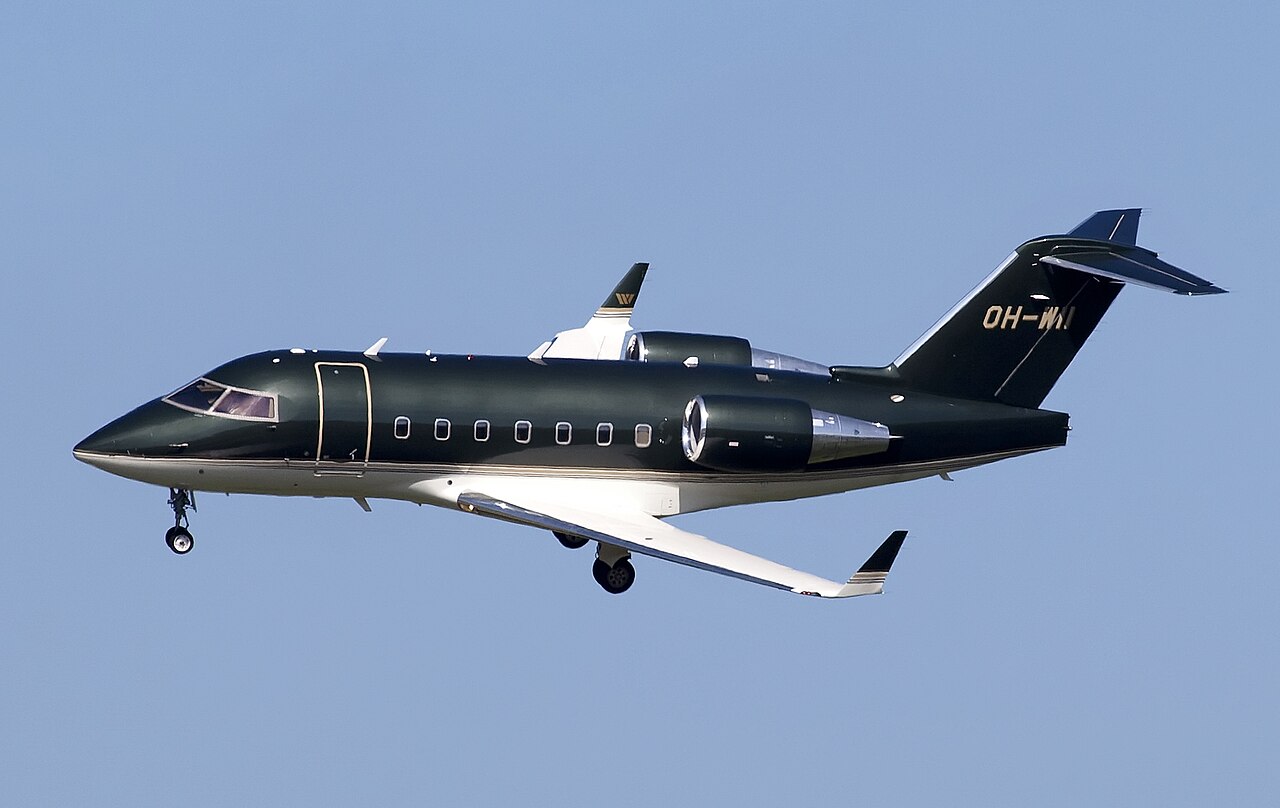
The Bombardier Challenger 600 is a large-cabin, wide-body business jet originally developed by Canadair from a concept by Learjet founder Bill Lear, entering production in 1980 as one of the first business jets to use a supercritical wing. Twin-engined and low-winged, with its turbofans mounted in aft fuselage pods and a stand-up cabin, it became the foundation for an entire Bombardier business jet and regional airliner family, including the CRJ and Global Express. For a simulator pilot it represents a classic, wide-cabin corporate jet from the analog-avionics era of business aviation.
The Challenger 600 is a twin-turbofan, large-cabin business jet originally designed and built by Canadair of Canada and later continued by Bombardier Aerospace. It is a low-wing aircraft with its two engines mounted in pods on the aft fuselage, a supercritical wing, and a wide, stand-up cabin divided into two seating sections. Described by Flight International as a miniaturised twinjet airliner in every respect, it established the wide-cabin, long-range business jet category and became the basis for further Bombardier designs, including the stretched CRJ100/200 regional airliner and the longer-range Global Express.
The type originated around 1974 as American aviation inventor Bill Lear's LearStar 600 concept, a low-wing, long-distance business jet powered by a pair of Garrett TFE731-1 geared turbofans and fitted with a supercritical wing. Lear lacked the resources to bring the aircraft to market and sought a manufacturing partner, and after weighing the concept against rivals such as the Lockheed Jetstar, Dassault Falcon 50 and Grumman Gulfstream II, Canadair agreed near the end of 1975 to back the project. Backed by financial guarantees from the Canadian federal government, Canadair formally acquired the LearStar 600 design in April 1976 and launched the programme on 29 October 1976 with firm orders and deposits for 53 aircraft. Around 2,500 employees were involved in the design work over the following two years, and more than 1,800 hours of wind tunnel testing were devoted to the supercritical wing alone. In March 1977 the aircraft was renamed the Challenger 600 as Lear's direct involvement ended, and the original conventional tail was replaced by a T-tail among other changes. The first prototype was rolled out on 25 May 1978 and made its maiden flight on 8 November 1978. The flight test programme suffered a fatal crash on 3 April 1980, but Transport Canada granted CL-600 type certification on 10 August 1980. Canadair came close to bankruptcy in 1986 and was acquired that year by Bombardier. The CL-601 variant, with new General Electric CF34 engines and winglets, first flew on 10 April 1982. The Challenger design was later stretched into the Bombardier CRJ100/200 regional airliner, introduced on 19 October 1992, and developed into the longer-range Global Express, introduced in July 1999. The 500th Challenger was rolled out in May 2000, and the 1,000th aircraft, a Challenger 650, was delivered to NetJets in December 2015. By October 2018, 1,066 Challengers had been built, with production running at a rate of two aircraft per month through that year.
The Challenger 600 is a low-wing twin-engined jet with its turbofans mounted in pods on the aft fuselage and a supercritical wing, one of the first business jets to use such a wing design. The cabin is a wide, stand-up space divided into two seating sections, with a cabin volume of 1,146 cubic feet and a typical layout of 19 passenger seats plus two crew. The aircraft carries four backup power systems, thrust reversers and an auxiliary power unit. The original CL-600 was powered by two Lycoming ALF 502 turbofans (marketed later as the Honeywell ALF502L-2C), each rated at 7,500 lb of thrust; these were replaced on the CL-601 by General Electric CF34 turbofans, which were accompanied by the addition of winglets. Weights for the original variant include a maximum ramp weight of 41,400 lb (18,776 kg), a maximum takeoff weight of 41,250 lb (18,707 kg), a maximum landing weight of 36,000 lb (16,327 kg), a maximum zero fuel weight of 28,500 lb (12,925 kg) and a standard basic operating weight of 24,150 lb (10,952 kg). Reflecting its introduction before electronic flight instrument systems became standard, the cockpit was fitted with analog electromechanical attitude and horizontal situation indicators, the Sperry SPZ-600 analog flight guidance system and SPZ-650 autopilot, an analog air data computer, Primus 400 weather radar and Collins Pro Line 1 communication, navigation and identification radios.
The Challenger 600 has a maximum cruise speed of 480 knots (458 km/h) and a long-range cruise speed of 425 knots (401 km/h). Range under NBAA IFR rules with four passengers and available fuel is 2,909 nautical miles. Takeoff distance at sea level, ISA conditions and maximum takeoff weight is 5,700 ft (1,738 m), while landing distance at sea level, ISA and maximum landing weight is 2,775 ft (846 m). Maximum operating altitude is 41,000 ft (12,497 m), and typical fuel burn is around 334 US gallons per hour.
The original CL-600 was powered by Lycoming ALF 502 turbofans. The CL-601 followed with General Electric CF34 engines replacing the Lycoming units and the addition of winglets, first flying on 10 April 1982; subsequent variants carried updated systems, avionics and higher operating weights. The family later included the Challenger 605 and 650, with the 200th Challenger 605 entering service in October 2012 and the 1,000th overall Challenger, a 650, delivered to NetJets in December 2015. The basic Challenger design was also stretched to create the Bombardier CRJ100/200 regional airliner and developed further into the longer-range Bombardier Global Express.
The Challenger 600 series has served predominantly as a corporate and privately operated business jet, with operators including large fractional-ownership fleets such as NetJets, which received the family's 1,000th aircraft in December 2015. Flight International observed that the Challenger family has given Bombardier a solid foothold in the business jet market and helped enable development of further types such as the Global Express, noting a production rate of two aircraft per month through 2018. The Challenger 605 airframe has also attracted interest for specialised roles, including a proposed Boeing maritime patrol design that would repackage some Boeing P-8 Poseidon sensor systems, though not its weapons, into the less expensive Challenger 605 airframe.
Flying the Challenger 600 in a simulator means stepping into an analog-era business jet cockpit, with electromechanical attitude and horizontal situation indicators, the Sperry SPZ-600 flight guidance system, SPZ-650 autopilot and Collins Pro Line 1 radios rather than the glass-panel displays of later Challenger models. Its twin rear-mounted turbofans and supercritical wing give it handling that has been likened to a miniaturised airliner, and its wide, stand-up cabin sets it apart from narrower contemporaries of its era, making it an interesting study for pilots curious about the transition-era of large-cabin business jets before electronic flight instrumentation became standard.