Departure
96%
vs 95% ▲ 1
 MY FS FLIGHTS
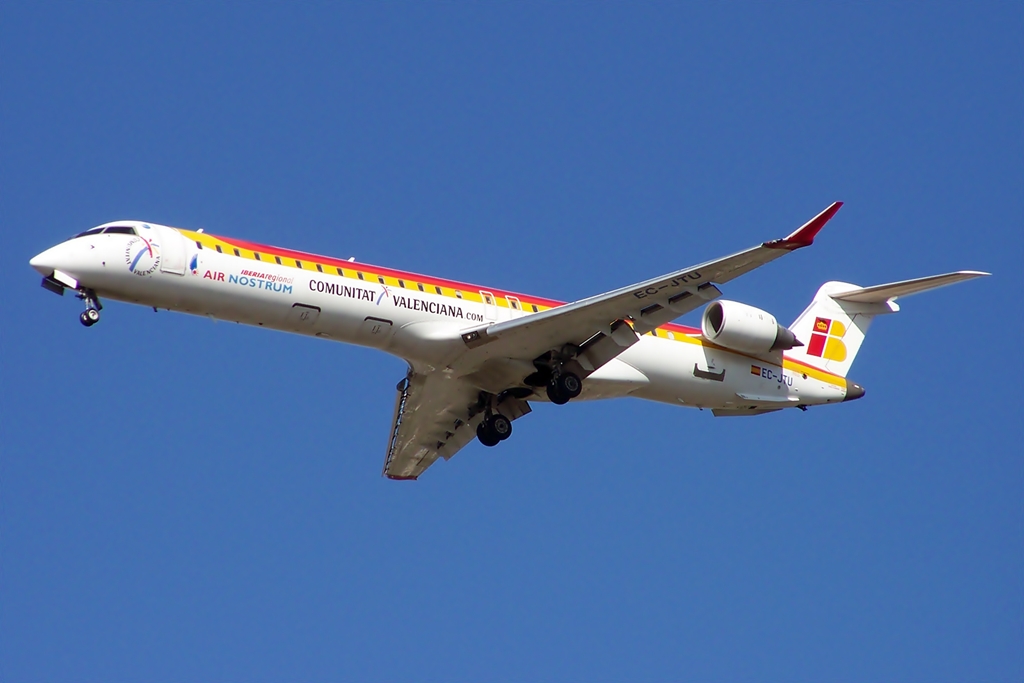
The Bombardier CRJ700ER is the extended-range version of the CRJ700 regional jet, a stretched development of the earlier CRJ200 family built to compete with the smaller Embraer E-Jets. It carries up to 78 passengers on regional routes and, through increased maximum weight and fuel capacity, offers greater range than the standard CRJ700, making it a mainstay of North American regional and feeder operations.
The CRJ700ER is a twin-engine regional jet airliner produced by Bombardier as part of the CRJ700 family, itself a further stretch of the CRJ200 fuselage, which in turn derived from the Challenger 600 business jet. Seating up to 78 passengers in a widened cabin, it was developed to allow Bombardier to compete more directly with smaller Embraer E-Jets in the regional market. The ER designation denotes an extended-range derivative achieved through an increase in maximum operating weight that allows for greater fuel capacity.
Design work on the CRJ700 began in 1995 and the programme was officially launched in January 1997, following the commercial success of Bombardier's earlier CRJ100/200 series. The aircraft introduced a new wing fitted with leading-edge slats, along with a stretched and slightly widened fuselage with a lowered floor compared with its predecessors. The type first flew on 27 May 1999, and it took around four years from initial concept to completion. BritAir became the launch customer, introducing the CRJ700 into commercial service in 2001. The CRJ700 was later superseded in production by the CRJ700 NextGen, an updated model with reduced operating costs and revised interiors.
The CRJ700ER retains the core CRJ700 airframe: a further-stretched and widened version of the CRJ200 fuselage, with a new wing featuring leading-edge slats and a lowered cabin floor to improve headroom and cabin comfort. Power comes from two General Electric CF34-8C5B1 turbofans. Fuselage length is 32.3 metres, tail height 7.6 metres and wingspan 23.2 metres. Maximum take-off weight is 75,000 lb, and the type is certified to a maximum operating speed of Mach 0.825. Cabin capacity extends to 78 passengers in a high-density configuration, with a more typical operational layout seating around 66. The ER variant's distinguishing feature is an increase in maximum weight over the baseline CRJ700, which permits additional fuel to be carried for extended-range missions.
The CRJ700ER cruises at high speed at up to 544 mph (875 km/h, 473 knots), corresponding to its maximum operating Mach number of 0.825. Published range for the CRJ700ER configuration is given as 1,378 nautical miles, reflecting the trade-off between the increased fuel load and the aircraft's payload in typical operating trim.
The core CRJ700 family includes the baseline CRJ700, the extended-range CRJ700ER described here, and the CRJ700LR long-range version, as well as the later CRJ700 NextGen with updated interiors and lower operating costs. The wider CRJ series was subsequently stretched further into the CRJ900 and CRJ900ER/LR models, and again into the CRJ1000, including a shorter-range CRJ1000 EuroLite variant aimed at European operators.
The CRJ700 family has been operated primarily on short-haul regional and feeder routes. Principal operators of the CRJ700 series have included SkyWest Airlines, Envoy Air and ExpressJet Airlines, along with Delta Air Lines, Endeavor Air, Mesa Airlines and PSA Airlines, typically flying the type on domestic regional networks feeding larger mainline hubs.
The CRJ700ER has been modelled as a study-level add-on for Prepar3D, presented through structured tutorial-style flights that walk pilots through planning, departure, cruise and arrival phases, reflecting the type's relatively complex regional-jet systems and cockpit procedures. The wider CRJ700 was also featured as one of the demonstration aircraft included with Microsoft Flight Simulator X, introducing many simmers to regional jet operations and helping cement the type's popularity as a benchmark short-haul airliner for virtual regional airline flying.