Departure
64%
vs 95% ▼ 31
 MY FS FLIGHTS
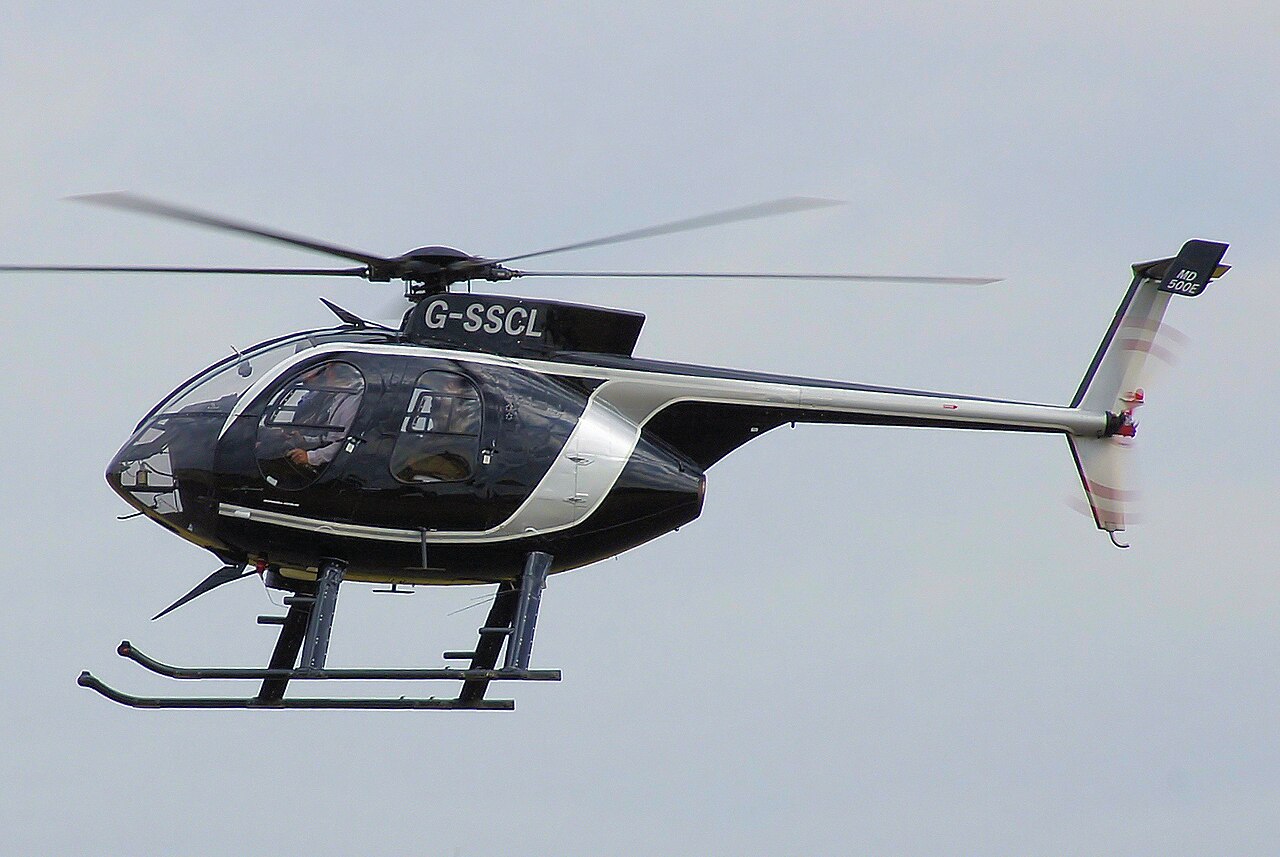
The MD500E is a light single-engine utility helicopter built by MD Helicopters, the direct descendant of the Hughes 500 series which itself grew out of the US Army's OH-6 Cayuse light observation helicopter. Distinguished by its pointed nose, five-blade main rotor and distinctive teardrop-shaped fuselage, it is prized for its agility and quick control response, making it a familiar sight in law enforcement, utility and military support roles worldwide.
The MD500E is a light utility helicopter produced by MD Helicopters, occupying the civil end of the long-running MD 500 family that traces its lineage back to the Hughes Model 369 and the US Army's OH-6 Cayuse. It seats a pilot and passengers in a compact, teardrop-shaped fuselage pod, a shape distinctive enough that the type earned the nickname the "flying egg". The 500E sits within a broader family that also includes the MD 520N, MD 530F and MD 530N, and military derivatives marketed as the MD 500 Defender.
The origins of the MD 500 series lie in the early 1960s, when the US Army issued a requirement for a Light Observation Helicopter. Hughes' Model 369 was selected over rival bids from Bell and Hiller, and first flew on 27 February 1963 under the military designation OH-6 Cayuse. Hughes had announced a civilian derivative even before that first flight, marketing it as the Hughes 500, available in basic five- and seven-seat configurations. The line was introduced to service in 1967. A more powerful utility model, the 500U, later became the 500C, and in 1976 the improved 500D became the primary production model, adding a more powerful engine, a T-tail and a new five-blade main rotor, with an optional four-blade tail rotor. The 500E superseded the 500D from 1982, introducing a pointed nose and interior improvements including greater head- and legroom. Hughes Helicopters was acquired by McDonnell Douglas in January 1984, and from August 1985 the 500E and 530F were rebranded as the MD 500E and MD 530F Lifter. Following the merger of Boeing and McDonnell Douglas, Boeing sold the former MD civil helicopter lines to the newly formed MD Helicopters in early 1999, which has continued production of the type into the twenty-first century. Across the whole MD 500 family, some 4,700 examples have been built since 1967.
The MD500E retains the shock-absorbing landing skid struts and turboshaft engine mounted at a 45-degree angle toward the rear of the cabin pod that have characterised the family since the original OH-6, along with a fuel tank cell under the floor and the battery housed in the nose. The engine exhaust port sits at the end of the cabin pod beneath the tailboom. It is fitted with a five-blade main rotor and is powered by a Rolls-Royce (Allison) 250-series turboshaft, offered as either the 420-shp 250-C20B or the 450-shp 250-C20R. Safety-related design features include energy-absorbing landing gear and seats, a crash-resistant fuel system, and a dual-hydraulic system.
The type's short-diameter main rotor and short tail give it an agile control response and make it less susceptible to weathercocking than many contemporaries, a handling trait inherited directly from the OH-6/500 lineage. The 500E's choice of the more powerful 450-shp 250-C20R engine option, alongside the standard 420-shp 250-C20B, gives operators a degree of flexibility in matching power to mission and altitude requirements.
The 500E followed the 500D in the Hughes/McDonnell Douglas lineage, introducing a pointed nose and cabin improvements over its predecessor. Its stablemate the MD 530F is a more powerful development optimised for hot-and-high operations, fitted with an enlarged main rotor and the more powerful Allison 250-C30 engine producing up to 425 hp. The MD 520N introduced the NOTAR anti-torque system in place of a conventional tail rotor, using fan-driven exhaust through slots in the tailboom together with a controllable thruster for yaw control, reducing noise and removing the exposed tail rotor blades. Military variants across the family are marketed under the MD 500 Defender name.
MD 500-series helicopters have been used extensively for utility work and have proven particularly popular with law enforcement agencies, including orders such as those placed by the Kansas City Police for MD500Es. Although predominantly a civil type, the family has occasionally seen military and even front-line combat use: the Salvadoran Air Force deployed examples during the Salvadoran Civil War, suffering several losses, and North Korea covertly acquired a fleet of MD500s for military purposes, with some allegedly configured as gunships.
For a simulator pilot, the MD500E's appeal lies in the handling traits built into the whole 500 family: the short-diameter main rotor and short tail produce a notably agile, responsive aircraft that resists weathercocking better than many light helicopters of similar size, making it well suited to precise utility and law-enforcement style flying. Its compact teardrop cabin and turbine-forward layout, inherited from the OH-6 Cayuse design, give it a distinctive feel and appearance that set it apart from more conventional light helicopters in the same class.