Departure
85%
vs 95% ▼ 10
 MY FS FLIGHTS
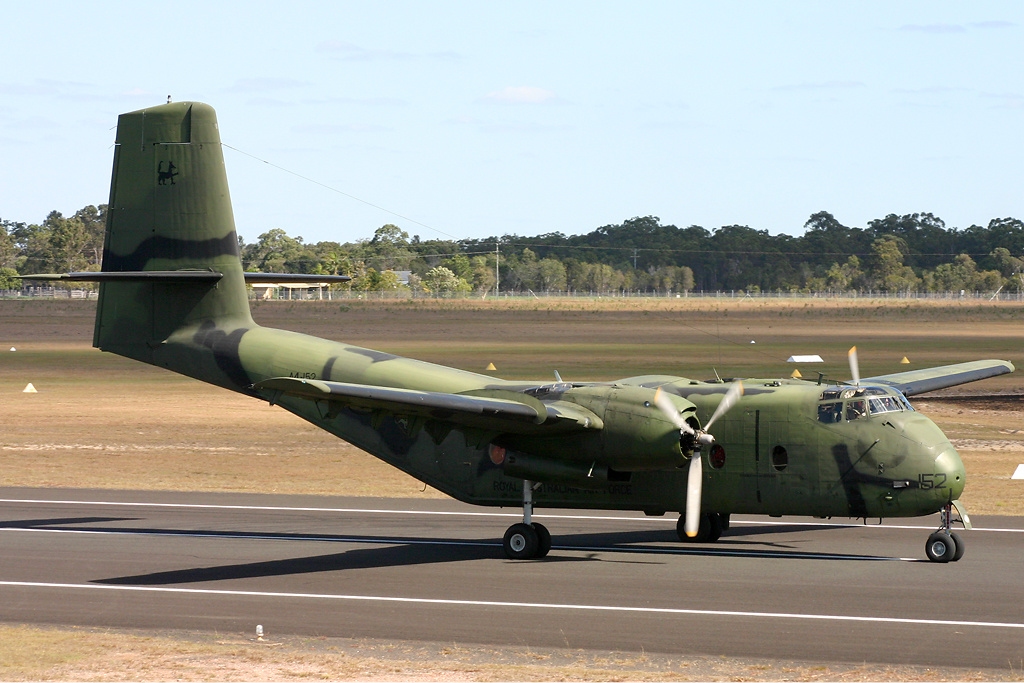
The de Havilland Canada DHC-4 Caribou is a rugged, twin piston-engine STOL tactical transport built in Canada from 1958, designed to carry troops and cargo into short, unprepared airstrips that larger transports could not use. It became the mainstay tactical airlifter of the US Army and later US Air Force during the Vietnam War, and went on to serve more than thirty air forces and a handful of civil bush operators worldwide. For a simmer it represents classic radial-engined STOL flying: big flaps, a steep approach attitude and confident short-field handling.
The DHC-4 Caribou is a Canadian-designed and built specialised cargo aircraft with short takeoff and landing capability, produced by de Havilland Canada. It was the company's third STOL design after the smaller single-engine DHC-2 Beaver and DHC-3 Otter, and the first DHC type powered by two engines. Conceived primarily as a military tactical transport, it also found a small commercial niche hauling cargo into remote airstrips, and it was later developed into the turboprop-powered DHC-5 Buffalo.
The Caribou originated in a mid-1950s United States Army requirement for a tactical airlifter able to move troops and supplies into unprepared, rugged terrain and evacuate casualties on the return leg. De Havilland Canada developed the DHC-4 with assistance from Canada's Department of Defence Production, and the prototype, registered CF-KTK-X, made its first flight on 30 July 1958; it initially featured a shorter forward fuselage, later extended ahead of the wing to meet centre-of-gravity requirements. A second prototype, CF-LAN-X, joined the flight test programme. Impressed by the type's STOL performance, the US Army ordered five for evaluation as YAC-1s before placing an initial order for 173 airframes in 1959, under the original designation AC-1. US type certification was awarded on 23 December 1960, and the aircraft entered service in 1961. De Havilland Canada built 307 Caribous in total between 1958 and 1968, the great majority for military customers, with the design later evolving into the turboprop DHC-5 Buffalo for even sharper short-field performance.
The Caribou is a high-wing monoplane with a high aspect ratio wing of polyhedral, inverted gull form, mounted forward on the fuselage and fitted with full-span, double-slotted flaps for STOL performance. Two Pratt & Whitney R-2000 Twin Wasp 14-cylinder radial piston engines, each delivering 1,450 horsepower, are carried in wing nacelles that also mount the main landing gear, and drive three-blade Hamilton Standard constant-speed, reversible-pitch propellers. The undercarriage is a retractable tricycle type with long legs suited to rough, unprepared strips. The tail is of cruciform design with a large vertical stabiliser and rudder to give low-speed yaw authority, and the fuselage has an elevated tail section and rear loading ramp that allows straight-in vehicle loading and enables in-flight drops of cargo and paratroops. Flown by a crew of two, the aircraft can carry up to 32 troops and their equipment, two Jeeps or similar light vehicles, or around 8,000 pounds of cargo.
The Caribou cruises at 182 mph, has a top speed of 215 mph and stalls at 68 mph. It offers a range of 1,300 miles, climbs at 1,355 feet per minute and has a service ceiling of 24,800 feet. Its defining performance characteristic is short-field capability, needing as little as 1,200 feet (365 metres) of runway, with ground rolls quoted as low as 1,000 feet in favourable conditions, allowing it to operate from strips that larger types such as the Fairchild C-123 Provider and Lockheed C-130 Hercules could not use.
The baseline production aircraft was the DHC-4, with the DHC-4A introduced as a version with increased takeoff weight. In US military service the type carried several designations reflecting changing service ownership: it began as the AC-1, was redesignated CV-2 Caribou in 1962, and became C-7 (with the C-7B sub-variant) when the US Army's Caribou fleet was transferred to the US Air Force in 1967. The design's STOL concept was carried forward into the turboprop-powered DHC-5 Buffalo, developed as its successor.
The United States Army was the largest single Caribou operator, purchasing 159 aircraft for use as a battlefield tactical transport during the Vietnam War, where it resupplied forward positions and evacuated casualties from airstrips inaccessible to bigger transports. Under the Johnson-McConnell agreement of 1966 the Army handed its fixed-wing Caribou fleet to the US Air Force in exchange for freedom to expand its own helicopter operations; the formal unit transfers took place on 1 January 1967 under Operation Red Leaf, when several Army aviation companies were inactivated and their aircraft passed to newly formed USAF tactical airlift squadrons. Following the Vietnam War, US Caribou passed to Air Force Reserve and Air National Guard units before retirement in the 1980s, with the last examples supporting the US Army's Golden Knights parachute team into 1985. The Royal Australian Air Force also flew the Caribou extensively in Vietnam and retired its fleet in 2009; in September 1975 an RAAF Caribou, A4-140, was commandeered on the ground at Baucau Airport in Portuguese Timor by armed supporters of the Timorese Democratic Union, who forced the crew to fly them to Darwin, after which Australian authorities briefly detained the hijackers. Other military operators included Canada, India (20 new-build aircraft plus four ex-Ghanaian machines), Malaysia, Spain, Ghana (eight new-build Caribou from 1963, replaced by Fokker F.27s in 1975), Kenya (six DHC-4As flown from 1966 to 1987) and Iran (a single aircraft, retired after the Iran-Iraq War); the Republic of Vietnam Air Force's Caribou were partly captured by North Vietnamese forces in 1975 and remained in service there into the late 1970s. On the civil side, early commercial operators included Ansett-MAL in the New Guinea highlands, Amoco Ecuador, and Air America, which used the type in covert Southeast Asian operations, and further examples entered civilian bush service after retirement from military fleets.
The DHC-4 Caribou is available for Microsoft Flight Simulator as the Local Legend VIII release, modelled from de Havilland Canada's own aircraft, priced at 14.99 dollars and supplied with seven liveries including a default scheme, camouflage finishes and colour variants. It is presented as a rugged, characterful STOL transport that responds confidently to pilot input and can be flown into and out of short, rough airstrips in keeping with its real-world reputation. The type is also modelled for X-Plane by developer X-Hangar, whose rendition has been described as a tough, dependable transport aircraft with plenty of character that rewards STOL-style flying and short-field operations for simmers of varying skill levels.