Departure
91%
vs 95% ▼ 4
 MY FS FLIGHTS
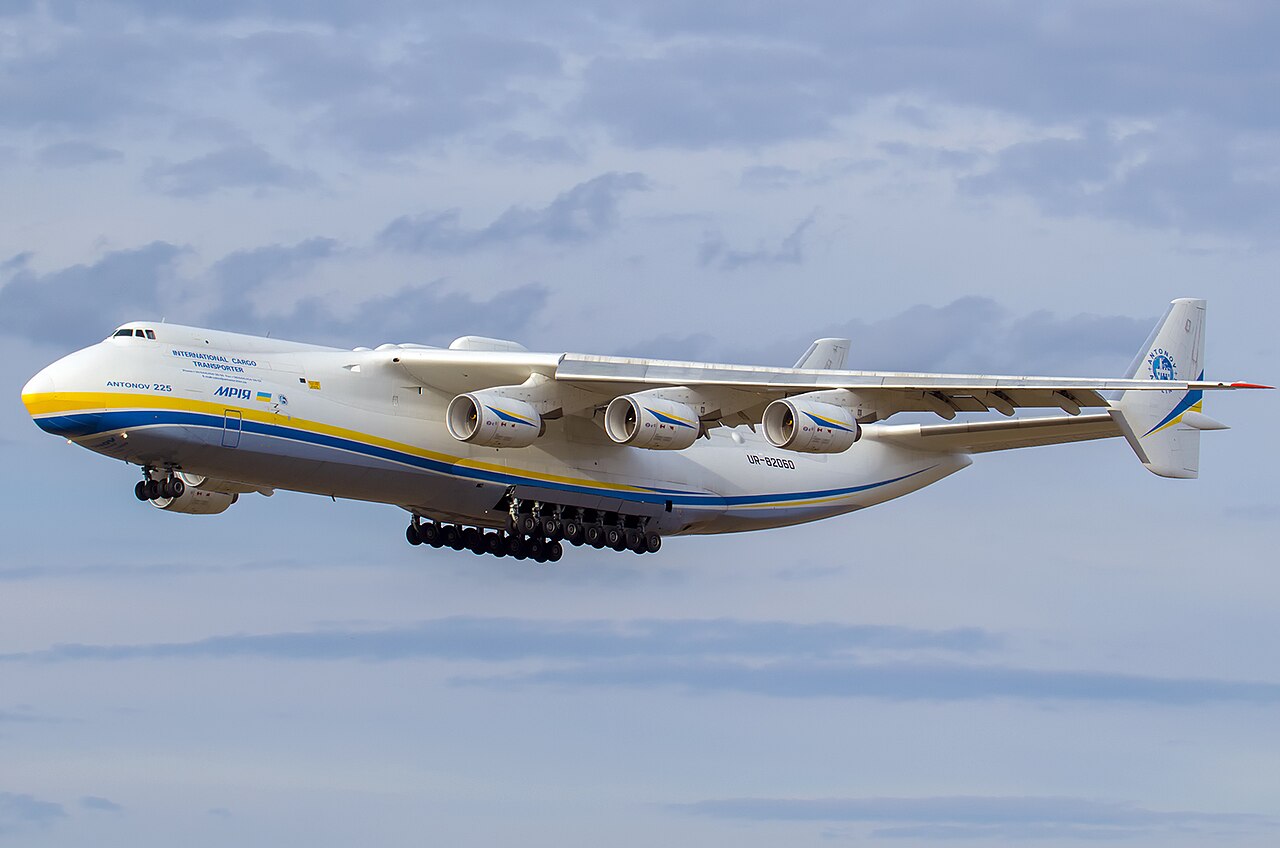
The Antonov An-225 Mriya was a six-engined Soviet-designed strategic outsize cargo aircraft, built by the Antonov Design Bureau as an enlarged derivative of the An-124 Ruslan to carry the Buran space shuttle and Energia rocket boosters. With a maximum takeoff weight of 640,000 kg it became the heaviest aircraft ever built and the largest by wingspan, later finding fame hauling record-breaking commercial cargoes before the sole completed example was destroyed in 2022 during the Russian invasion of Ukraine.
The An-225 Mriya was a Soviet-origin, Ukrainian-built strategic airlift and outsize cargo freighter designed and produced by the Antonov Design Bureau. It was a stretched, six-engined derivative of the four-engined An-124 Ruslan, conceived to carry the Buran orbiter and Energia rocket components on its back. Only one aircraft was ever completed, registered CCCP-82060 and later UR-82060, and it went on to become one of the most recognisable aircraft in the world, operated commercially by Antonov Airlines for oversized freight until its destruction in 2022.
Work on the An-225 began in 1984 at the request of the Soviet government for a large airlifter to replace the Myasishchev VM-T, tasked with carrying a maximum payload of 231,838 kg, internally or externally, from any runway of at least 3,500 metres, in order to transport the Energia rocket's boosters and Buran-class orbiters for the Soviet space programme. Formal approval came on 16 October 1986, with the development enactment issued on 20 May 1987 under the code designation '400M', later '402' or An-225. Antonov's engineers, led by Viktor Tolmachev, produced the design by stretching the An-124 airframe with additional fore and aft fuselage barrel sections, designing a new, enlarged wing centre section to accommodate two extra Progress D-18T turbofans (taking the total from four to six), and fitting a completely new twin tail to cope with the wake turbulence generated by bulky external loads. The fuselage and tail unit were assembled at the Antonov Kyiv Mechanical Works, while the wing centre section and outer wing panels were built at the Tashkent Aviation Production Association and flown to Kyiv aboard an An-22. The aircraft was rolled out on 30 November 1988 and made its maiden flight on 21 December 1988 from Svyatoshyn, flown by a crew headed by Oleksandr Galunenko. It first appeared publicly outside the Soviet Union at the 1989 Paris Air Show carrying a Buran orbiter, and performed a flying display at Farnborough in 1990. Two airframes were ordered but only one was finished; the second was partially built during the late 1980s before work was suspended after the collapse of the Soviet Union. The completed aircraft was mothballed in the early 1990s, returning to flight on 7 May 2001 after a seven-year downtime and receiving its Type Certificate on 26 May 2001 during a runway-opening ceremony at Boryspil. Renewed interest in completing the second airframe surfaced repeatedly: a September 2006 decision aimed for completion around 2008, but the work was delayed, and by August 2009 it was reported to have been abandoned at some 60-70 percent complete. In May 2011 Antonov's CEO stated that finishing the second aircraft, with a payload capacity of 250 tons, would need at least $300 million and around three years once funded; different sources again put it at 60-70 percent complete by 2016. During the early 2000s Antonov also studied an even larger eight-engined derivative, the An-325, intended for use with Russia's proposed MAKS space plane, though this did not proceed. The sole completed An-225 was destroyed on 27 February 2022 during the Battle of Antonov Airport in the Russian invasion of Ukraine, after Russian forces attacked Hostomel airport and damaged the runway, preventing its evacuation. In May 2022 President Volodymyr Zelenskyy announced intentions to complete the second airframe as a replacement and tribute to Ukrainian pilots killed in the war, and in November 2022 Antonov confirmed plans to rebuild the aircraft at an estimated cost of $500 million, potentially using components salvaged from both the destroyed aircraft and the unfinished second airframe.
Despite its unprecedented scale, the An-225's design was largely conventional, following the layout of its An-124 progenitor with a high-mounted wing, upswept rear fuselage and multi-wheel undercarriage suited to unprepared strips. It was powered by six ZMKB Progress D-18T turbofans, each rated at around 51,600 lbf (230 kN) of thrust, mounted on a purpose-designed enlarged wing centre section. A new twin-fin tail was fitted to manage the wake turbulence generated by bulky loads carried externally on top of the fuselage, which could measure up to 70 m in length. The aircraft measured 84 m in length, stood 18.2 m tall, and had a wingspan of 88.40 m with a wing area of 905.0 square metres. The cargo hold itself was reported at around 45.40 m long, 6.40 m wide and 4.40 m high, with a fuselage diameter of about 7.00 m and a cargo volume in the order of 1,200 cubic metres. Maximum takeoff weight was 640,000 kg (1,411,000 lb), and the aircraft could carry up to 250,000 kg (550,000 lb) internally or 200,000 kg (440,000 lb) mounted externally on the upper fuselage. Fuel capacity was around 242,300 litres, equivalent to roughly 193,800 kg of Jet A.
Antonov quoted a cruise speed of 800 km/h, an operational range of 15,400 km, and an operational ceiling of 9,000 m. Other published performance figures give a maximum cruise speed of around 850 km/h (459 kt), a service ceiling of 11,000 m (36,000 ft), an approach speed of about 278 km/h (150 kt), a rate of climb near 10 m/s (1,900 ft/min), a takeoff distance of about 3,500 m and a landing distance of roughly 3,300 m. These figures reflect an aircraft built to lift immense, often unbalanced external and internal loads while still being able to operate from long paved runways, with performance and handling shaped throughout by the demands of carrying oversized cargo rather than by speed or agility.
Only one An-225 was ever completed and flown. A second airframe was laid down in the late 1980s for the Soviet space programme but work stopped after the Soviet Union's collapse; at various points it was reported to be 60-70 percent complete, and its completion was repeatedly announced and postponed over the following decades without success before the war in Ukraine. Antonov also studied a further-enlarged, eight-engined derivative, the An-325, in the early 2000s for use with the proposed MAKS reusable space-launch system, but this design was never built.
The An-225 first entered service with the Soviet space programme, carrying the Buran orbiter piggy-back from Baikonur, including 13 test flights in that configuration, and appearing at the 1989 Paris Air Show with Buran mounted on its back. Following the end of Buran-related flying and a lengthy period of storage, the aircraft was returned to airworthy condition and re-entered flight in 2001, subsequently operating commercially for Antonov Airlines carrying outsize freight worldwide. Its first commercial flight, in May 1990, carried a T-800 tractor of over 110 tons from Chelyabinsk to Yakutia. Over its career it set numerous world records, including 110 world records in a single flight on 22 March 1989 while carrying 156.3 tons of cargo, 124 world and 214 national records on 11 September 2001, and six further world records in June 2004 when it carried 247 tons of cargo, four pipe-laying machines, from Prague to Tashkent. In June 2010 it transported the longest cargo item ever carried by air, two 42.1 m wind turbine blades from China to Denmark, and in September 2012 it lifted an exhibition of 500 paintings to an altitude of 10,150 m, a flight recorded in the Guinness Book of Records. In 2016 it carried a 182-ton cargo, a 155-ton electric turbine in its carrying frame, from Sao Paulo to Santiago. Typical commercial payloads included generators of some 130 tons, wind turbine blades and diesel locomotives, cargoes too large or heavy for almost any other aircraft. The sole completed aircraft was destroyed on the ground during the Battle of Antonov Airport at Hostomel in February 2022, bringing an end to its operational life.