
Departure
94%
vs 95% ▼ 1
Track every flight, analyse your performance,
and master your flying skills with My FS Flights
Get 10 flights free every month!
Tracked and analysed flights over miles
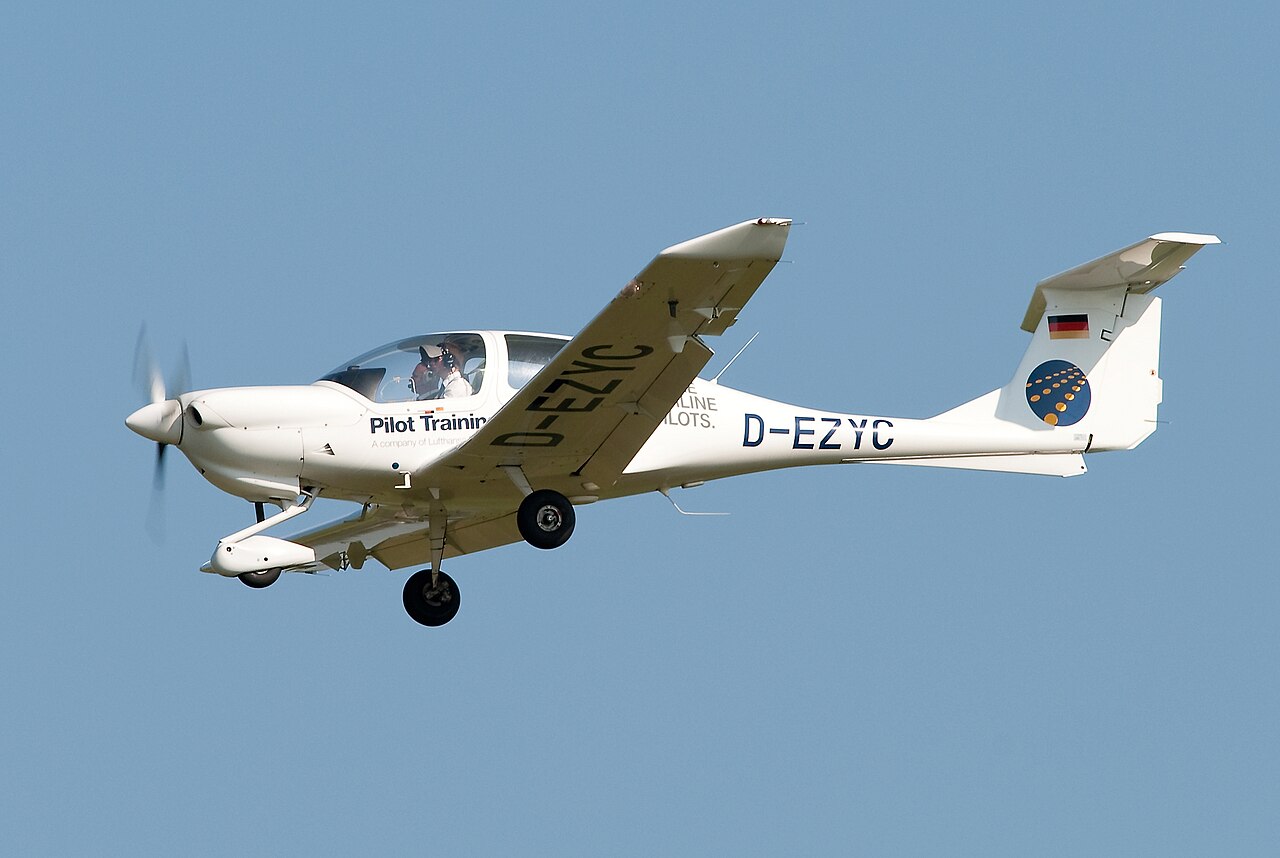
The Diamond DA40 Diamond Star is an Austrian four-seat, single-engine, low-wing light aircraft built from composite materials by Diamond Aircraft Industries, developed as a four-seat successor to the DA20. Popular with flight schools and private owners alike for its docile handling, low fuel burn and glass cockpit, it has become one of the most widely used piston trainers and touring aircraft in modern general aviation.
The DA40 Diamond Star is a four-seat, single-engine, low-wing cantilever monoplane of composite construction, built by the Austrian manufacturer Diamond Aircraft Industries with production also carried out in Canada and, for the diesel-powered variant, through a joint venture in China. It was developed as a scaled-up, four-seat derivative of the earlier two-seat DA20/DV20 Katana and has established itself as both a flight training aircraft and a practical cross-country touring machine, prized for its docile handling and modern systems.
The DA40 grew out of the success of Diamond's two-seat DV20/DA20, with the company designing a four-seat variant to broaden its appeal. The first prototype, the Rotax 914-powered DA40-V1 registered OE-VPC, made its first flight on 5 November 1997. A second prototype, DA40-V2 (OE-VPE), followed powered by a Continental IO-240, and in 1998 a third prototype, DA40-V3, flew with a Lycoming IO-360 engine. Four further test aircraft were built before the first production aircraft appeared in 2000, with JAR23 certification of the Lycoming IO-360 production variant obtained in October 2000. In 2002 production of the Lycoming-engined variant moved to Canada, while the Austrian factory concentrated on diesel-engined models; the diesel DA40D first flew on 28 November 2002. In late 2006 the XL and FP models replaced the original DA40-180, offering higher maximum cruise speeds, and in the second half of 2007 the line was updated again with the introduction of the XLS and CS versions, the FP being discontinued. The XLS became the deluxe model, bundling a Powerflow tuned exhaust, WAAS-capable Garmin G1000, GDL69 datalink and TAS traffic alert system, while the CS was offered as a lower-cost variant; both used the Lycoming IO-360-M1A engine but differed in propeller choice. Production capacity was expanded to up to 1,000 aircraft a year following European Aviation Safety Agency certification in 2008. Garmin Synthetic Vision Technology became an option on the XLS from April 2008. By December 2020, 2,200 DA40s had been delivered, including 500 of the NG model. In October 2021 Diamond announced an all-electric training variant, the eDA40, with initial flights planned for the second quarter of 2022 and EASA/FAA Part 23 certification expected in 2023; it was intended to offer roughly 90 minutes of flight endurance, a 20-minute fast charge turnaround, and operating costs some 40 percent lower than piston-engined equivalents.
The DA40 is a four-seat, low-wing, cantilever monoplane with a T-tail, fixed tricycle landing gear and an airframe built almost entirely from composite materials. Officially only three type-certificated versions exist - the DA40, DA40D and DA40F - with the many marketing names (180, XL, XLS, CS, FP, TDI, NG, XLT) representing configurations rather than distinct type certificates. The original DA40-180 was powered by a fuel-injected Textron Lycoming IO-360-M1A. The DA40-XL used the same 180 hp (130 kW) Lycoming IO-360-M1A with a constant-speed propeller, a maximum cruise speed of 147 kn (272 km/h; 169 mph) at a fuel burn of 9.2 US gallons per hour, and a maximum take-off weight of 2,535 lb (1,150 kg). The DA40-F, marketed as the FP, used a carburetted 180 hp (130 kW) Lycoming O-360-A4M with a fixed-pitch propeller and a simpler interior. The DA40-TDI used a Thielert Centurion 135 hp (101 kW) diesel engine burning diesel or jet fuel, with a constant-speed propeller and single-lever FADEC control; this diesel model was not certified in the United States. Later refinement focused on the propeller and wheel fairings: a three-blade scimitar-type constant-speed propeller was introduced, wheel spat streamlining improved, and the Powerflow exhaust carried over from the XL. The canopy was also revised with more vertical sides for extra shoulder and head room. Boarding is via the leading edge of the wing, an unusual arrangement for a low-wing type. The nosewheel is free-castoring, with directional control on the ground provided by mainwheel differential braking. Current production centres on the DA40 NG, powered by a 168 hp turbocharged Austro Engine AE300 common-rail diesel with a three-blade MT hydraulic constant-speed propeller (MTV-6-R/190-69) running on Jet A-1, Jet A, TS-1, RT or No. 3 jet fuel, and the DA40 XLT, powered by a 180 hp Lycoming IO-360-M1A on AVGAS/100LL with a choice of Hartzell two-blade metal, Hartzell two-blade composite or MT three-blade constant-speed propellers. The DA40 NG has an empty weight of 903 kg (1,991 lb), a maximum useful load of 407 kg (897 lb), a maximum take-off mass of 1,310 kg (2,888 lb) and total fuel capacity of 147 litres (39 US gallons). The DA40 XLT has an empty weight of 792 kg (1,746 lb), a maximum useful load of 408 kg (900 lb), a maximum take-off mass of 1,200 kg (2,646 lb) and a fuel capacity of 189 litres (50 US gallons). Both variants seat four. A backcountry-oriented DA40 Tundra Star has also been offered, with reinforced landing gear attachments and Beringer wheels fitted with 8.50x6 tyres, along with a forward-opening one-piece canopy and a large rear door for loading flexibility.
The DA40 NG has a maximum cruise speed of 285 km/h (154 kt) TAS at 16,000 ft on maximum cruise power, a 60 percent-power cruise speed of 230 km/h (124 kt) TAS at 14,000 ft, a landing-configuration stall speed of 107 km/h (58 kt) CAS, and a sea-level rate of climb of 3.3 m/s (651 ft/min). Its maximum range at FL160 on 50 percent power, including climb but with no reserves, is 1,730 km (934 nm), and fuel consumption at 60 percent power is 19.3 litres/hour (5.1 US gal/h). Take-off ground roll/obstacle distance at sea level is 397 m/590 m (1,302 ft/1,935 ft), landing ground roll/distance is 318 m/650 m (1,043 ft/2,132 ft), maximum operating altitude is 5,000 m (16,400 ft), and maximum demonstrated crosswind is 46 km/h (25 kt). The DA40 XLT has a maximum cruise speed at sea level of 263 km/h (142 kt) TAS on maximum cruise power, a 75 percent-power cruise speed of 254 km/h (137 kt) TAS at 6,000 ft, a landing-configuration stall speed of 96 km/h (52 kt) IAS, and a sea-level rate of climb of 4.0 m/s (780 ft/min). Its maximum range at 10,000 ft on 55 percent power in best-economy mode, with no climb allowance and no reserves, is 1,569 km (847 nm), with fuel consumption of 31 litres/hour (8.2 US gal/h) at 65 percent power. Take-off ground roll/obstacle distance at sea level is 305 m/450 m (1,000 ft/1,476 ft), landing ground roll/distance is 290 m/620 m (951 ft/2,033 ft), and maximum demonstrated crosswind is 37 km/h (20 kt). The earlier DA40-XL had a maximum cruise speed of 147 kn (272 km/h; 169 mph) burning 9.2 US gallons of Avgas per hour. The DA40 has accumulated a very low accident record, particularly regarding stall and spin accidents, with an overall and fatal accident rate that Diamond and reviewers have highlighted as an industry-leading safety feature.
Officially, only three type certificates exist: DA40, DA40D and DA40F, though the aircraft has been marketed under many names representing different engine and equipment configurations. The DA40-180 was the original Lycoming IO-360-M1A-powered version. The DA40-XL introduced a constant-speed propeller and higher cruise speed, largely thanks to a Powerflow exhaust system. The DA40-F, marketed as the FP, used a carburetted, fixed-pitch-propeller Lycoming O-360-A4M and a simpler interior. The DA40D, and later the DA40-TDI, were diesel-powered variants using Thielert Centurion engines, not certified in the United States. In 2007 the FP was dropped in favour of the XLS, a deluxe model with a WAAS-capable G1000, GDL69 datalink and TAS traffic system as standard, and the CS, a lower-cost model, both using the Lycoming IO-360-M1A but differing in propeller type. Current production models are the DA40 NG, powered by the turbocharged Austro Engine AE300 diesel running on jet fuel, and the DA40 XLT, powered by the Lycoming IO-360 on AVGAS. A backcountry-oriented DA40 Tundra Star variant has also been offered, with reinforced landing gear and larger tyres for rough-field operation. In October 2021 Diamond announced the eDA40, an all-electric training variant intended for initial flights in 2022 and certification in 2023.
The DA40 has been used extensively both as a flight training aircraft and for private touring and travel, and has been noted as a good stepping stone toward Diamond's twin-engine types given similarities in its systems. It has built a strong reputation among flight schools for reliability and low operating costs, particularly with the jet-fuel-powered NG variant, which one flight school reported gave fuel consumption reductions of around 32 percent for single-engine aircraft compared with an AVGAS-powered fleet. The type has also seen use as a military and academy trainer under other designations. Production has taken place at Diamond's factories in Wiener Neustadt, Austria, and London, Ontario, Canada, with a further joint venture established with Shandong Bin Ao Aircraft Industries in Shandong Province, China, for production of the diesel-powered TDI variant.
The DA40 is often praised for delightful handling, excellent low-speed manners and superb visibility from its wide, forward-opening canopy, qualities that make it a natural choice for both ab initio training and instrument flying practice in a simulated environment. Its glass-cockpit Garmin G1000 (and later G1000 NXi) avionics, including the optional GFC700 autopilot and Synthetic Vision Technology, make it a good platform for practising modern IFR procedures and cockpit automation. The free-castoring nosewheel and differential-braking ground steering are a notable handling quirk worth learning, since directional control on the ground is achieved through the brakes rather than nosewheel steering. Its reputation for a very low stall and spin accident rate, combined with docile stall characteristics, makes it a forgiving type for less experienced pilots to fly.