Departure
97%
vs 95% ▲ 1
 MY FS FLIGHTS
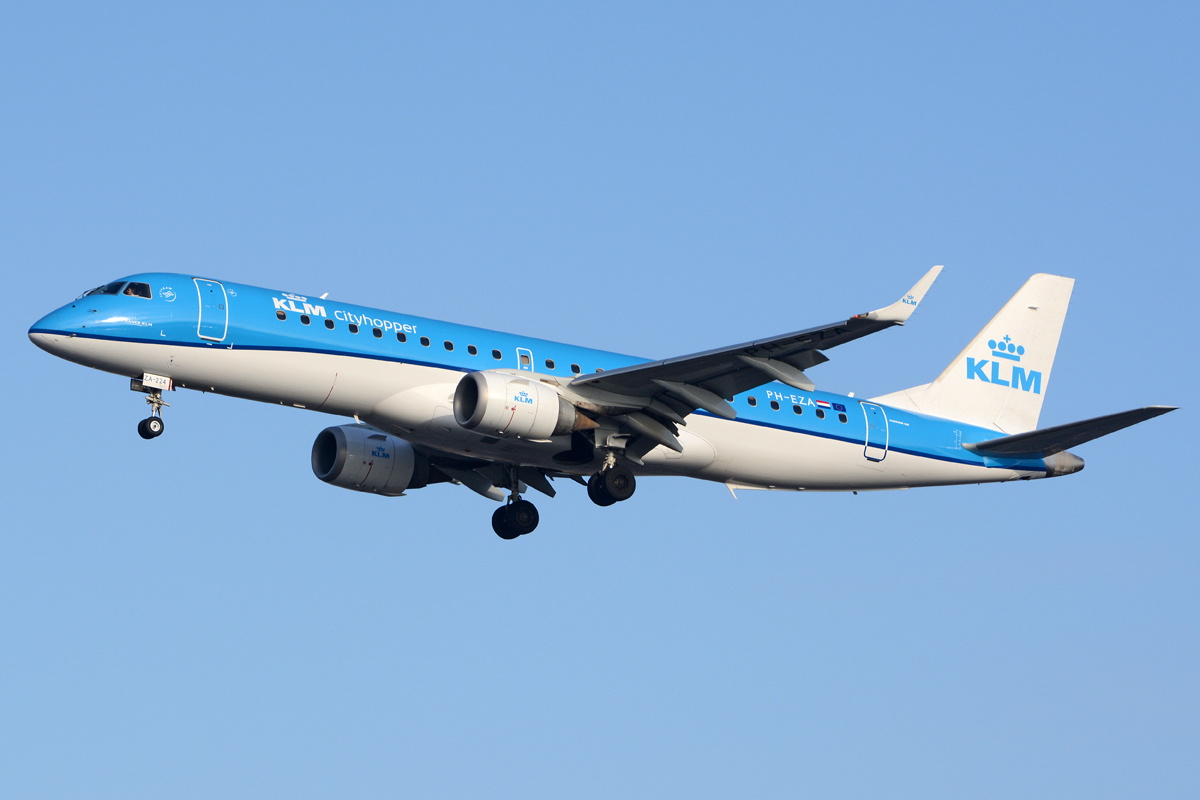
The Embraer E175 is a twin-engine regional jet airliner from Embraer's E-Jet family, seating between 76 and 88 passengers on short to mid-range routes. Developed as a stretched derivative of the smaller E170, it combines fly-by-wire flight controls and modern avionics with the size and economics that suit regional and feeder operations for mainline carriers, making it a familiar and technically interesting type for pilots moving up from turboprops or smaller regional jets.
The E175 is a narrow-body regional jet built by the Brazilian manufacturer Embraer, sitting within the original E-Jet family alongside the E170, E190 and E195. It is a twin-engine airliner seating 76 to 88 passengers, designed for short to mid-range flights and intended to bring a mainline level of cabin comfort to regional route networks. It shares a common design philosophy, systems architecture and a high degree of parts commonality with its E-Jet family relatives.
Embraer, founded in 1969 and privatised in 1994, developed the E-Jet family to succeed its earlier ERJ 135/140/145 turbojets and to capture a larger segment of the regional aviation market with a genuinely modern platform. Rather than pursue a clean-sheet design, Embraer created the E175 as a stretched derivative of the E170, adding a 1.78 metre (5.8 ft) fuselage plug to increase seating capacity while retaining the same wing, engines and cockpit. The type, designated ERJ 170-200 in regulatory documents, received FAA type certification on 31 August 2005. Embraer later developed the E175-E2, a re-engined evolution incorporating fourth-generation fly-by-wire technology as part of the broader E-Jet E2 programme.
The E175 has a wingspan of 84 ft 4 in, an overall length of 98 ft, and stands 32 ft 3 in tall. It is powered by two General Electric CF34-8E turbofans, each rated at approximately 14,200 lb of thrust. The aircraft uses the Honeywell Primus Epic integrated avionics suite together with fly-by-wire flight controls, a feature that was a first for this class of regional jet when introduced. The fuselage employs a distinctive double-bubble cross-section, giving more overhead space and two rows of overhead bins able to accommodate 22-inch bags, and the cabin windows, at around 185 square inches, are notably larger than those found on some wide-body types. Approximately 86 percent of the E175's parts are common across the wider E-Jet commercial family, simplifying maintenance for operators running mixed fleets. Pilots require a specific type rating to fly the aircraft.
The E175 has a maximum operating speed of Mach 0.82 and takes around 18 minutes to climb to cruising altitude. Embraer markets the type with a range of up to 2,450 nautical miles, giving it reach well beyond short domestic hops and into longer regional and thin mainline routes.
The original E175 is a stretched version of the E170, sharing the same wing, engines and cockpit but with a longer fuselage for greater seating capacity. Embraer subsequently introduced the E175-E2 as part of the E2 family upgrade, bringing fourth-generation fly-by-wire technology, revised aerodynamics and improved fuel efficiency while retaining the combination of capacity and range that made the original E175 successful.
The E175 was conceived specifically for regional and feeder route operations, offering airlines a way to match capacity to market demand with a flexible seating configuration while providing passengers with a cabin comfort level closer to that of mainline jets than earlier regional aircraft. Its role centres on short-to-medium range regional air travel, often operated on behalf of larger network carriers under regional flying arrangements.
The E175's fly-by-wire flight controls and Primus Epic avionics suite set it apart from older-generation regional jets, giving it handling characteristics that draw on the same computer-mediated control philosophy found in larger mainline airliners rather than the more mechanical feel of older turbojet regional types. Its brisk 18-minute climb to cruising altitude and Mach 0.82 operating speed reflect its role as a quick-climbing, efficient regional hauler, while the double-bubble cabin cross-section and family commonality with the E170/E190/E195 give it a distinct identity within the broader E-Jet range for anyone stepping between the different variants.