Departure
95%
vs 95%
 MY FS FLIGHTS
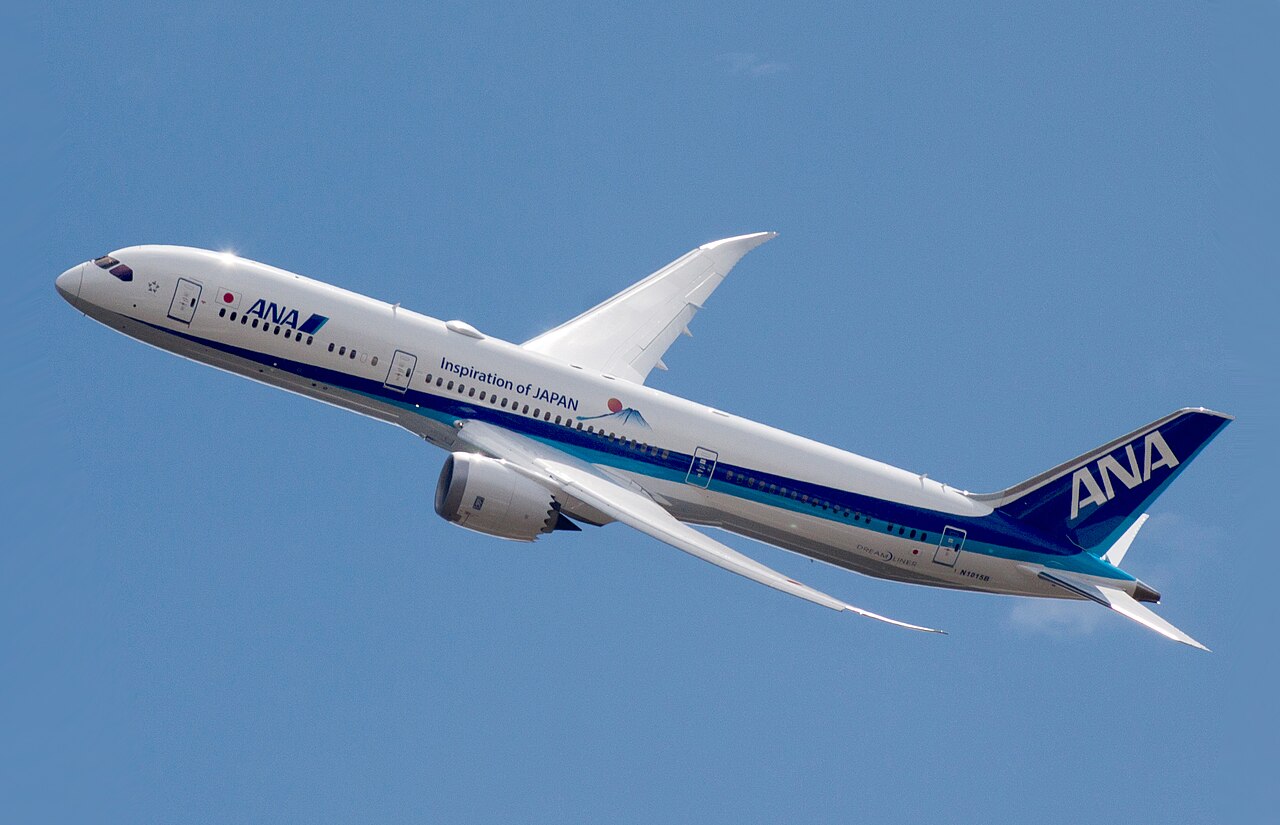
The Boeing 787-8 Dreamliner is a long-range widebody twinjet built by Boeing in the United States, the first and baseline variant of the 787 family to enter airline service. It introduced extensive composite construction, new-generation engines and a redesigned passenger environment, and for a simulator pilot it represents one of the most significant advances in airliner efficiency and technology of the early 21st century.
The Boeing 787-8 is a long-range widebody twin-engine airliner and the first member of the 787 Dreamliner family to enter service. Built by Boeing at its Everett, Washington facility, it was designed around extensive use of composite materials in the fuselage and wings, advanced avionics and improved environmental systems, marking a clear technological step from Boeing's earlier widebody jets such as the 747. Boeing received orders for over 1,000 aircraft across the three major 787 variants, of which the -8 was the pathfinder.
Flight testing of the 787-8 began in 2009, and the aircraft entered airline service in 2011 with launch customer All Nippon Airways. A second prototype was built by Boeing at Everett, Washington and delivered on 22 December 2009; it took part, alongside the other prototype airframes, in the testing and certification programme that ran from late 2009 through to 2011. The 787-8's introduction of extensive composite construction, together with new advanced engines and aerodynamic refinements in the wing shape, made it one of the most fuel-efficient and cost-effective jet airliners built up to that time.
The 787-8 has an exterior length of 187 ft 0 in (57.00 m) and a wingspan of 196 ft 10 in (60.00 m), with a fuselage diameter of 18 ft 10 in (5.75 m). The cabin measures 167 ft 4 in (51.00 m) long, 18 ft 0 in (5.49 m) wide and 8 ft 2 in (2.50 m) high, with a baggage volume of 4,828 cubic feet (136.7 cubic metres). It is powered by two turbofans, either the Rolls-Royce Trent 1000 or the General Electric GEnx, each producing in the region of 64,000 to 74,000 lbf (285 to 329 kN) of thrust. Maximum takeoff weight is given as 502,000 lb (228,000 kg), with a maximum payload of 95,500 lb (43,300 kg) and fuel capacity of 33,550 US gallons (126,900 litres, 101,500 kg of Jet A). Typical cabin layouts have accommodated up to 250 passengers in an economy-only configuration or around 210 in a mixed layout including business class, and the aircraft was fitted with Rockwell Collins next-generation avionics. Unlike later 787 variants, the -8 as specified here carries no winglets.
The 787-8 has a maximum cruise speed of around 510 knots (587 mph, 945 km/h), with typical cruise performance quoted at roughly 485 knots (900 km/h). It has a range of 8,200 nautical miles (9,440 miles, 15,190 km) and a service ceiling of 43,000 ft (13,100 m). Published takeoff distance is 5,000 ft (1,520 m) and landing distance 3,000 ft (910 m). Its combination of composite airframe, efficient engines and aerodynamic wing design allowed it to open long-haul routes that had previously been considered uneconomical for widebody equipment.
The 787-8 was the first of the 787 family to fly and enter service, and it sits alongside the shorter-fuselage 787-3, the stretched 787-9 and the further-stretched 787-10 within the wider Dreamliner range. Boeing's order book across these three major variants exceeded 1,000 aircraft.
All Nippon Airways was the launch operator of the 787-8, bringing it into service in 2011. The type has since been operated on long-haul passenger routes by a wide range of international carriers, including Japan Airlines, United Airlines, American Airlines, British Airways, Air Canada, Qatar Airways and Kenya Airways, flying services that link major hubs across Asia, Europe, Africa and North America. Its efficiency and range have made it a mainstay of medium-capacity long-haul networks, and its design approach influenced subsequent widebody aircraft development across the industry.
For a simulator pilot, the 787-8 offers the chance to fly a genuinely modern long-haul widebody, with a modern electronic flight deck, fly-by-wire handling and the kind of range and cruise performance that supports realistic ultra-long-haul route planning across continents. Its efficient, composite-based design and advanced systems make it a natural choice for pilots wanting to explore contemporary widebody operations rather than the older generation of jumbo jets.