Departure
94%
vs 95% ▼ 1
 MY FS FLIGHTS
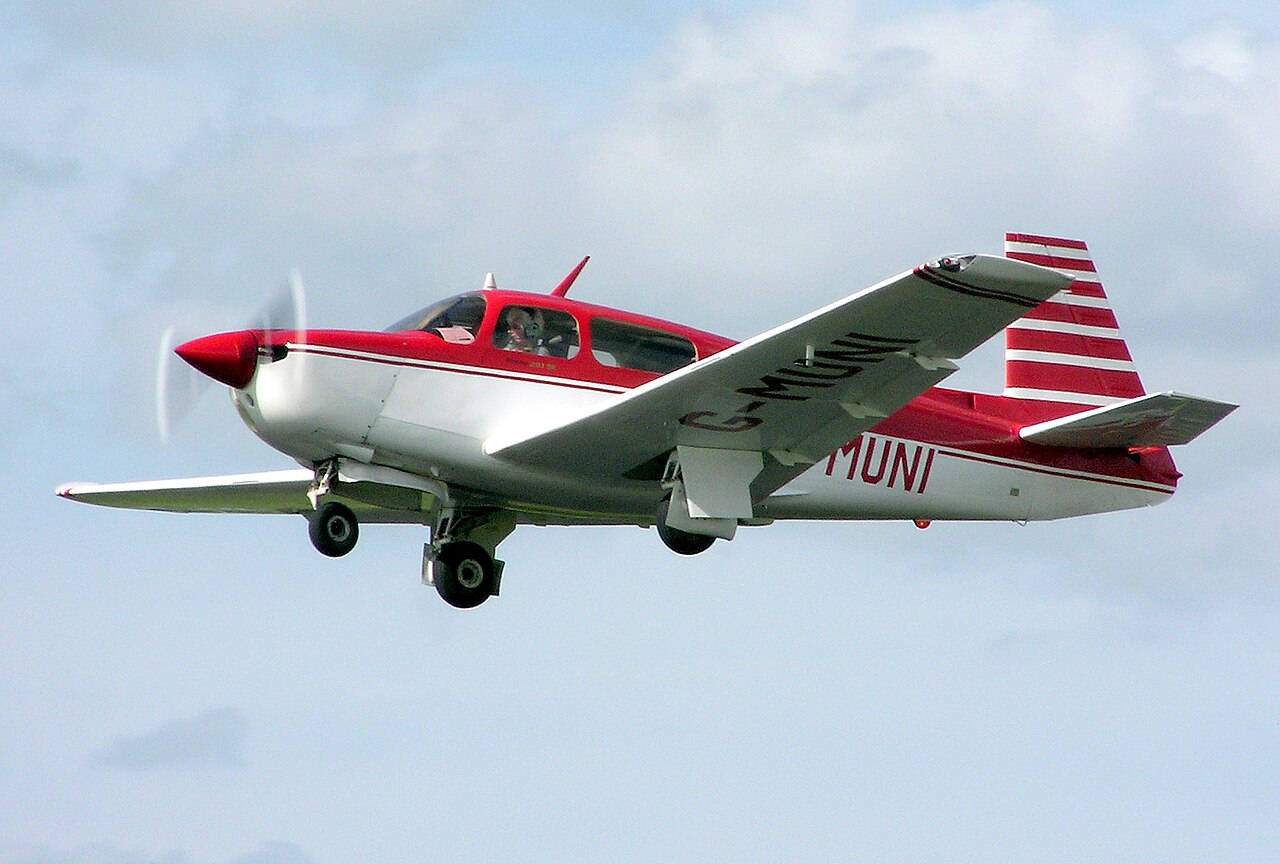
The Mooney M20R Ovation is a high-performance, four-seat, retractable-gear light aircraft built by Mooney International Corporation in Kerrville, Texas, introduced in 1994 as the naturally-aspirated flagship of the M20 family. Fitted with a fuel-injected Continental IO-550-G engine on Mooney's long-fuselage airframe, it was designed to out-run other single-engine piston aircraft while retaining Mooney's traditional efficiency, making it of particular interest to simmers who enjoy fast, systems-rich piston touring aircraft.
The M20R Ovation is a member of the long-running Mooney M20 family of low-wing, tricycle-gear, piston-single general aviation aircraft. It occupies the top of the naturally-aspirated line-up, sitting between the smaller-engined M20J/M20S models and the turbocharged M20M Bravo and later Acclaim variants. Built on Mooney's stretched, long-fuselage airframe, the Ovation was conceived as a fast, comfortable four-seat cross-country machine for the owner-pilot market.
The Ovation was introduced for the 1994 model year, developed partly in response to aftermarket modifiers who were already fitting ever-larger engines into the M20 airframe; Mooney's engineers had by this point embraced a philosophy of chasing speed through bigger engines as much as aerodynamic refinement. It was intended to bridge the gap between the naturally-aspirated M20J MSE, introduced in 1990, and the turbocharged M20M TLS/Bravo line. Only 21 examples were built in the 1994 launch year, yet the type was named Flying Magazine's Single-Engine Plane of the Year. Production rose to 46 in 1995 and slipped to 33 in 1996, the year Mooney introduced an optional TKS anti-icing system that made the Ovation the first normally aspirated single-engine aircraft to earn FAA Flight Into Known Icing certification, following the turbocharged M20M's certification the previous year. Thirty-four aircraft were produced in 1997. In 1999 Mooney rationalised its line-up around a single common airframe, dropping the M20J in favour of the M20S Eagle, which prompted a rethink of the Ovation itself; this led to the Ovation2 in 2000, fitted with a two-blade McCauley propeller developed specially for Mooney that raised the advertised true airspeed to 190 knots. The Ovation2 GX followed in 2005 with a Garmin G1000-based glass cockpit and a three-bladed Hartzell propeller, and Mooney's 11,000th aircraft delivered from the factory was a 2006 Ovation2 GX. The line was later further developed into the Ovation3, with a 310 hp IO-550-G engine and a 2,000-hour TBO, and eventually into the M20U Ovation Ultra, based on the M20R airframe, which first flew on June 4, 2016 after Mooney resumed production under new ownership.
The Ovation uses Mooney's long-fuselage, all-metal, low-wing airframe with retractable tricycle landing gear, the same stretched cabin structure first used on the M20L. Power comes from a Continental IO-550-G, a fuel-injected, air-cooled, six-cylinder horizontally-opposed engine rated at 280 hp, driving either a three-bladed Hartzell propeller on early Ovations or, from the Ovation2 onward, a two-blade McCauley propeller developed specifically for Mooney. The electrical system is built around two batteries housed in the tailcone; pilots select whichever battery shows the higher voltage, while the unused battery is kept charged via a trickle-charge circuit, with a 100-ampere, 28-volt DC engine-driven alternator supplying the aircraft's electrical needs once the engine is running. An optional TKS weeping-wing anti-icing system was available, which secured the type's Flight Into Known Icing approval. Later Ovation2 GX aircraft were equipped with a Garmin G1000 integrated glass cockpit in place of the earlier analogue panel.
Early Ovations were advertised with true airspeeds in the mid-180-knot range, a figure that made the type seldom overtaken by any single-engine piston aircraft other than another Mooney. The introduction of the McCauley propeller on the Ovation2 in 2000 raised the factory book true airspeed to 190 knots. The combination of the Continental IO-550-G's power with Mooney's efficient, long-fuselage airframe gave the Ovation a reputation as a comfortable, quick cross-country tourer rather than an outright sports machine.
The original M20R Ovation was produced from 1994. The Ovation2, introduced in 2000, featured a redesigned two-blade McCauley propeller that improved cruise speed to a book figure of 190 knots. The Ovation2 GX, released in 2005 alongside the contemporary Ovation2 DX, added a Garmin G1000 glass cockpit and reverted to a three-bladed Hartzell propeller; 64 were built that year. The line was subsequently developed into the higher-powered Ovation3, fitted with a 310 hp IO-550-G engine and a 2,000-hour TBO. Mooney also offered turbocharged derivatives of the same 280 hp Ovation2 GX airframe as the Acclaim and Acclaim S. The M20U Ovation Ultra, based on the M20R airframe, followed in 2016 after Mooney's production resumed under new Chinese ownership.
The Ovation was aimed squarely at private and business owner-pilots seeking a fast, efficient four-seat piston tourer, and it quickly became the best-selling model in Mooney's post-1994 line-up, outselling other contemporary production variants by roughly two to one. Its Flying Magazine Single-Engine Plane of the Year award in its debut year, and its subsequent Flight Into Known Icing certification with the optional TKS system, reinforced its reputation as a serious cross-country traveller capable of extending its utility into marginal weather conditions not normally open to a normally aspirated single.
For a simulator pilot, the Ovation offers a fast, well-equipped, retractable-gear piston single that rewards attention to systems management as much as stick-and-rudder flying: the dual-battery electrical arrangement with its trickle-charge backup, the substantial 100-amp alternator, and the optional TKS anti-icing system all add a layer of real-world systems depth beyond a simple fixed-gear trainer. Later Ovation2 GX-standard panels, built around the Garmin G1000, give a modern glass-cockpit workflow, while earlier Ovations with analogue instruments and a Hartzell or McCauley propeller reflect the type's transitional place between Mooney's classic short-body singles and its later high-speed, glass-panel models. The type's reputation for outrunning most other naturally aspirated singles makes it a natural choice for pilots wanting a quick, efficient point-to-point tourer in the simulator.