Departure
89%
vs 95% ▼ 6
 MY FS FLIGHTS
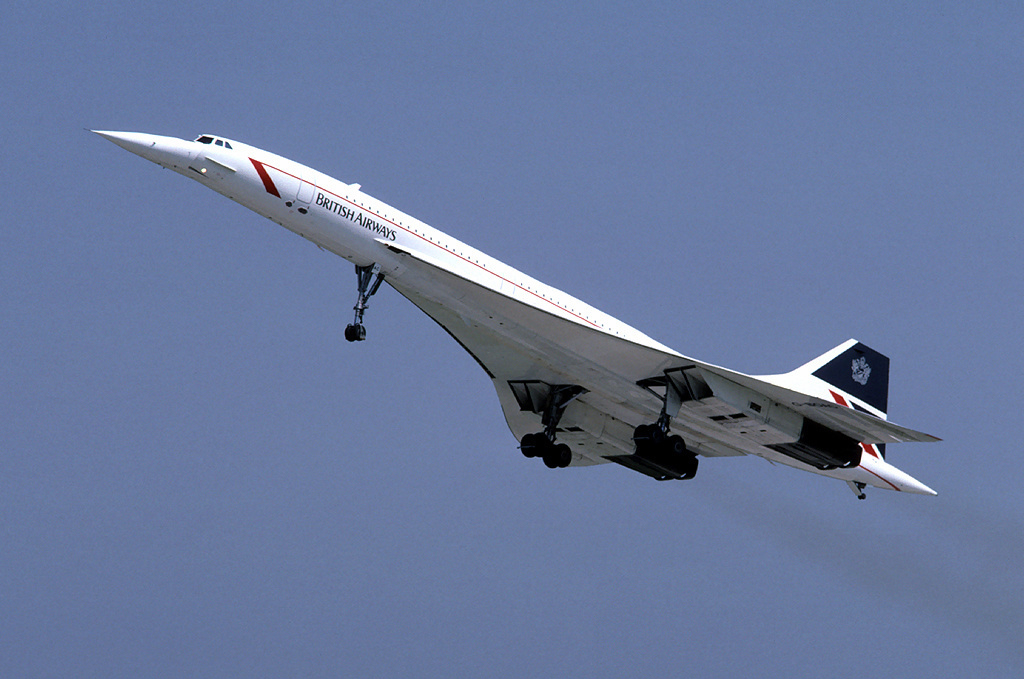
Concorde was the Anglo-French supersonic airliner developed jointly by the British Aircraft Corporation and Sud Aviation, the only such aircraft to enter sustained commercial service. Flown solely by British Airways and Air France between 1976 and 2003, it cruised at twice the speed of sound and cut the London-New York crossing to well under half the time of a conventional jet. For a simulator pilot it remains one of the most technically distinctive airliners ever built, combining a slender delta wing, reheat-boosted turbojets and pioneering fly-by-wire controls.
Concorde was a narrow-bodied supersonic airliner jointly developed and manufactured by Sud Aviation (later Aerospatiale) of France and the British Aircraft Corporation (later British Aerospace) of the United Kingdom. It carried between 92 and 128 passengers four-abreast and was distinguished by its ogival delta wing, a hinged droop nose for landing visibility, and four Rolls-Royce/Snecma Olympus 593 turbojets fitted with reheat. It was the first airliner to be fitted with analogue fly-by-wire flight controls and offered true transatlantic range while supercruising at twice the speed of sound for the majority of its route. Only twenty were built, and it was flown commercially exclusively by British Airways and Air France, remaining the only supersonic airliner to achieve sustained passenger service.
The origins of Concorde lie in early-1950s British studies into supersonic transport, when Royal Aircraft Establishment director Arnold Hall asked Morien Morgan to form a committee that first reported in April 1955. Early baseline designs, influenced by short-span trapezoidal wings seen on contemporary missiles and interceptors, were judged infeasible because such wings produced too little low-speed lift, demanding excessive engine power and impractically large aircraft. The breakthrough came from RAE researchers Johanna Weber and Dietrich Kuchemann, who published work on the slender delta planform, showing that extending a delta wing far along the fuselage generated strong vortex lift at high angles of attack, giving workable take-off and landing performance while retaining good supersonic characteristics. Test pilot Eric Brown recalled that when Kuchemann presented this idea to Morgan, Morgan seized on it immediately as the solution to the SST problem, a moment Brown regards as the birth of the Concorde project. British and French aerospace companies began formal collaboration on supersonic transport studies in 1956, and a UK-France treaty covering the shared costs and risks of the project was signed on 29 November 1962, with the programme then estimated at around £70 million. French President Charles de Gaulle named the aircraft Concorde in a 1963 speech. Construction of six prototype and pre-production aircraft began in February 1965. The French-built prototype 001 made the first flight from Toulouse on 2 March 1969, followed about a month later by the British-built 002 from Filton, England. Development costs spiralled to more than six times original projections, reaching £1.5-2.1 billion by 1976, with a unit cost of around £23 million in 1977. Concorde received its French certificate of airworthiness on 9 October 1975 and was certified by the UK Civil Aviation Authority on 5 December 1975. It entered commercial service on 21 January 1976, with Air France flying from Paris-Roissy and British Airways from London Heathrow. Manufacturers had originally forecast a market of 350 aircraft and received options for up to 100 from major airlines, but in the end only Air France and British Airways took delivery, with seven airframes each, for a total production run of 20 aircraft built between 1965 and 1979.
Concorde used a narrow fuselage of aluminium construction permitting four-abreast seating for between 92 and 128 passengers, mated to a slender ogival delta wing that generated vortex lift at high angles of attack during take-off and landing, removing the need for the complex and heavy flaps and slats fitted to conventional airliners. A hinged, drooping nose section could be lowered to give the crew adequate forward visibility during the nose-high attitudes required at low speed. It was the first airliner fitted with analogue fly-by-wire flight controls. Power came from four Rolls-Royce/Snecma Olympus 593 turbojets with variable engine intake ramps and reheat, used for take-off and for accelerating through to supersonic speed; it was the only turbojet with reheat used in commercial airliner service. A preserved production airframe, British Airways' G-BOAG, had a wingspan of 83.83 ft, a length of 204 ft, a height of 37 ft and a wing area of 3,856 sq ft, with an empty weight of 173,500 lb and a gross weight of 408,000 lb. Its four Rolls-Royce/Snecma Olympus 593 Mk 610 turbojets each produced 38,050 lb of thrust. The flight crew numbered nine.
Concorde cruised at more than twice the speed of sound, with published cruise speeds around 1,354 mph and altitudes reported between 55,000 and 60,000 ft, high enough for passengers to perceive the curvature of the earth. Range for the preserved production aircraft G-BOAG is given as 4,090 miles. Supersonic cruise was maintained for roughly 75 percent of a typical transatlantic sector. The aircraft could cross the Atlantic in under four hours, and on some routes in under three hours, roughly half the time of a conventional subsonic jetliner. Its sonic boom, however, meant supersonic flight was only practical over water; overland supersonic operation, including over the United States, was prevented by environmental objections, confining Concorde's high-speed capability to purely transoceanic sectors. On its final delivery flight to the Museum of Flight in Seattle on 5 November 2003, G-BOAG set a New York-to-Seattle speed record of 3 hours 55 minutes 2 seconds, including 1 hour 34 minutes 4 seconds flown supersonically over northern Canada.
Concorde was built as six prototype and pre-production aircraft followed by fourteen production airframes, twenty in total constructed between 1965 and 1979. The first prototype, 001, was French-built and flew from Toulouse on 2 March 1969; the second, 002, was British-built and first flew from Filton about a month later. Production deliveries were split evenly between the two launch customers, with seven aircraft each going to Air France and British Airways. Later production aircraft, such as British Airways' G-BOAG, were fitted with the Olympus 593 Mk 610 version of the engine, each rated at 38,050 lb of thrust.
Concorde entered commercial service on 21 January 1976, with Air France flying from Paris-Roissy and British Airways from London Heathrow. Transatlantic services formed the core of its operations: flights to Washington Dulles began on 24 May 1976, followed by New York JFK from 17 October 1977. Air France and British Airways remained the type's only commercial operators throughout its career. Its sole competitor in service was the Soviet Tupolev Tu-144, which carried passengers from November 1977 until a fatal crash in May 1978 ended its passenger operations; a rival American programme, the Boeing 2707, was cancelled in 1971 before any prototype was completed. On 25 July 2000, Air France Flight 4590 crashed shortly after take-off from Paris, killing all 109 occupants and four people on the ground; it was the only fatal accident in Concorde's history and led to the suspension of commercial service until November 2001. Rising operating costs and falling demand following the accident led both airlines to retire their fleets in 2003, 27 years after commercial operations had begun; British Airways' last commercial flight, from New York to London, operated on 24 October 2003, with the final delivery flight to Filton occurring on 26 November 2003. Eighteen of the twenty aircraft built survive and are preserved in museums across Europe and North America; one was destroyed in the 2000 accident and one was scrapped.
For a simulator pilot, Concorde's appeal lies in the sheer distinctiveness of its handling model: a slender ogival delta wing that relies on vortex lift rather than flaps or slats, demanding a pronounced nose-high attitude on approach and departure, with the drooping nose lowered to preserve forward visibility during those phases. Its four reheated Olympus turbojets give a dramatic take-off roll and acceleration through the transonic regime, followed by a sustained climb and cruise at altitudes and Mach numbers far beyond those of any conventional airliner, offering a supersonic transatlantic profile unlike anything else in commercial aviation. As the first airliner built with analogue fly-by-wire controls, it also represents an important step in the evolution of airliner flight control systems, adding a further layer of interest for pilots studying its systems and procedures alongside its unique aerodynamic behaviour.