Departure
95%
vs 95% ▼ 1
 MY FS FLIGHTS
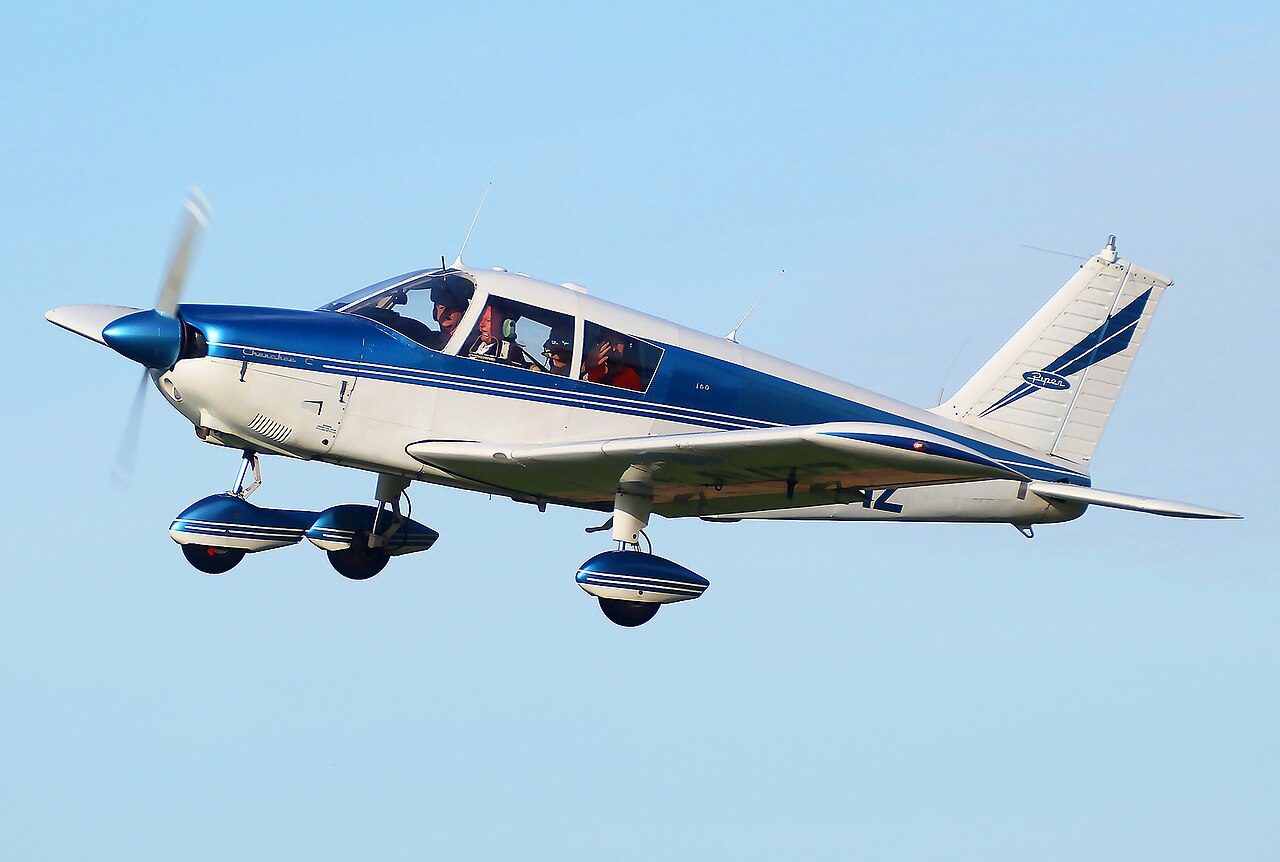
The Piper PA-28 Archer is a four-seat, single-engine, low-wing light aircraft built by Piper Aircraft, and is one of the principal derivatives of the long-running PA-28 Cherokee family. Powered by a 180-horsepower Lycoming engine driving a fixed-pitch propeller, it is prized by flight schools and private owners alike for its simplicity, predictability and low operating costs, and remains one of the most widely used trainers in the world.
The Archer, designated PA-28-181, is an all-metal, unpressurised, single-engine light aircraft with a low-mounted wing and fixed tricycle landing gear, entered through a single door on the right side reached by stepping onto the wing. It sits within the vast Piper PA-28 Cherokee family, which also includes the Warrior, Arrow, Dakota and Cherokee Six derivatives, and was conceived as a lower-cost, easier-to-fly rival to the Cessna 172. Today it serves primarily as a four-seat trainer and personal touring aircraft, and remains in production as the Archer TX and LX alongside diesel-powered DX and DLX variants.
The PA-28 line was designed by Karl Bergey, Fred Weick and John Thorp as a less expensive, simpler alternative to Piper's PA-24 Comanche, aimed squarely at the training and personal-aircraft market then dominated by the Cessna 172. The type first flew on 14 January 1960 and received its FAA type certificate that year, with production of the original Cherokee 150 and 160 beginning in 1961. In 1962 Piper introduced the Cherokee 180 with a 180 hp Lycoming O-360 engine, a model that proved practical for flying with all four seats occupied and remained popular on the used market. The cockpit was modernised in 1968 with quadrant throttle controls and a third cabin window per side. The Archer itself appeared in 1974 as a rebranded, updated version of the Cherokee 180, and in 1976 the Archer II introduced a tapered wing that improved aerodynamics and fuel efficiency; a similar semi-tapered wing and longer stabilator later featured on other PA-28 variants such as the Arrow III. The Archer III followed in 1994 with a redesigned cowling and updated avionics. Piper discontinued the Archer in 2009 but, following investment from new ownership, returned it to production in 2010, and by the mid-2020s the range included the Archer TX and LX along with diesel DX and DLX models and the simplified Pilot 100i trainer. In Argentina, Chincul SACAIFI produced PA-28 variants including the Cherokee Archer under license, building 960 airframes between 1972 and 1995.
The Archer is of all-metal monocoque construction with a low-mounted, semi-tapered wing, fixed tricycle undercarriage, and a single entry door on the right side accessed via the wing walkway. It is fitted with a Lycoming O-360-A4M or IO-360-B4A engine of 180 hp, driving a fixed-pitch two-blade propeller of 74 inches diameter. Flight controls use a traditional cable-and-pulley system, and flaps are operated by a manually-actuated Johnson bar rather than an electric switch. The aircraft is 24 ft long, has a wingspan of 35 ft 6 in, stands 7 ft 3 in high, and has a wing area of 160 square feet. Standard equipped weight is around 1,688 lb, useful load is approximately 870 lb, and maximum takeoff weight is 2,550 lb. Fuel capacity is 48 US gallons. Later production Archer TX and LX models are equipped with the Garmin G1000 or G1000 NXi glass cockpit avionics suite and a GFC700 dual-axis autopilot, while earlier and some training examples retain traditional six-pack instrumentation.
The Archer cruises at up to 128 KIAS and stalls (VSO) at 45 KIAS. Rate of climb is around 667 ft/min, and service ceiling is approximately 14,100 ft. Minimum takeoff ground roll is about 1,135 ft, extending to roughly 1,608 ft to clear 50 ft, while minimum landing distance is around 1,400 ft. Maximum range is quoted at 522 nm with a 45-minute reserve, extendable to around 795 miles (1,280 km) with long-range tanks, at an average fuel burn of about 10.5 US gallons per hour. The aircraft is generally described as stable, predictable and forgiving in its handling, characteristics that have long made it well suited to both initial flight training and cross-country touring.
The Archer began life in 1974 as a rebrand of the Cherokee 180, itself powered by the 180 hp Lycoming O-360. The Archer II, introduced in 1976, added a tapered wing for improved aerodynamic efficiency and updated cabin comfort. The Archer III, launched in 1994, brought a redesigned cowling, further aerodynamic refinement and updated avionics. In the 2010s Piper introduced the current Archer TX, aimed at flight training with rugged, simplified systems, and the Archer LX, oriented toward personal and business flying with additional comfort features; both are fitted with Garmin G1000 NXi avionics. Diesel-powered Archer DX and DLX variants have also been developed, and the related Pilot 100 and 100i, unveiled in 2019, are simplified, cost-reduced trainer derivatives sharing the Archer's basic airframe. The Archer sits within the broader PA-28 Cherokee family, which also encompasses the Warrior, Arrow (with retractable gear and constant-speed propeller), Dakota, and the stretched six-seat PA-32 Cherokee Six line, of which more than 32,000 airframes have been produced in total.
The Archer and its PA-28 relatives have been mainstays of flight training worldwide for decades, used by major flight academies and universities as a primary trainer for both traditional and glass-cockpit instruction. Beyond training, the type is widely flown by private owners and flying clubs for personal transport and touring, valued for its simple systems and low running costs. Some air forces, including those of Argentina, Chile, Qatar and Honduras, have operated PA-28 family aircraft for various support and training roles. The type's service history includes the 1986 mid-air collision between Aeromexico Flight 498 and a privately owned Piper PA-28-181 Archer over Cerritos, California, an accident that led to regulatory changes requiring traffic collision avoidance systems on airliners and mode C transponders on light aircraft operating in terminal airspace.
Pilots and instructors consistently describe the Archer as simple, reliable and easy to fly, with cable-and-pulley flight controls and a manually operated Johnson bar flap lever that keep the systems uncomplicated compared with more modern trainers. It is pleasantly responsive in the circuit and during basic maneuvering, yet remains predictable and forgiving, which is part of why it has endured as one of the world's most widely used training aircraft. Modern production Archer TX examples fitted with Garmin G1000 NXi avionics and a GFC700 autopilot give pilots a straightforward path into glass-cockpit flying, while older six-pack-equipped Archers remain in wide use for traditional instrument training, giving students and simmers alike a feel for both eras of Piper's long-serving Cherokee-based trainer.