
Departure
87%
vs 95% ▼ 8
Track every flight, analyse your performance,
and master your flying skills with My FS Flights
Get 10 flights free every month!
Tracked and analysed flights over miles
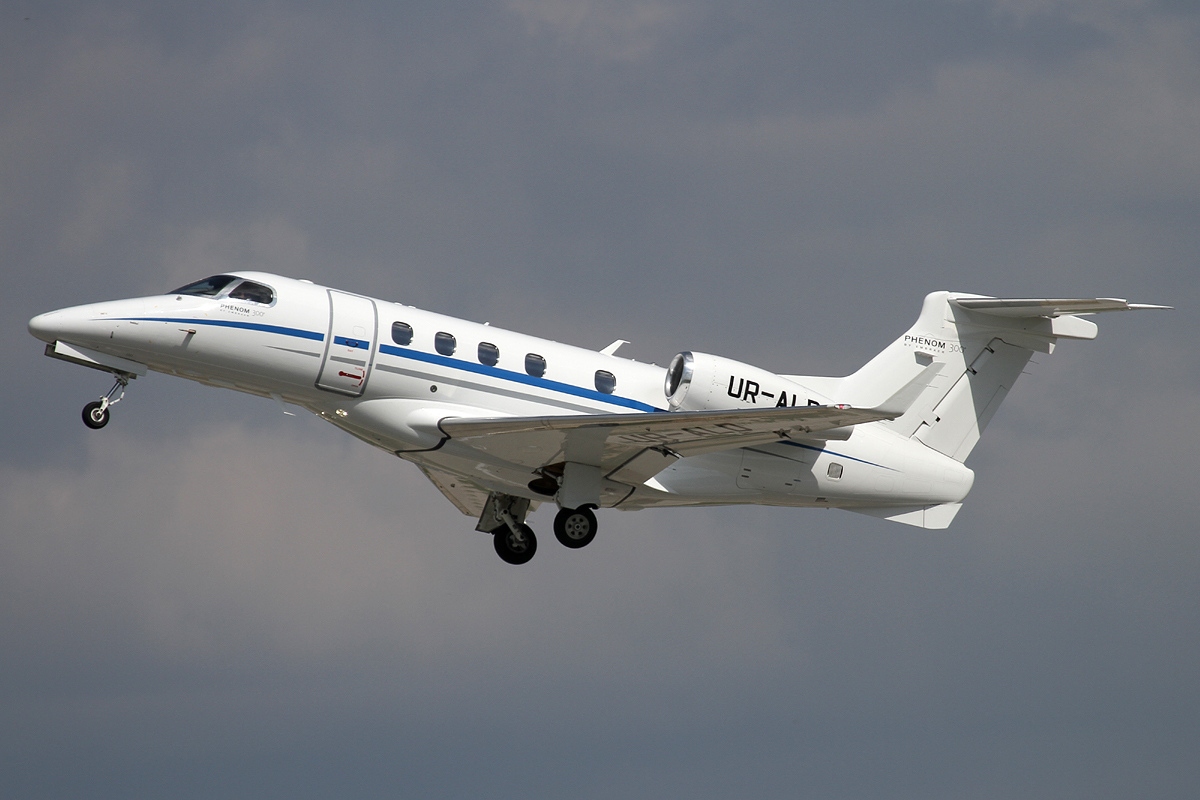
The Embraer Phenom 300E is a twin-engine, single-pilot certified light business jet built by Embraer of Brazil, and has been the best-selling light jet in the world for over a decade. It combines a purpose-built swept-wing airframe, rear-mounted Pratt & Whitney Canada turbofans and a Garmin-based Prodigy Touch flight deck to deliver class-leading speed, range and cabin comfort, making it a benchmark type for pilots moving into single-pilot jet operations.
The Phenom 300E is a twin-engine cantilever monoplane with low-mounted swept wings, winglets and rear-mounted turbofan engines, produced by Embraer as the larger, faster sibling to the Phenom 100. It sits in the light jet category, is certified for single-pilot operation, and is aimed at owner-operators, corporate flight departments and charter operators. Since entering service it has become the most-delivered light jet of its era, valued for pairing genuine cross-country range with a stand-up cabin and simplified single-pilot systems.
The Phenom 300 programme grew out of customer demand for a larger companion to the Phenom 100. Although Embraer initially considered a simple stretch of that smaller jet, it took a clean-sheet approach instead, resulting in more powerful engines, spoiler-equipped swept wings with winglets, a purpose-built cabin, and a higher gross weight with a strengthened structure. The aircraft first flew on 29 April 2008 and was certified on 3 December 2009, entering service that year. The Phenom 300 quickly built a strong sales record, becoming the most-delivered business jet of any size or category in the world in 2013, and by March 2019 Embraer had delivered the 500th example, having captured more than half of the light jet market since 2012. Fractional operators including Flexjet, NetJets and Flight Options have operated Phenom 300s. The Phenom 300E designation was introduced in 2018, bringing a redesigned interior and a new Garmin G3000-based Prodigy Touch avionics suite along with a Ground Power Mode. A further upgrade followed in March 2020 with the introduction of the PW535E1 engine, which raised thrust from 3,360 lbf to 3,478 lbf per engine, increased maximum cruise speed from Mach 0.78 to Mach 0.80, and extended range from 1,992 nm to 2,010 nm. This upgrade also added predictive windshear detection, stabilized approach guidance, and the Runway Overrun Awareness and Alerting System (ROAAS), described as an industry first for business aviation.
The Phenom 300E is built around an airframe that is 18 percent composite material, with a rated structural life of 28,000 flight cycles or 35,000 flight hours. Overall length is 51 ft 4 in, wingspan (with winglets) is 52 ft 2 in, and height is 16 ft 9 in; maximum takeoff weight is 18,553 lbs. Power comes from two rear-mounted Pratt & Whitney Canada PW535E1 turbofans, each rated at 3,478 lbf of thrust for a combined 6,956 lbf. The flight deck uses the Garmin G3000-based Prodigy Touch avionics suite, offering a touchscreen interface intended to reduce pilot workload and support single-pilot operation. The cabin uses Embraer's Oval Lite cross-section, measuring 17.2 ft in length, 5.1 ft (61 in) in width and 4.9 ft (59 in) in height, for a total volume of 324 cubic ft, and provides a genuine stand-up centre aisle. Standard seating accommodates 7 to 8 passengers in a club layout, with optional configurations for up to 10 occupants using a cockpit jumpseat, a side-facing seat and a belted lavatory. Total baggage volume across forward and aft compartments is 84 cubic ft. Cabin pressurisation gives a cabin altitude of 5,600 ft at FL450, described as the lowest in its class. Layout options include a Standard Club, a Four Plus Two Forward arrangement, an Executive Club Six layout, the Bossa Nova interior available since 2020 with refined finishes inspired by Embraer's larger Praetor jets, and a Ready-Fit Medevac configuration offered for new builds and retrofits since August 2020.
The Phenom 300E has a maximum cruise speed of 464 ktas (Mach 0.80), a high-speed cruise of 444 ktas and a long-range cruise of 385 ktas. NBAA IFR range with four passengers is quoted at 2,010 nm, falling to 1,732 nm at maximum payload. Service ceiling is 45,000 ft, and the aircraft climbs to FL450 in approximately 26 minutes. Runway performance is strong for the class, with a takeoff distance of 3,209 ft and a landing distance of 2,220 ft at maximum takeoff weight, sea level and ISA conditions. A pilot report on the type highlighted it as the fastest single-pilot light jet with the highest payload in its class, combined with the ability to operate from short runways and a rapid climb to FL450.
The line began with the original Phenom 300, certified in December 2009. The Phenom 300E, introduced in 2018, brought a redesigned interior and the Garmin G3000-based Prodigy Touch avionics suite along with a Ground Power Mode. In March 2020 the Phenom 300E was further upgraded with the PW535E1 engine, higher thrust, increased maximum cruise speed, extended range, predictive windshear capability, stabilized approach guidance and the ROAAS runway overrun protection system. Cabin options across the E-model line include the Bossa Nova interior, available from 2020, and a Ready-Fit Medevac configuration offered from August 2020 for both new-build and retrofit aircraft.
The Phenom 300 family has been in service since 2009 and has been the most-delivered light business jet for multiple consecutive years, with production well past 750 aircraft. It is flown by owner-operators and corporate flight departments as well as fractional and charter operators; Flexjet, NetJets and Flight Options have all operated Phenom 300s. Its single-pilot certification and light jet operating costs have made it a common sight on business aviation ramps, often alongside other Embraer types such as the Phenom 100 and Praetor 500 and 600.
Pilot reports on the Phenom 300E emphasise its single-pilot-friendly cockpit, built around the Garmin G3000-based Prodigy Touch avionics suite, which is designed to reduce workload through a touchscreen interface and integrated flight management. The aircraft is noted for its rapid climb to FL450, short-field capability and stabilized-approach guidance, alongside the ROAAS runway overrun alerting system, all of which are intended to support a single pilot through demanding phases of flight. Combined with its class-leading cruise speed and payload, these characteristics make the type a benchmark for evaluating single-pilot jet handling and systems management.