Departure
93%
vs 95% ▼ 2
 MY FS FLIGHTS
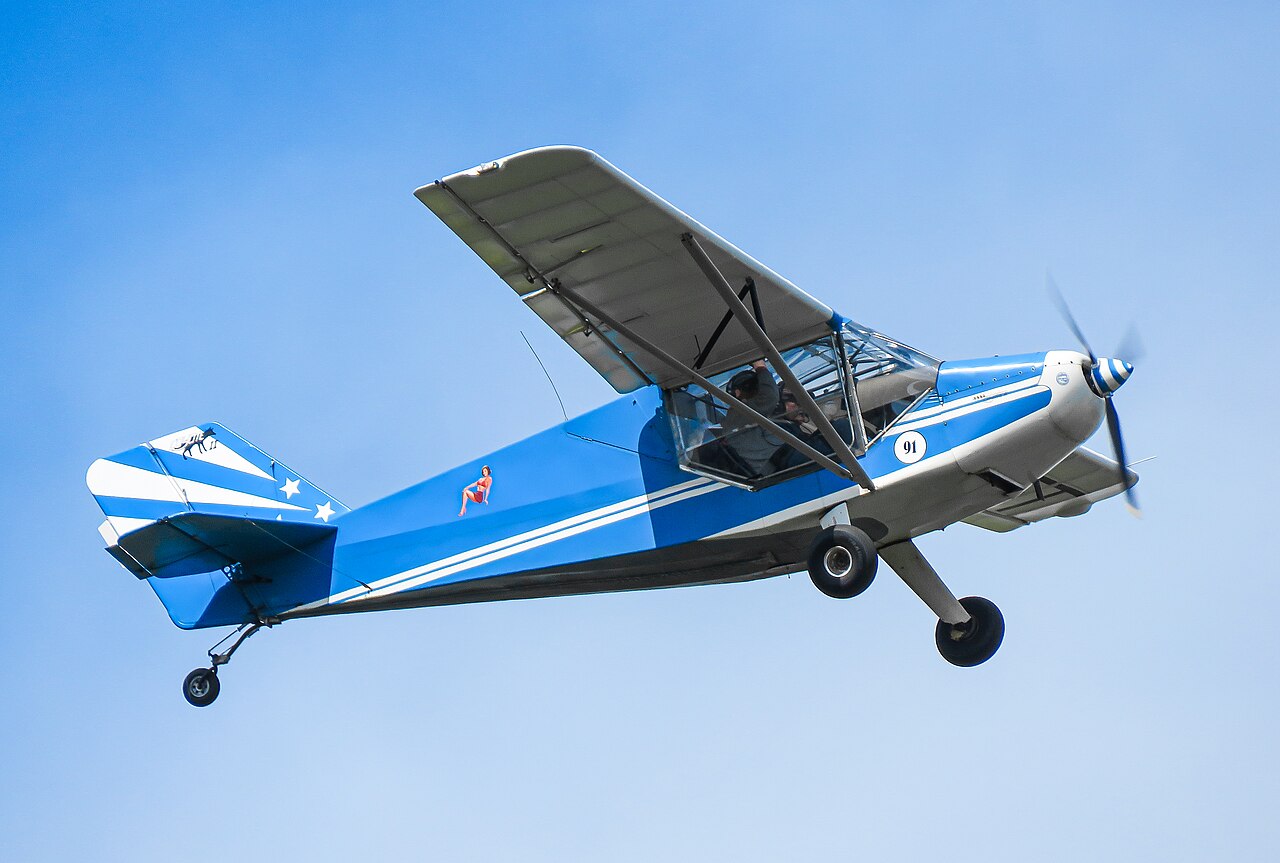
The Rans S-6 Coyote II is an American two-seat, high-wing kit and light-sport aircraft designed by Randy Schlitter and built by Rans Inc, developed out of the earlier single-seat S-4 and S-5 Coyote ultralights. It combines a welded steel-tube cockpit with fabric-covered aluminium wings and tail, and has become one of the most widely built light kit aircraft, making it a familiar and forgiving trainer-type machine for sim pilots exploring slow, stick-and-rudder flying.
The Rans S-6 Coyote II is a single-engined, tractor-configuration, two-seat, high-wing monoplane produced by Rans Inc of the United States, designed by company founder Randy Schlitter. It is offered both as a kit for amateur construction and as a factory-built light-sport aircraft, and it occupies a well-established place among small, affordable, easy-to-build sport and training aircraft of the ultralight and light-sport class.
The Coyote lineage began with the single-seat S-4 Coyote, which Schlitter designed in 1982 out of dissatisfaction with the ultralight designs then available; construction of the first prototype started in November 1982 and it first flew in March 1983. The two-seat Coyote II was developed from the S-5 Coyote, itself a development of the S-4, with the initial S-6 model first flying in 1988. The S-6 was replaced by the improved S-6ES, featuring an extended wing span, in April 1990, and in 1993 the range was joined by the S-6S Super Coyote. Since 1983 Schlitter's design work produced a broad family of Rans aircraft, and the Coyote II quietly grew into one of the most popular single-engine sport aircraft ever made, with over 1800 examples flown by January 2008 and around 2100 built by 2011; in November 2010, 615 examples were registered across European countries west of Russia, excluding Ireland. One S-6ES was flown across the Atlantic Ocean twice. A later S-6ELS variant, launched into a weak economy, did not attract the sales its predecessors had enjoyed.
All S-6 models share a welded 4130 steel-tube cockpit structure with a riveted aluminium-tube rear fuselage, wings and tail surfaces, all covered in fabric. The original S-6 and S-6ES used pre-sewn Dacron fabric envelopes to shorten build time, quoted at around 250 man-hours, while the S-6S reverted to more traditional dope-and-fabric covering, taking around 500 man-hours to complete; the Dacron envelope option, noted for its clear-coated, airtight finish, remained available on the S-6ES kit. The Coyote II can be built with tricycle or conventional landing gear and can be fitted with floats or skis. Early aircraft used the 50 hp (37 kW) Rotax 503 as the base engine, with the 64 hp (48 kW) Rotax 582 offered as an option; later production standardised on the 80 hp (60 kW) Rotax 912UL, with the 100 hp (75 kW) Rotax 912ULS as an upgrade, and the aircraft could also be fitted with the Sauer S2200 UL. The S-6ES, as documented with the Rotax 582 engine, has a length of 20 ft 0 in (6.10 m), a wingspan of 34 ft 6 in (10.52 m), an empty weight of 440 lb (200 kg) and a gross weight of 930 lb (422 kg), driving a two-bladed wooden propeller. The factory S-6LS, fitted with the 80 hp Rotax 912UL, has a shorter wingspan of 30.4 ft, two doors, 50 lb of baggage capacity and 18 US gallons of fuel capacity.
With the 64 hp Rotax 582, the S-6ES is quoted with a maximum speed of 120 mph (190 km/h, 100 kn), a cruise speed of 90 mph (140 km/h, 78 kn), a range of 220 mi (350 km, 190 nmi) and a rate of climb of 1,000 ft/min (5.1 m/s). The Rotax 912UL-powered S-6LS is quoted with a cruise speed of 98 kn, a Vo of 37 kn, a Vso of 31 kn, a Vne of 111 kn and a best rate of climb of 950 fpm. The dope-and-fabric S-6S Super Six is credited with an endurance of up to 4.5 hours, a cruise speed of up to 100 mph and a range of up to 440 miles, and is noted for sturdy, forgiving handling, agility at low speeds, and strong short take-off and landing performance. Reviewers have also described the Coyote II generally as lean and spirited, handling the elements athletically despite its lightweight, tube-and-fabric ultralight roots.
The original S-6 was the initial two-seat version, powered by the 50 hp Rotax 503, and is no longer in production. The S-6ES, introduced in April 1990, added an extended wing span and standardised on the 100 hp Rotax 912ULS, being offered with a standard wing, a '116' wing, or a 'light sport wing', and remained in production through at least 2012. The S-6LS is the factory-built light-sport aircraft version of the Coyote II; one account lists its standard engine as the 100 hp Rotax 912ULS with a 2010 base price of US$99,000, while another describes a production example fitted with the 80 hp Rotax 912UL at a base price of US$82,000. The S-6S Super Six, introduced in 1993, uses traditional dope-and-fabric covering rather than the Dacron envelope, is standardised on the 100 hp Rotax 912ULS, and was offered with the same standard, '116' and light sport wing options, remaining in production in 2010.
The Coyote II has proven consistently popular with private owners and builders, amassing well over 1800 flying examples by January 2008 and around 2100 by 2011, with a substantial fleet registered across Europe by 2010. It has served as a general sport and recreational aircraft available on wheels, floats or skis, and individual examples have demonstrated long-range capability, including one S-6ES that crossed the Atlantic Ocean twice. Examples of the type have also been built by student groups, including one constructed by students of Ercall Wood Technology College in England that appeared at the Royal International Air Tattoo in 2017.
In simulated form the Coyote II, modelled as the S-6S Coyote II, is presented as a single-engine, two-seat light-sport aircraft carrying forward the sturdy, forgiving character of the real machine, with an emphasis on agility at low speeds and strong short-field capability that suits low-and-slow sightseeing or grass-strip flying. Quoted simulator performance includes an endurance of up to 4.5 hours, a cruise speed of up to 100 mph and a range of up to 440 miles, broadly in line with the type's real-world figures. The model has attracted a strongly positive reception from simmers, reflecting the Coyote II's reputation as an approachable, good-natured taildragger-style trainer rather than a demanding or high-performance type.