Departure
93%
vs 95% ▼ 3
 MY FS FLIGHTS
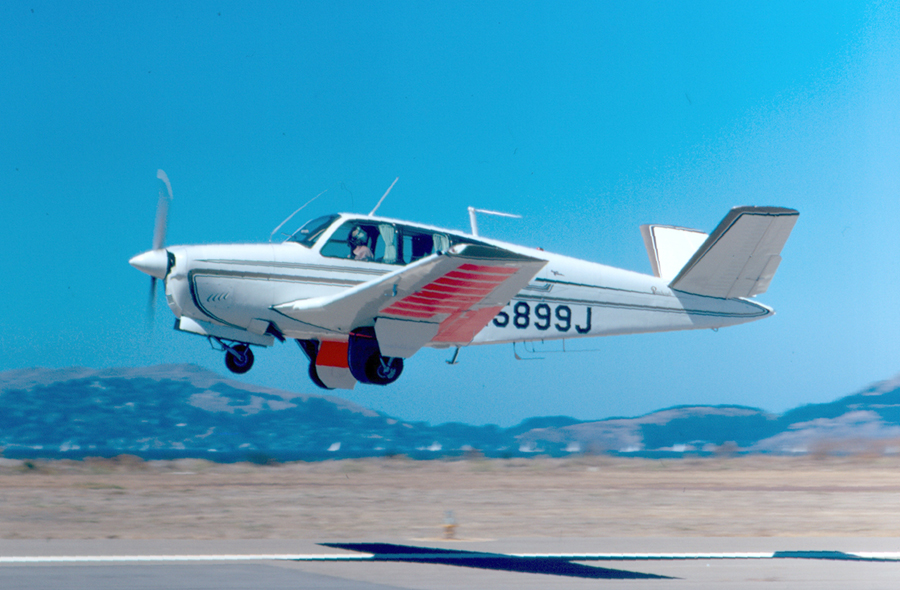
The Beechcraft B35 Bonanza is an early production variant of the Model 35 Bonanza, the pioneering V-tail light aircraft that Beech Aircraft Corporation of Wichita, Kansas built from 1947 onward. Produced in 1950 with an uprated Continental engine, it represents a refinement of the original Bonanza formula: an all-metal, low-wing, retractable-gear four-seater with the type's signature butterfly tail, and it remains of interest to sim pilots as one of the formative marks in the longest continuously produced aircraft line in history.
The Beechcraft B35 is a single-engine, four-seat, low-wing cabin monoplane and one of the early production variants within the Model 35 Bonanza family built by Beech Aircraft Corporation of Wichita, Kansas. Like all Model 35s, it carries the type's distinctive V-tail, with combination elevator-rudders known as ruddervators, all-aluminium construction and retractable tricycle undercarriage, at a time when most light aircraft of its class were still built with wood and fabric.
The Model 35 Bonanza line began with a prototype first flight on December 22, 1945, and received its airworthiness certificate on March 25, 1947, with production starting that year. The B35 followed the initial Model 35 (1947 to 1948, five prototypes and 1,500 production aircraft) and the A35 (1949, 701 built, which introduced a higher take-off weight and minor internal changes). Built in 1950 with serial numbers D-2201 through D-2680, 480 B35 aircraft were produced, making it an incremental but important step in the Bonanza's early development as Beech refined the design that would go on to become the longest continually produced aircraft in history, with over 18,000 Bonanzas of all variants eventually built.
The B35 retains the definitive Model 35 layout: an all-metal, low-wing airframe with retractable tricycle landing gear and the signature V-tail with ruddervators in place of a conventional tail. It is fitted with a Continental Motors E-185-8 engine, rated at 196 hp, an upgrade over the 165 hp Continental E-185 and E-185-1 engines used in the original Model 35 and continued into the early A35. As with other early Bonanzas, the flaps and ailerons were covered in magnesium alloy sheet rather than the fabric used on only the first 30 to 40 aircraft off the line. The nosewheel on these early Bonanzas was castering rather than steerable.
The early Model 35 Bonanza family, of which the B35 is part, was capable of cruising at speeds up to 170 mph (270 km/h), a figure that placed it well ahead of contemporaries such as the radial-engined, high-wing Cessna 195 and marked it out as one of the first genuinely modern light aircraft of the postwar era.
The B35 sits within the wider Model 35 Bonanza series, which ran from the original 35 through the A35, B35, C35, D35, E35, F35, G35, H35, J35, K35, M35, N35, O35, P35, S35 and on to the V35, V35A, V35B, V35B-TC and V35TC, produced from 1947 to 1982. The B35 followed the A35 as an incremental update, differing mainly through its adoption of the 196 hp Continental E-185-8 and other minor changes, before giving way to the C35.
Bonanzas of the Model 35 line, including early variants such as the B35, were sought after as business and personal transport for the executive and professional class, and the type gained fame alongside the North American Navion as one of the first two fully modern light aircraft. Model 35 airframes were also used for notable long-distance record flights, including William P. Odom's nonstop distance flight from Honolulu to Teterboro, New Jersey, in March 1949 and Congressman Peter F. Mack's around-the-world goodwill flight beginning in October 1951, both flown in early Model 35 aircraft that established the type's reputation for range and reliability.
Flying an early V-tail Bonanza such as the B35 means handling an aircraft whose retractable gear, castering nosewheel and ruddervator-equipped tail set it apart from typical fixed-gear trainers of its era, rewarding a pilot who respects its higher performance and complexity. The V-tail configuration later earned the type a reputation, sometimes unfairly applied, as the forked-tail doctor killer following a number of fatal in-flight breakups, with investigations pointing to stabilizer leading edges cantilevered too far ahead of the main spars; an FAA Airworthiness Directive, AD 2002-21-13, specifically applies to the earliest 35, A35 and B35 models built between 1947 and 1950 and mandates detailed inspection and repair procedures, a point worth bearing in mind for anyone studying the type's real-world handling quirks and limitations.