Departure
79%
vs 95% ▼ 16
 MY FS FLIGHTS
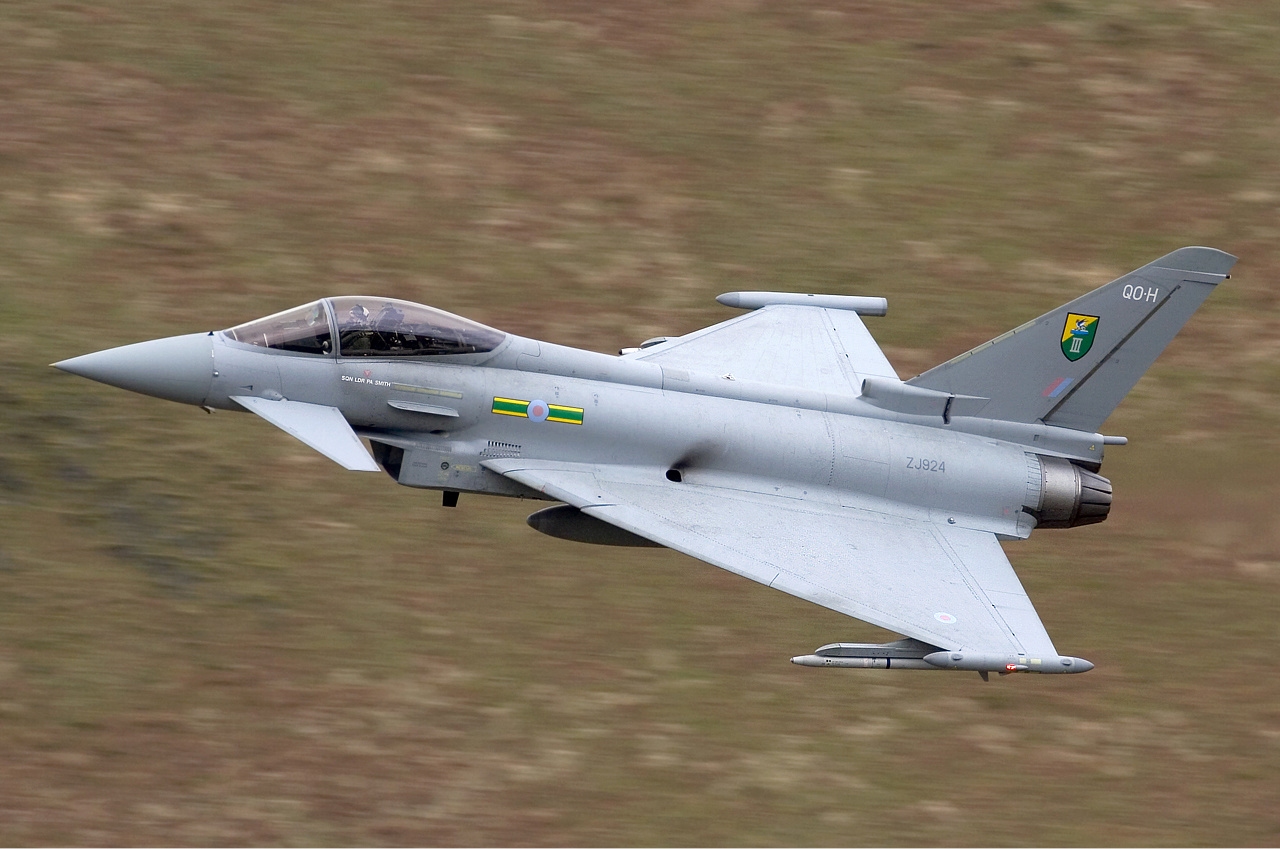
The Eurofighter Typhoon is a European twin-engine, canard delta wing, multirole fighter built by a consortium of Airbus, BAE Systems and Leonardo through the joint company Eurofighter Jagdflugzeug GmbH. Conceived as an air-superiority fighter and now developed into a genuine swing-role combat aircraft, it combines high agility with an increasingly broad air-to-surface strike capability. For a sim pilot it represents one of the benchmark modern European fast jets, notable for its canard-delta aerodynamics, HOTAS cockpit and helmet-mounted display systems.
The Eurofighter Typhoon is a multinational twin-engine, supersonic, canard delta wing, multirole fighter manufactured by a consortium of Airbus, BAE Systems and Leonardo, with the majority of the project conducted through the joint holding company Eurofighter Jagdflugzeug GmbH. The NATO Eurofighter and Tornado Management Agency, representing the UK, Germany, Italy and Spain, manages the programme and is the prime customer. Designed originally as an air-superiority fighter, the Typhoon has evolved into a true swing-role aircraft capable of shifting between air-to-air and air-to-surface tasks during a single mission, and it remains a highly agile aircraft intended to be an effective dogfighter in combat.
Work toward the aircraft's origins began in the UK as early as 1971, with a specification for a manoeuvrable tactical aircraft to replace the SEPECAT Jaguar that expanded to include an air-superiority requirement, formalised as Air Staff Target 403 in 1972 and leading to the unbuilt Hawker P.96. In parallel, West Germany ran a competition among Dornier, VFW-Fokker and Messerschmitt-Bolkow-Blohm for a future Luftwaffe requirement known as Taktisches Kampfflugzeug 90, won by an MBB design featuring a cranked delta wing, close-coupled canard controls and artificial stability. In 1979 MBB and British Aerospace proposed a collaboration known as the European Collaborative Fighter, joined by Dassault of France in October 1979, at which point the Eurofighter name was first attached to the programme. The collaboration collapsed in 1981 over differing requirements and Dassault's insistence on design leadership, and France subsequently left to develop the Dassault Rafale independently. The programme continued as the Future European Fighter Aircraft effort from 1983, a multinational collaboration among the UK, Germany, France, Italy and Spain. A technology demonstrator, the British Aerospace EAP, first flew on 6 August 1986, and a Eurofighter prototype made its maiden flight on 27 March 1994. The Typhoon name was formally adopted on 2 September 1998 at a naming ceremony at Farnborough, initially for export aircraft only, and the first production contract was signed on 30 January 1998 between Eurofighter GmbH, Eurojet and NETMA. Procurement totals under that contract were the UK 232, Germany 180, Italy 121 and Spain 87 aircraft, with production shares allotted as BAe 37.42 percent, DASA 29.03 percent, Aeritalia 19.52 percent and CASA 14.03 percent. The end of the Cold War reduced European demand for fighter aircraft, contributing to protracted development and debate over cost and division of work between partner nations. The Typhoon entered operational service on 4 August 2003. As of January 2025, 609 aircraft plus 7 prototypes had been built, with a procurement total of 680 aircraft recorded as of November 2023.
The Typhoon is a twin-engine, canard-delta wing configuration combining a proven, agile airframe built using stealth materials with advanced sensors, control and weapons systems. It is powered by two EJ200 engines, which give the aircraft its thrust-to-weight ratio and manoeuvrability. The cockpit is built around a hands-on-throttle-and-stick, or HOTAS, interface, combined with an advanced cockpit design and a Helmet Equipment Assembly, together intended to render the aircraft well equipped for all aspects of air operations. In the air interdiction role the aircraft can be configured for ground attack while still carrying four radar-guided and two infrared air-to-air missiles alongside a targeting pod and up to four ground-attack weapons. Later production aircraft have been progressively equipped to carry a growing range of armaments, including Storm Shadow, Brimstone and Marte ER missiles.
The Typhoon is described as a highly agile aircraft, designed to be an effective dogfighter in combat, with its thrust-to-weight ratio derived from its twin EJ200 engines contributing to its manoeuvrability. In December 2004, Typhoon IPA4 underwent three months of Cold Environmental Trials at Vidsel Air Base in Sweden to verify the operational behaviour of the aircraft and its systems in temperatures between minus 25 and plus 31 degrees Celsius.
Eurofighter, later named Typhoon, entered production in three stages known as Tranches, each bringing incremental improvements over its predecessor. The aircraft was initially deployed in the air-to-air role as the Typhoon F2, with the subsequent FGR4 standard acquiring a wider variety of weapons and the capability to engage numerous target types, reflecting the type's evolution from a primarily air-superiority fighter toward a full swing-role multirole aircraft.
The Typhoon entered operational service in 2003 and is in service with the air forces of Austria, Italy, Germany, the United Kingdom, Spain, Saudi Arabia and Oman, with Kuwait and Qatar also having ordered the aircraft; Turkey has been noted as a further customer, doubling the number of original user nations beyond the four founding partners. The type has taken primary responsibility for air defence duties for the majority of customer nations. Its combat debut came during the 2011 military intervention in Libya, when the UK's Royal Air Force and the Italian Air Force employed the Typhoon for aerial reconnaissance and ground strike missions. In RAF service the Typhoon FGR4 is used across the full spectrum of air operations, from air policing to high-intensity conflict, and the RAF Museum notes its capability across air policing, peace support and high-intensity operations.