Departure
94%
vs 95% ▼ 2
 MY FS FLIGHTS
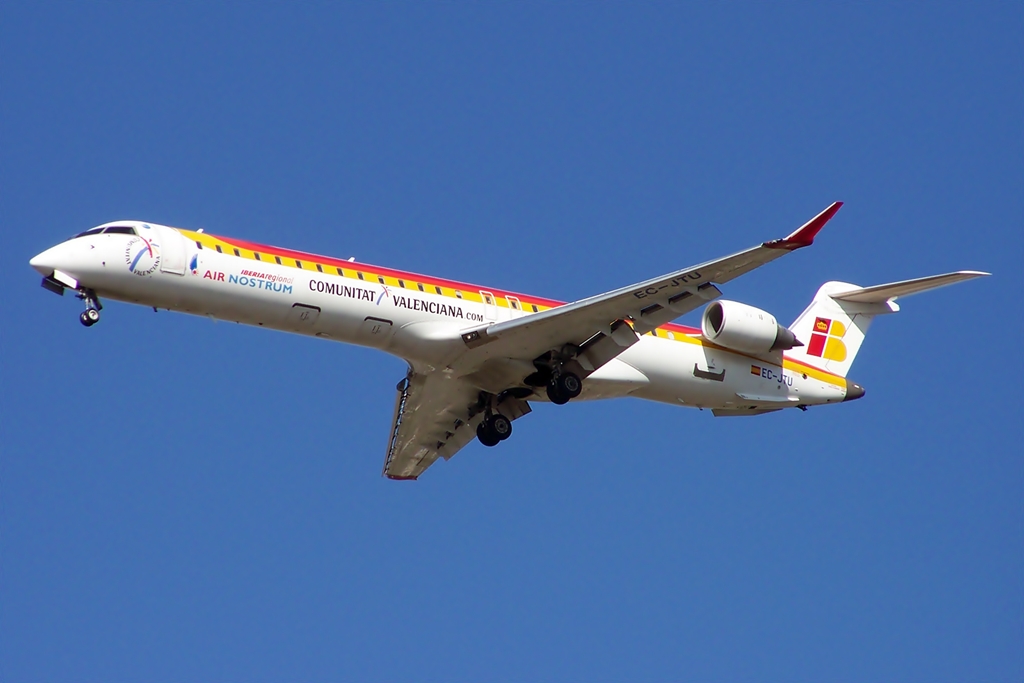
The Bombardier CRJ550 is a 50-seat, triple-class regional jet derived from the CRJ700 airframe, created specifically to satisfy North American pilot-union scope clauses that cap regional aircraft by seat count rather than weight. Every CRJ550 in service is a converted CRJ700, re-certified under its own type certificate, and the type is notable for pairing a small passenger count with an unusually spacious, premium cabin layout. For a simulator pilot interested in the wider CRJ family, it represents a niche but operationally important variant flown by major US regional carriers on behalf of United Express and Delta Connection.
The CRJ550 is a regional jet airliner manufactured by Bombardier as part of the CRJ700 series, sharing its basic airframe with the CRJ700 but limited by its type certificate to just 50 passenger seats. It carries the model designation CL-600-2C11 on Transport Canada and FAA type certificates, distinguishing it from the standard CRJ700's CL-600-2C10 certification. Bombardier described it as the first triple-class 50-seat aircraft in the world, built to let US regional operators comply with scope-clause agreements that restrict aircraft by seat count while still offering a first, Economy Plus and standard economy cabin.
The CRJ550 sits within the wider CRJ700 series, which itself grew out of the CRJ-X programme launched by Bombardier in 1994 to produce larger derivatives of the CRJ100/200. The CRJ700 was officially launched in January 1997 and first flew on 27 May 1999, followed by the stretched CRJ900 and later the CRJ1000. The CRJ550 emerged later as a specific response to scope-clause limits, alongside the CRJ705, and was launched by Bombardier as a new CRJ Series model carrying its own type certificate based on the CRJ700 platform. All CRJ550s in service were converted from existing CRJ700 airframes rather than built new, and the type received its type certification in 2019; it has not yet been certified by the European Aviation Safety Agency. Bombardier divested its commercial aircraft programmes in the late 2010s, and on 1 June 2020 Mitsubishi finalised acquisition of the CRJ programme, with Bombardier continuing to build CRJ aircraft on Mitsubishi's behalf until existing orders were fulfilled in December 2020; Mitsubishi has since supported existing CRJ operators with parts but has not resumed production.
The CRJ550 is based on the CRJ700 fuselage and systems but is deliberately limited by its type certification to 50 passenger seats, well below the CRJ700's typical capacity, and carries a lower maximum takeoff weight of 65,000 pounds (29,000 kg) compared with the CRJ700's 75,000 pounds (34,000 kg). Its cabin is configured in three classes: 10 first-class seats, 20 Economy Plus seats and 20 standard economy seats. Because the large first-class section is not always served by a dedicated flight attendant, the aircraft is fitted with a self-service galley area stocked with snacks and a refrigerator of non-alcoholic beverages, allowing forward-cabin passengers to help themselves while the single flight attendant serves economy. The CRJ550 also features four carry-on bag storage closets, addressing the notoriously small overhead bins found on regional jets of this size, and offers more overall legroom per seat than other 50-seat aircraft flown by US carriers. The type retains a high degree of cockpit commonality with the rest of the CRJ family, from the CRJ200 through to the CRJ900.
Specific published performance figures for the CRJ550 are limited, but its most significant operational distinction from the standard CRJ700 is a reduced maximum takeoff weight of 65,000 pounds (29,000 kg) against the CRJ700's 75,000 pounds (34,000 kg), reflecting its lower seat count and lighter passenger and baggage load. As a derivative of the CRJ700 airframe it inherits that aircraft's General Electric CF34-8C-powered platform and aerodynamic features, including leading-edge extensions, high-lift slats and an enlarged horizontal tailfin developed for the original CRJ700/900 family.
The CRJ550 is one of several derivatives developed within the CRJ700 series specifically to meet scope-clause requirements, alongside the CRJ705, which was similarly modified from the larger CRJ900 platform. Unlike newly built CRJ700 or CRJ900 aircraft, every CRJ550 has been produced by converting an existing CRJ700 airframe to the reduced-capacity, triple-class configuration under its own CL-600-2C11 type certificate, rather than through new manufacture.
GoJet Airlines was the first operator to introduce the CRJ550's premium cabin concept, flying the type for United Express. In 2024 SkyWest Airlines significantly expanded CRJ550 operations, introducing 19 aircraft under the Delta Connection brand in July and a further 40 under the United Express brand in October, the latter including 11 airframes previously operated by GoJet. The aircraft is used specifically on regional routes where carriers want to offer a first-class product without exceeding scope-clause seat limits, and because it lacks EASA certification its operation has remained confined to North American carriers.
There is no dedicated simulator model built specifically around the CRJ550's unique cabin, but because the type shares its airframe, systems and cockpit commonality with the rest of the CRJ700/900 family, from the pilot's seat it flies essentially as a CRJ700 with a lighter maximum takeoff weight. Pilots who fly other CRJ variants in a simulator would find the flight deck, systems architecture and handling characteristics of the CRJ550 unchanged from the standard CRJ700, the principal difference being operational rather than aerodynamic: a reduced payload and passenger count rather than any change to the wing, engines or flight controls.