Departure
94%
vs 95% ▼ 1
 MY FS FLIGHTS
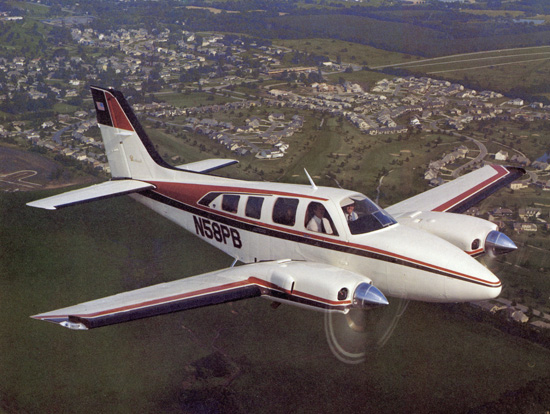
The Beechcraft Baron 58P is the pressurized, turbocharged version of the long-body Baron 58, a light twin-engined piston aircraft built by Beechcraft as part of the wider Baron family that has been in continuous production since 1961. Aimed at owner-pilots wanting cabin comfort at altitude, the 58P combined the Baron's twin-Continental power with a sealed, climate-controlled cabin, making it one of the more capable pressurized piston twins of its era for a simulator pilot to fly in the flight levels.
The Baron 58P is a member of Beechcraft's long-running Baron family of light twin-engined piston aircraft, itself developed from the Beechcraft Travel Air and, ultimately, the Bonanza. Where the standard Baron 58 is a normally aspirated long-body cabin twin, the 58P added a pressurized cabin and turbocharged engines, sitting alongside the non-pressurized turbocharged 58TC as the higher-performance, higher-altitude members of the 58-series line.
The Baron lineage traces back to the Beechcraft 95 Travel Air, which married the Bonanza's fuselage to the tail control surfaces of the T-34 Mentor military trainer. To create the Baron, the Travel Air's tail was replaced with that of the Debonair, the engine nacelles were streamlined, and six-cylinder engines were fitted, with the first Model 55 Baron introduced in 1961. The Baron range subsequently split into three basic types: the short-body 55, the short-body turbocharged 56, and the long-body 58. The 58P represented the pressurized development of the long-body line, produced alongside the non-pressurized turbocharged 58TC. Production records place early 58P airframes (serials TJ-1 through TJ-168) in the 1976 to 1978 period, with a later production block (TJ-169 through TJ-497) running from 1979 to 1985. The turbocharged 58TC was discontinued in 1984 and the pressurized 58P followed in 1985, while the normally aspirated Baron 58 remained in production long afterwards.
The 58P used the long-body Baron 58 airframe with a pressurized cabin and turbocharged Continental engines. Early production aircraft, built from 1976 to 1978, were fitted with Continental TSIO-520LB engines rated at 310 hp; from 1979 through the end of production in 1985, the type was built with the more powerful TSIO-520WB engines rated at 325 hp. The 58P and 58TC were typically equipped with 190 US gal (720 L; 160 imp gal) fuel tanks. A significant cockpit change came in 1984, when the instrument panel was redesigned to remove the large central control column and to relocate engine controls, which had previously been mounted high on the panel to clear it. On pre-1984 aircraft fitted with the optional dual control yokes, the arm to the right-hand yoke partially obstructed the radios and some cockpit switches; the 1984 redesign gave a more industry-standard control arrangement and freed up panel space, though at the cost of the earlier option of a single yoke, which had made the right-hand seat more comfortable for a passenger or relief pilot.
The pressurized and turbocharged 58P was capable of cruising at 200 kn (370 km/h) at 8,000 ft (2,400 m) and at 220 kn (410 km/h) at 20,000 ft (6,100 m), figures that reflect the benefit of turbocharging and cabin pressurization in allowing sustained high-altitude cruise well above the levels practical in the normally aspirated Baron 58.
Within the long-body Baron 58 family, the 58P was the pressurized turbocharged variant, distinct from the non-pressurized turbocharged 58TC and the standard normally aspirated 58. The 58P itself was produced in two principal engine sub-variants: an early run (1976 to 1978) with Continental TSIO-520LB engines of 310 hp, and a later run (1979 to 1985) with Continental TSIO-520WB engines of 325 hp. The turbocharged 58TC was withdrawn from production in 1984 and the 58P followed in 1985, while the standard Baron 58 continued in production for decades afterwards.
As a pressurized cabin-class twin, the 58P was aimed at private and business owner-pilots wanting to operate above much of the weather and turbulence encountered by non-pressurized piston twins, while retaining the four-to-six seat cabin-class layout common to the long-body Baron 58 series. The wider Baron family, of which the 58P forms one variant, has seen more than 7,000 aircraft built since production began in 1961, underlining the type's enduring role in general aviation as a light twin for personal and business transport.
For a simulator pilot, the 58P's most tangible personality trait carried over from the real aircraft is its cockpit layout, which differed depending on production year. Pre-1984 aircraft fitted with optional dual control yokes had a right-hand yoke arm that partially blocked the radios and some switches, while the 1984 panel redesign removed the large central control column, relocated the engine controls, and gave a more conventional, spacious instrument panel at the cost of the single-yoke option. Flying the 58P means managing a pressurized, turbocharged twin capable of cruising at 220 kn at 20,000 ft, considerably faster and higher than the normally aspirated Baron 58, which makes it a satisfying type for high-altitude cross-country flying in the sim.