Departure
96%
vs 95% ▲ 1
 MY FS FLIGHTS
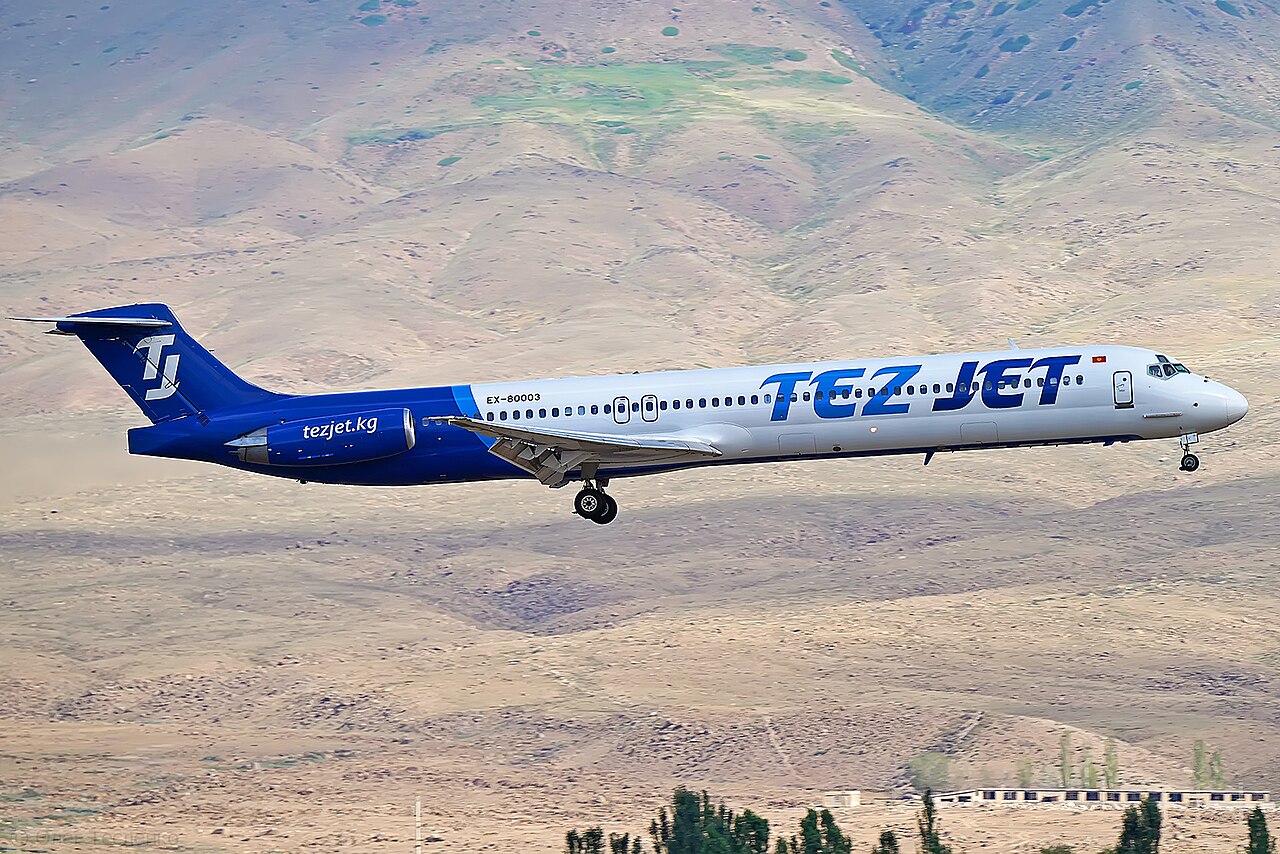
The McDonnell Douglas MD-82 is a stretched, higher-gross-weight member of the MD-80 series, itself the second generation of the DC-9 family of narrow-body twinjet airliners. Built by McDonnell Douglas and later Boeing Commercial Airplanes, it became one of the definitive short- to medium-haul workhorses of American domestic aviation through the 1980s and 1990s, flown in large numbers by carriers such as American Airlines, Northwest Airlines, Republic Airlines and Delta Air Lines. For a sim pilot it represents a classic rear-engined, T-tailed five-abreast jet with analogue-era systems and a long, well-documented service history.
The MD-82 is a variant within the McDonnell Douglas MD-80 series, a family of five-abreast, single-aisle jet airliners developed from the DC-9-50 as the second generation of the DC-9 line. It retains the DC-9's rear fuselage-mounted twin turbofans and T-tail configuration but with a stretched fuselage, a larger wing and higher-thrust engines than the earlier DC-9 variants. Originally designated the DC-9-82, it was marketed under the McDonnell Douglas MD prefix, and the aircraft still carries the DC-9 prefix on its FAA type certificate for certification cost reasons, with the MD designation shown in parentheses.
The MD-80 series grew out of McDonnell Douglas studies in the 1970s to further develop the successful DC-9 family, whose Series 50 had entered production with 976 units built by the time production ended in 1982. Early feasibility work considered lengthened, higher maximum take-off weight derivatives with a larger wing, new main landing gear and increased fuel capacity, taking advantage of newer, higher-bypass versions of the Pratt & Whitney JT8D engine. By August 1977 design effort had settled on what became known as the Series 80. Swissair launched the Series 80 programme in October 1977 with an order for 15 aircraft plus five options, and the type's first flight, on October 18, 1979, was made as the Super 80. The MD-82 itself, then designated Series 82, was launched on April 16, 1979, made its first flight on January 8, 1981, and was certified by the FAA on July 29, 1981. Deliveries of the type to airlines such as Republic Airlines began in August 1981. Production of the MD-80 family as a whole continued until 1999, by which time 1,191 aircraft had been delivered, with the MD-82 built in substantial numbers among them.
The MD-82 shares the DC-9's fuselage cross-section but is stretched by up to 14 ft (4.3 m) over the DC-9-50 and fitted with a wing some 28% larger in area. Along with the other larger variants in the family (MD-81, MD-83 and MD-88), it measures 148 ft (45.1 m) in length and seats 155 passengers in a five-abreast coach layout. It retains the DC-9's twin rear fuselage-mounted turbofans and T-tail arrangement, and compared with the earlier MD-81 it is fitted with higher-thrust engines to support its increased weights. Depending on configuration, the larger MD-80 variants can carry sufficient fuel and payload to achieve a maximum range of up to 2,550 nautical miles (4,720 km; 2,930 mi).
As one of the higher-thrust, higher-weight members of the MD-80 family, the MD-82 was developed specifically to extend range and payload capability beyond the original DC-9-based design, with maximum range for the larger MD-80 variants quoted at up to 2,550 nmi (4,720 km; 2,930 mi). Its increased thrust engines, combined with the larger wing, were intended to support operations across a variety of route lengths and airfield conditions typical of the domestic networks it served.
The MD-80 family comprises the MD-81, MD-82, MD-83, MD-87 and MD-88. The MD-81 was the first variant, launched in October 1977, powered by JT8D-209 engines and certified in August 1980. The MD-82 followed with higher-thrust engines than the MD-81 to handle greater weights. The MD-83, launched on January 31, 1983, and first flown on December 17, 1984, extended range further and was certified on October 17, 1985. The MD-87, introduced from January 1985, is 17 ft (5.3 m) shorter than the larger variants, seats around 130 passengers and offers a maximum range of up to 2,900 nmi (5,400 km; 3,300 mi). The MD-88, launched on January 23, 1986, is broadly similar to the MD-82 or MD-83 in performance but introduced a modern cockpit with Electronic Flight Instrument System (EFIS) displays in place of the traditional analogue flight deck used on the other MD-80 variants; some aircraft ordered as MD-88s, such as several delivered to Delta Air Lines, were initially delivered as MD-82s ahead of the MD-88's introduction.
The MD-82 was widely operated on domestic and regional routes by major United States carriers. Republic Airlines took early deliveries from August 1981, having inherited orders originally placed by Southern Airways; in the end only nine MD-82s were delivered to Republic. Northwest Airlines, which merged with Republic, operated the type and leased in an additional MD-82 (registration N931MC) after the loss of Northwest Flight 255 in August 1987, though it chose not to add further MD-82s as Airbus A320s were already on order. Delta Air Lines also flew MD-82s, including aircraft delivered ahead of its MD-88 order, with one MD-82, Ship 905 (N915DL), serving as the symbolic centerpiece of Delta's 1987 merger ceremonies with Western Airlines. American Airlines operated large numbers of MD-82s as part of its