Departure
93%
vs 95% ▼ 2
 MY FS FLIGHTS
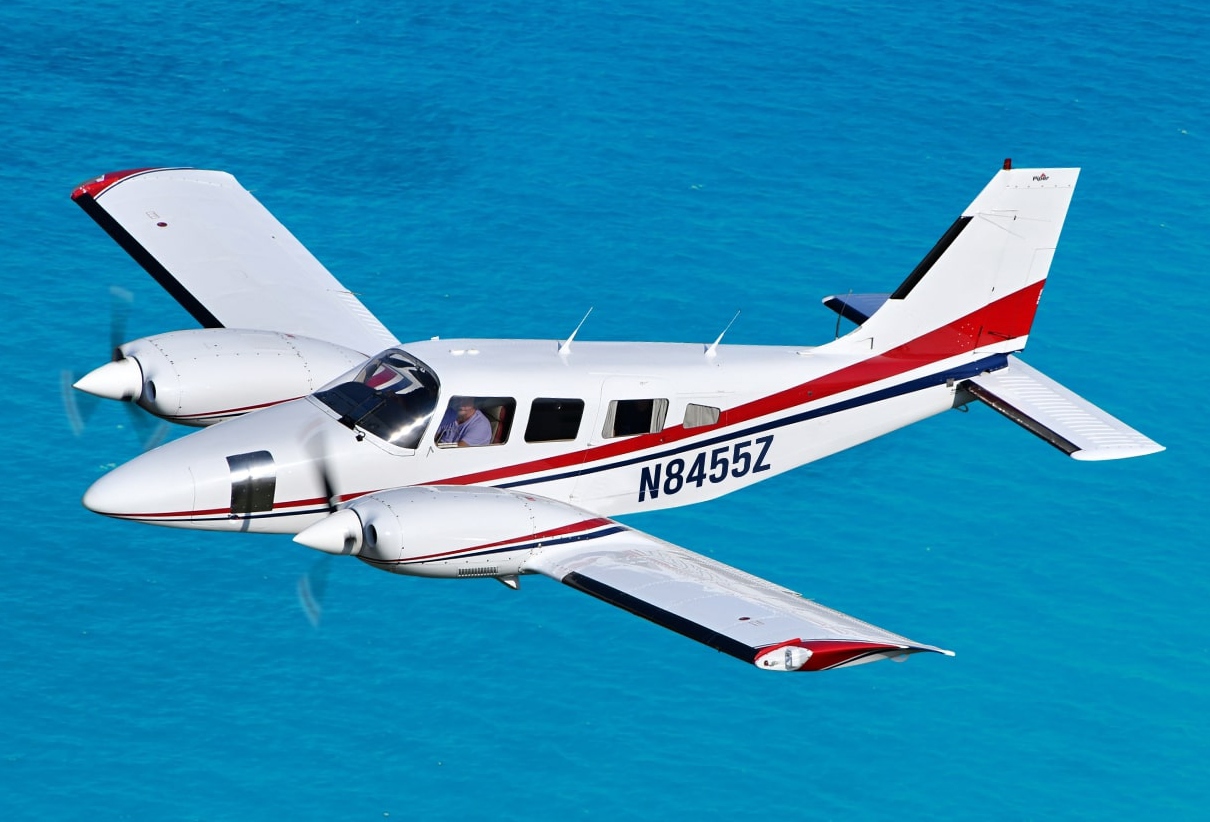
The Piper PA-34 Seneca is an American twin-engined light aircraft built by Piper Aircraft, developed as a twin-engined derivative of the Cherokee Six and produced in various forms since 1971. Seating up to six and fitted with counter-rotating engines for benign single-engine handling, it became the mainstay of multi-engine flight training and light business travel worldwide, and remains a familiar sight in flight simulation as an accessible twin trainer.
The PA-34 Seneca is a low-wing, retractable-gear, twin-engined piston aircraft manufactured by Piper Aircraft in the United States. Classed as a six-place light twin, it is used primarily for personal and business flying and for multi-engine class rating flight training. It shares its basic airframe with the single-engined Piper Cherokee Six, from which it was directly developed, and it has been built in non-continuous production since 1971, making it one of Piper's longest-running twin designs.
The Seneca's origins lie in a converted Cherokee Six, designated PA-32-3M, which Piper flew as an experimental tri-motor with two additional Lycoming O-235 engines of 85 kW (115 hp) fitted to the wings while retaining the nose engine. After this three-engined layout was abandoned, the design was developed as a purely twin-engined aircraft. The first prototype, the PA-34-180 Twin Six registered N3401K, first flew on 25 April 1967 with two 180 hp (134 kW) Lycoming O-360 engines, fixed nosewheel gear and a Cherokee Six vertical tail. A second prototype flew on 30 August 1968 with retractable gear and a taller tail, still using the 180 hp Lycomings, and the wingspan was increased by two feet during flight testing. A third prototype, closer to production standard and fitted with 200 hp (149 kW) Lycoming IO-360-A1A engines, flew on 20 October 1969. The PA-34-200 Seneca was certified on 7 May 1971 and entered production later that year as a 1972 model. Complaints about handling qualities led Piper to introduce the improved PA-34-200T Seneca II, certified on 18 July 1974 and sold as a 1975 model, followed by the PA-34-220T Seneca III in 1981 (certified 17 December 1980), the Seneca IV in 1994 (certified 17 November 1993) under the New Piper Aircraft company, and the Seneca V, certified 11 December 1996 and introduced as a 1997 model. Beyond Piper's own production, the type was also built or assembled abroad: by AICSA in Colombia, by Chincul in Argentina as the PA-A-34, by Embraer in Brazil as the EMB-810, with over 870 built, and by PZL-Mielec in Poland as the M-20 Mewa, partly using PZL/Franklin engines, with around 20 built. Total Piper production reached approximately 5,037 aircraft, including around 200 Seneca Vs.
The Seneca is a low-wing, all-metal monoplane with retractable tricycle landing gear, developed directly from the single-engined Cherokee Six airframe by fitting wing-mounted piston engines. A key design feature carried through every production model is the use of counter-rotating engines: on the PA-34-200 Seneca, the right-hand Lycoming LIO-360-C1E6 has a crankshaft that turns in the opposite direction to its left-hand counterpart, eliminating the 'critical engine' handling problem found on many light twins and improving controllability after an engine failure. Early Seneca I aircraft had a maximum gross weight of 4,000 lb (1,810 kg), later raised to 4,200 lb (1,910 kg) on later serial numbers; empty weight for the PA-34-200 was around 1,190 kg (2,623 lb). The Seneca II introduced enlarged and balanced ailerons, a rudder anti-servo tab and a stabilator bobweight to address earlier handling criticisms, switching to turbocharged, six-cylinder Continental TSIO-360-E or EB engines, and offered optional rearward-facing 'club seating' in the middle row for extra cabin legroom. Gross weights on the Seneca II were 4,570 lb (2,070 kg) for takeoff and 4,342 lb (1,969 kg) for landing, with all weight above 4,000 lb (1,800 kg) required to be fuel. The Seneca III adopted Continental TSIO-360-KB engines rated at 220 hp (165 kW) for five minutes before dropping to 200 hp (149 kW), a higher engine rpm limit of 2,800 rpm, a one-piece windshield and a bare-metal instrument panel; gross weight rose to 4,750 lb (2,155 kg) for takeoff and 4,513 lb (2,047 kg) for landing, and the type recorded the highest useful load of all PA-34 variants, up to 1,377 lb (625 kg) with air conditioning and de-icing fitted. The last 37 Seneca IIIs used a 28-volt electrical system in place of the earlier 14-volt system. The Seneca IV retained the same counter-rotating TSIO-360-KB engines with a streamlined cowl for better cruise performance, while the Seneca V introduced the intercooled Continental TSIO-360-RB engine, which maintains rated power up to 19,500 ft, together with redesigned cowls and relocated cockpit switches; useful load on the Seneca V fell to around 1,134 to 1,331 lb (514 to 604 kg) owing to added equipment. Typical dimensions for the PA-34-200 are a wingspan of 11.85 m (38 ft 11 in), length of 8.69 m (28 ft 6 in), height of 3.02 m (9 ft 11 in) and wing area of 19.2 sq m (206.5 sq ft); the Seneca V is slightly longer at 8.72 m (28 ft 8 in) with a wing area of 19.4 sq m (208.7 sq ft) and empty equipped weight of 1,532 kg (3,377 lb). Seating is for six in most variants, though the Seneca V is configured for five with a sixth seat optional in place of a standard executive worktable.
Performance grew substantially across the type's development. The original PA-34-200 Seneca had a maximum speed of 314 km/h (170 kt), maximum cruising speed of 300 km/h (160 kt), long-range cruising speed of 267 km/h (144 kt), initial rate of climb of 1,360 ft/min, a service ceiling of 19,400 ft and a maximum no-reserve range of 1,818 km (982 nm). The later Seneca V is considerably more capable: maximum speed of 379 km/h (205 kt), maximum cruising speed of 341 km/h (184 kt) at 10,000 ft and 367 km/h (198 kt) at 18,500 ft, normal cruising speeds of 322 km/h (174 kt) at 10,000 ft and 352 km/h (190 kt) at 16,500 ft, an initial rate of climb of 1,550 ft/min, and a maximum certificated altitude of 25,000 ft. Range at maximum-range power with reserves is 1,295 km (700 nm) at 10,000 ft or 1,222 km (660 nm) at 18,500 ft. The counter-rotating engine layout used across all production Seneca variants removes the asymmetric 'critical engine' effect found on conventionally-configured light twins, giving more predictable handling and control in the event of an engine failure, a characteristic that has long made the type valued for multi-engine training.
The PA-34-180 Twin Six was the initial prototype configuration with 180 hp Lycoming O-360 engines, evolving through a second prototype with retractable gear and a taller tail, and a third prototype closer to production standard with 200 hp Lycoming IO-360-A1A engines. The PA-34-200 Seneca (Seneca I) was the first production model, certified in 1971 with counter-rotating Lycoming IO-360-C1E6/LIO-360-C1E6 engines; 934 were built including the prototype. The PA-34-200T Seneca II, certified in 1974, introduced turbocharged Continental TSIO-360-E/EB engines and revised flight controls; 2,588 were built. The PA-34-220T Seneca III, introduced in 1981, used higher-output Continental TSIO-360-KB engines, a one-piece windshield and increased gross weights, with more than 930 built; Piper had originally planned a T-tail for this model but dropped the idea. The PA-34-220T Seneca IV, certified in 1993 under New Piper Aircraft, offered a streamlined cowl and revised interior with 71 built. The PA-34-220T Seneca V, certified in 1996, introduced intercooled Continental TSIO-360-RB engines, redesigned cowls and cockpit switch relocations, with around 200 built. Beyond Piper's own line, licensed and locally-assembled versions included the Chincul PA-A-34 in Argentina, the Embraer EMB-810 in Brazil (over 870 built), the PZL-Mielec M-20 Mewa in Poland using PZL/Franklin engines (around 20 built), and assembly by AICSA in Colombia. Aftermarket conversions include the Seguin Princess and the Robertson Super Seneca I and II.
The Seneca has been used chiefly for personal and business flying and has become a standard platform for multi-engine class rating flight training around the world, prized by flight schools for its predictable, forgiving handling qualities stemming from its counter-rotating engines. Private owners have valued it for cabin comfort, including the optional club seating layout, and for the operational redundancy offered by a second engine over longer or more demanding routes. Licensed production and assembly in Argentina, Brazil, Colombia and Poland extended its operational reach well beyond the United States, and the type has remained in wide civilian use across successive variants from the Seneca I through to the Seneca V.
For a simulator pilot, the Seneca represents an accessible entry point into twin-engine flying, its counter-rotating engines removing the classic 'critical engine' asymmetry that complicates engine-out handling on many other light twins, so a simulated engine failure behaves more symmetrically regardless of which engine is cut. The later turbocharged Seneca II, III, IV and V variants offer meaningfully higher cruise speeds and service ceilings than the original Seneca I, giving a noticeably different performance feel between early and late model simulations of the type, from a workmanlike 160 kt cruiser to a 190 kt-plus high-altitude tourer. Its long production run and continued popularity in real-world flight training make it a natural subject for multi-engine training scenarios in a simulator, and its Cherokee Six-derived airframe and six-seat cabin layout, including club seating in some variants, are recognisable features for anyone familiar with Piper's single-engine PA-32 family.