Departure
96%
vs 95% ▲ 1
 MY FS FLIGHTS
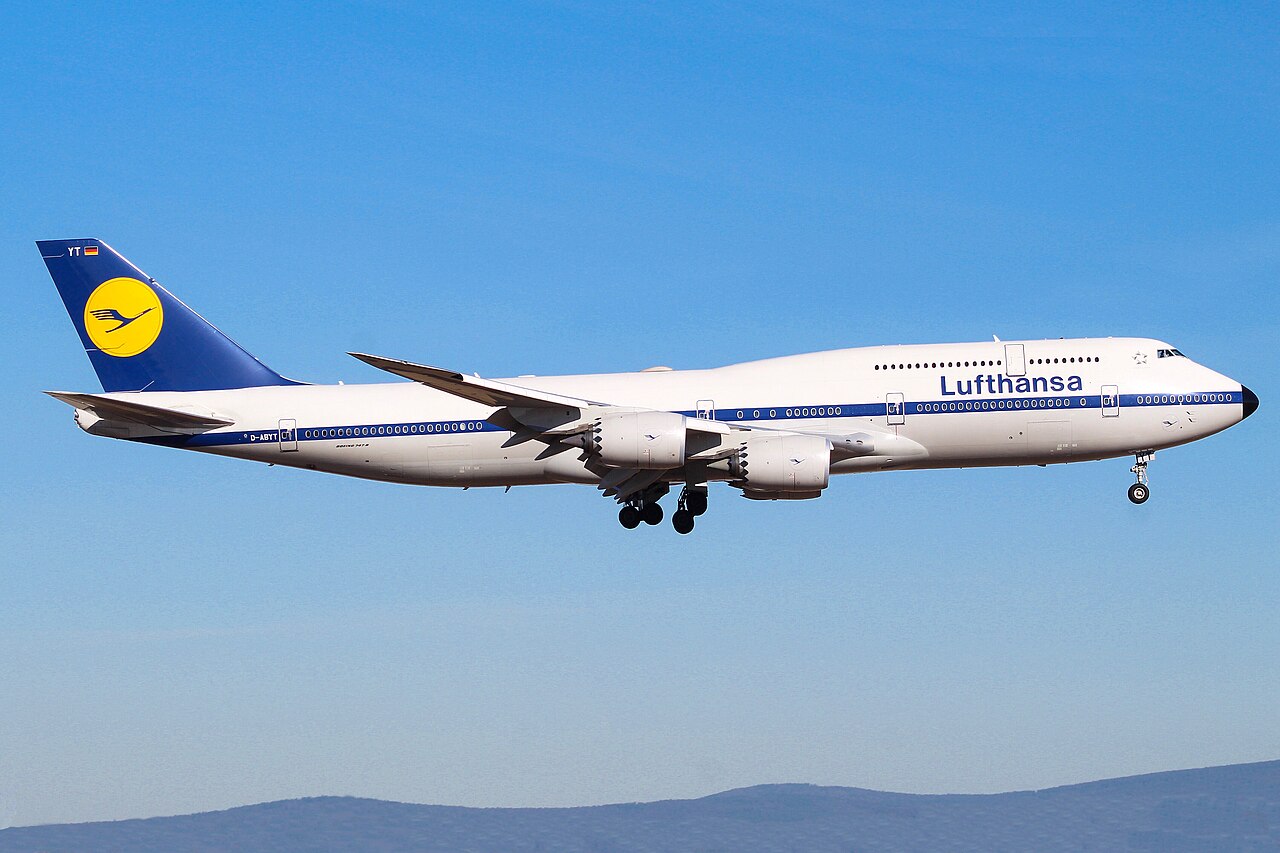
The Boeing 747-8 is the final and largest member of the Boeing 747 family, a four-engined long-range widebody built by Boeing Commercial Airplanes and offered in freighter (747-8F) and passenger (747-8 Intercontinental) versions. Developed as a stretched, re-engined derivative of the 747-400 to rival the Airbus A380, it holds the distinction of being the longest airliner in service and the heaviest aircraft Boeing has built. For simmer pilots it represents the ultimate evolution of the classic four-engined jumbo, blending the familiar 747 silhouette with 787-derived systems and engines.
The 747-8 is a wide-body, four-engine jet airliner and the last version of Boeing's iconic 747 line, built by Boeing Commercial Airplanes in the United States. It comes in two forms: the 747-8F freighter and the 747-8 Intercontinental (747-8I) passenger model, both developed from the 747-400. As Boeing's largest aircraft overall, it retains the classic 747 hump and partial double-deck configuration while incorporating technology shared with the 787 Dreamliner, including General Electric GEnx engines and fly-by-wire ailerons and spoilers.
Boeing had studied larger 747 derivatives through the 1990s and 2000s, including the 747-500X and -600X unveiled at the 1996 Farnborough Airshow and the 747X and 747X Stretch proposals of 2000, none of which attracted sufficient interest to enter development. Ideas from the 747X programme fed into the 747-400ER, and further study produced the 747-400XQLR (Quiet Long Range), which introduced raked wingtips similar to those on the 767-400ER and explored sawtooth engine nacelles for noise reduction, though it too did not reach production. Many of these features carried over into the 747 Advanced concept announced in early 2004, which Boeing formally launched as the 747-8 on November 14, 2005, with the designation chosen to reflect its technological links to the 787 Dreamliner. Boeing at the time forecast a market for around 300 aircraft, split evenly between freighter and passenger variants. The freighter, 747-8F, made its first flight on February 8, 2010, from Paine Field in Everett, Washington, flown by chief project pilot Captain Mark Feuerstein and Captain Paul Stemer; the aircraft reached a cruising altitude of 19,000 feet and a speed of up to 250 knots during the sortie. Further flight testing was conducted at Moses Lake, Washington, for airworthiness and flutter trials, before the bulk of certification flying moved to Palmdale, California, to avoid conflicting with the concurrent 787 test programme. The passenger 747-8 Intercontinental followed with its first flight on March 20, 2011, in a red and silver livery, departing Paine Field and landing four hours and 25 minutes later at Boeing Field in Renton. The first 747-8F was delivered to Cargolux on October 12, 2011, and Lufthansa received the first 747-8I on May 5, 2012, beginning passenger operations on June 1, 2012, on the Frankfurt-Washington, DC route. A total of 155 aircraft were built, comprising 107 freighters and 48 passenger airliners, before the final 747 ever constructed, a 747-8F, rolled out of the Everett factory on December 6, 2022, and was delivered to Atlas Air on January 31, 2023, ending the 747 programme's 54-year production run.
The 747-8 stretches the fuselage by 18 feet (5.5 m) over the 747-400, giving a total length of 250 feet (76 m, precisely 76.25 m or 250 ft 2 in), making it the longest airliner in service until the Boeing 777-9 exceeded it at slightly over 251 feet. The aircraft retains the basic structural design and wing sweep of earlier 747s but features a deeper, thicker and broader wing for greater fuel capacity, along with larger raked wingtips for improved aerodynamics, and a larger vertical stabiliser to counteract yaw from the longer fuselage. It is powered by General Electric GEnx turbofans, a smaller and more efficient version of the engine used on the 787 Dreamliner, easily recognisable by the chevron-edged engine nacelles; the GEnx is the sole engine option offered on the type. Maximum takeoff weight rises to 975,000 pounds (442 t), making the 747-8 the heaviest airliner Boeing has produced. The 747-8I incorporates fly-by-wire ailerons and spoilers shared with the 787, and its cabin windows are 8 percent larger than those of the 747-400, comparable in size to those on the 777. The aircraft also features mood lighting in the cabin. The 747-8F freighter has a shorter upper deck than the passenger variant and can carry a payload of up to 133 tonnes (308,000 pounds) with a main-deck cargo volume of 693 cubic metres (24,462 cubic feet).
The 747-8F freighter is capable of hauling 308,000 pounds (140 t) of payload over 4,120 nautical miles (7,630 km; 4,740 mi). The 747-8 Intercontinental is designed to carry up to 467 passengers in a typical three-class configuration over a range of 7,790 nautical miles (14,430 km; 8,960 mi); Lufthansa currently operates its 747-8Is with 364 seats. During the freighter's maiden flight in February 2010, the aircraft reached a cruising altitude of 19,000 feet and a speed of up to 250 knots (463 km/h) while crews evaluated handling and performance characteristics. Compared with the Airbus A380, Boeing designed the 747-8 to be 10 percent lighter with 11 percent lower fuel consumption per passenger, translating to a 21 percent lower operating cost and 6 percent lower cost per seat-mile.
The type comprises two principal production variants: the 747-8F freighter, which was the first to fly and enter service, featuring a shorter upper deck optimised for cargo capacity, and the 747-8 Intercontinental (747-8I), the passenger version with a full-length upper deck, larger cabin windows and mood lighting. A Boeing Business Jet derivative, the BBJ 747-8, has also been produced for VIP and private operators, with 11 delivered as of August 2025. The type was additionally selected as the basis for the next generation of the United States presidential aircraft, designated VC-25B, intended to replace the VC-25A as Air Force One.
The 747-8F entered service with Cargolux on October 12, 2011, becoming the primary type for several major cargo carriers. The 747-8 Intercontinental entered passenger service with Lufthansa on June 1, 2012, initially flying the Frankfurt to Washington, DC route. Principal operators of the 747-8 include UPS Airlines, Lufthansa, Korean Air and Cathay Pacific Cargo. On June 20, 2011, a 747-8 Freighter completed the first transatlantic flight by a large commercial airplane with all engines running on sustainable aviation fuel, landing at Paris-Le Bourget after burning a blend of 15 percent camelina-based biofuel and 85 percent conventional Jet A kerosene. The freighter variant found particular success in the cargo market, where it had no like-for-like competitor, while the passenger 747-8I saw more limited uptake against the Airbus A380 in the very large aircraft segment.
The 747-8 offers simulator pilots the classic four-engine jumbo experience updated with modern 787-derived systems, including fly-by-wire ailerons and spoilers and GEnx engines with their distinctive chevron nacelles. As the longest airliner in service and the heaviest Boeing has built, with a maximum takeoff weight of 975,000 pounds, it presents the scale and momentum characteristic of large four-engined widebodies, while its deeper and thicker wing and larger raked wingtips reflect aerodynamic refinements over the 747-400. Its long-range capability, with the 747-8I rated at 7,790 nautical miles and the 747-8F at 4,120 nautical miles, makes it well suited to ultra-long-haul passenger routes or heavy intercontinental freight operations in a simulated environment.