Departure
96%
vs 95% ▲ 1
 MY FS FLIGHTS
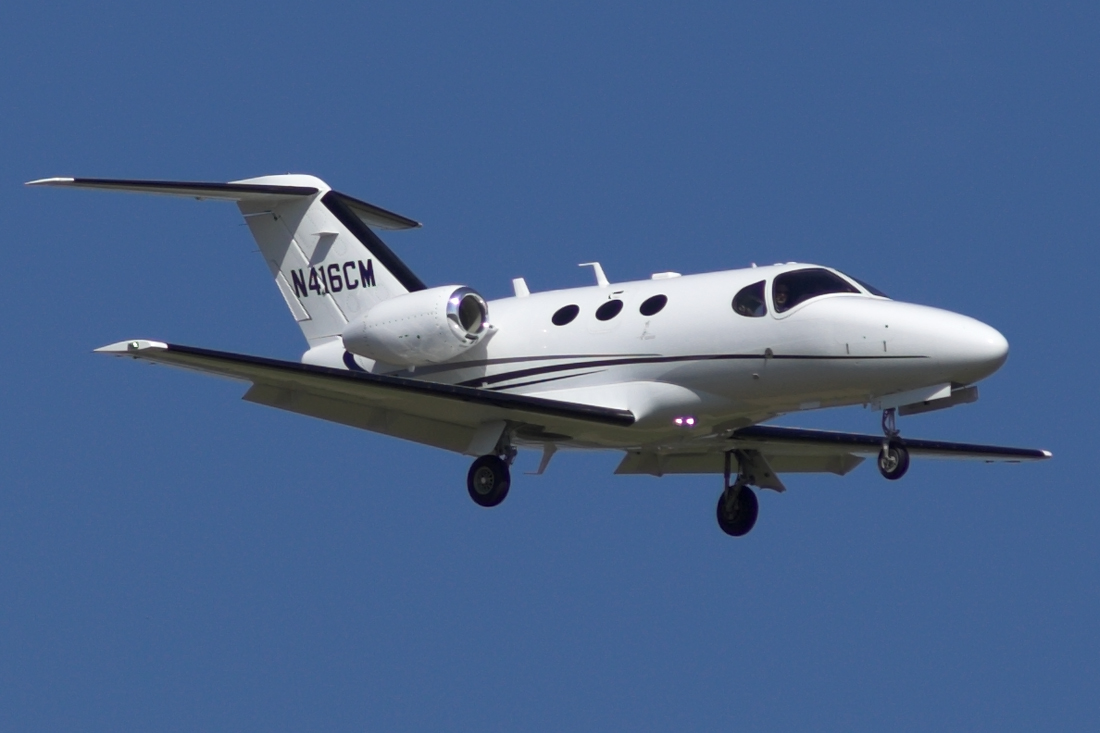
The Cessna Citation Mustang is a very light business jet built by Cessna at its Independence, Kansas facility, designed as an entry-level four-passenger twinjet approved for single-pilot operation. Launched at the 2002 NBAA convention and delivered from 2006, it became one of the best-selling very light jets of its era, popular with owner-pilots stepping up from high-performance piston singles. Its Garmin G1000 avionics suite and simple systems make it a natural first jet for sim pilots exploring turbofan operations.
The Citation Mustang, Cessna's Model 510, is a very light jet (VLJ) business aircraft occupying the entry point of Cessna's Citation family. It is a low-wing, cantilever monoplane with a T-tail, retractable tricycle undercarriage and twin aft-mounted turbofans, built primarily of aluminium alloy with a three-spar wing. Designed as an entry-level four-passenger business jet, it was certified for single-pilot operation and built at Cessna's production facility in Independence, Kansas.
The Mustang was launched at the 2002 NBAA convention, priced at the time at around $2.4 million. The Model 510 prototype first flew on April 23, 2005. It received full FAA type certification on September 8, 2006, and certification to fly into known icing conditions followed on November 9, 2006. The first production aircraft was delivered on November 22, 2006, the same day the FAA granted the necessary certification, while the first retail delivery went to Dave and Dawn Goode of GOODE Ski Technologies on April 23, 2007. In 2010 Cessna introduced an enhanced High Sierra edition with higher-quality cabin furnishings and improved avionics including synthetic vision. By 2015 the unit cost had risen to US$3.35 million. Cessna had been selling an average of 40 Mustangs a year until its own Citation M2 was introduced in 2013, after which Mustang sales fell to just 24 aircraft over the following three years; production ended in May 2017 as a result, with the M2's greater speed and size, similar runway requirements, and more widely held C/E-525 type rating making it the more attractive option. A total of 479 examples were produced between 2006 and 2017. In 2019 a modified Mustang fuselage fitted with a single turboprop engine, registration N350CE, was photographed, and a Cessna vice president confirmed its existence as a technology demonstrator exploring a possible model to bridge the gap between the Mustang and the Cessna 350 Corvalis, without confirming production plans.
The Mustang seats one or two pilots and carries four to five passengers with a useful load of 3,130 lb (1,420 kg). It is 40 ft 7 in (12.37 m) long, with a wingspan of 43 ft 2 in (13.16 m) and a height of 13 ft 5 in (4.09 m). Empty weight is 5,600 lb (2,540 kg) and maximum take-off weight is 8,645 lb (3,930 kg). Power comes from two Pratt & Whitney Canada PW615F turbofans mounted in pods on the aft fuselage, each producing 1,460 lbf (6.5 kN) of thrust. In standard configuration the cabin has four passenger seats in the aft section plus a toilet, with one main door on the forward left side and an emergency exit on the centre right of the fuselage. Avionics are built around the Garmin G1000 suite.
Published figures give a maximum speed of 483 mph (777 km/h, 420 kn) and a cruise speed of 391 mph (629 km/h, 340 kn), with a range of 1,343 mi (2,161 km, 1,167 nmi) at maximum take-off weight. Service ceiling is 41,000 ft (12,500 m) and rate of climb is 3,010 ft/min (15.3 m/s). Take-off distance is 3,110 ft (948 m) and landing distance 2,380 ft (729 m). In practice, owners report an honest 325 to 345 knots true airspeed at FL410 depending on weight and temperature, with fuel flows around 500 lb/hr total at altitude, and a typical burn of about 100 gallons per hour day to day. Pilots are advised to flight plan for 320 KTAS to be conservative, and with four passengers and a lower cruise altitude a realistic range is closer to 700 nm. The speed brakes and landing gear, extendable at up to 250 knots indicated airspeed, aid descent and deceleration planning.
The main production run was the Model 510 Citation Mustang itself. In 2010 Cessna introduced the High Sierra edition, an enhanced package featuring higher-quality cabin furnishings and improved avionics including synthetic vision, offered alongside the standard aircraft rather than as a separate model designation.
Roughly half the Mustang fleet is based in the United States and Canada, mostly operated by firms or individual owner-pilots, some of whom offset fixed costs by sharing use with air charter operators; outside North America most aircraft are flown by third-party crews. The remainder of the fleet is spread across Europe, with 23 aircraft in the British Isles, 20 in Austria, 20 in France, 11 in Germany, six in the Czech Republic, five in Switzerland and four in Italy. In Latin America, Brazil has 31 aircraft, Mexico 10, Argentina three, Venezuela two, and one each in Chile, Guatemala, Panama and Paraguay. Four are based in Turkey, four in Egypt and two in Israel, with six in Africa, nine in Australia and five in New Zealand. Notable operators include GlobeAir AG of Hoersching, Austria, WiJet of Paris, Blink Ltd of London and Aeropartner A.S. of Prague. Four certified full flight simulators for the type exist worldwide, in Rome Monterotondo, Scottsdale, Wichita and Farnborough. It has proved popular for short business trips, particularly journeys of under two hours in Europe, and remains valued as a step-up jet for pilots transitioning from high-performance piston singles.
For a pilot moving up from a high-performance piston single, the Mustang's Garmin G1000 avionics suite will feel immediately familiar, easing the transition to jet operations. It offers a genuine mix of jet performance and operational simplicity, being certified for single-pilot flying, which makes it approachable for owner-pilots. Its speed brakes and landing gear, deployable up to 250 knots indicated airspeed, give useful flexibility for managing descents and slowing the aircraft, and its short take-off and landing distances mean it can operate from relatively modest runways, adding to its appeal as an accessible entry-level business jet.