Departure
95%
vs 95%
 MY FS FLIGHTS
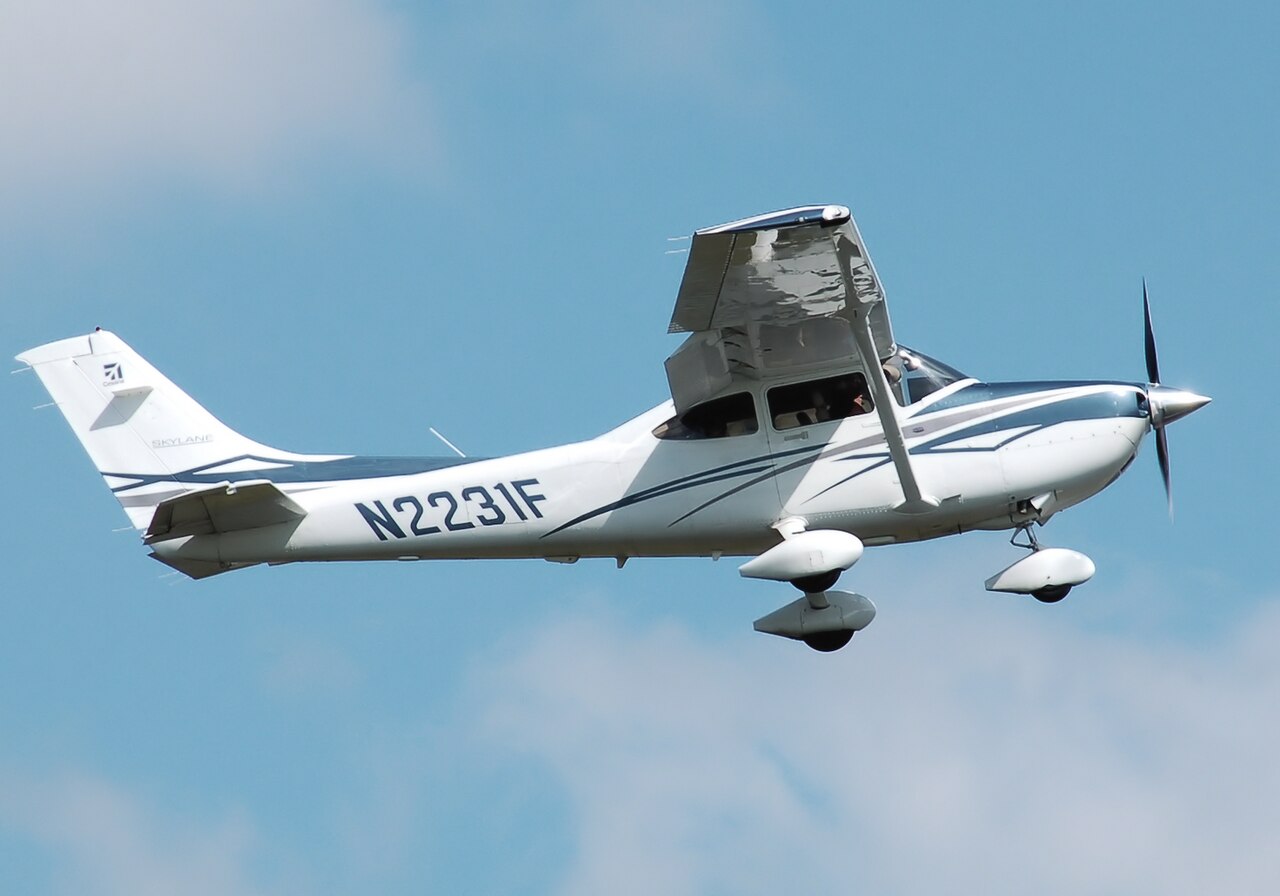
The Cessna 182T Skylane is the current-production version of Cessna's long-running four-seat, single-engine, high-wing piston light aircraft, built by the Cessna Aircraft Company of Wichita, Kansas. It descends directly from the original 1956 Cessna 182, itself a tricycle-gear derivative of the Cessna 180, and remains the second-most popular Cessna model still in production after the 172. For the simulator pilot it represents the modern face of the Skylane family: a docile, load-carrying tourer with a lineage stretching back through decades of incremental refinement.
The Cessna 182 Skylane is an American four-seat, single-engined, high-wing light aircraft manufactured by the Cessna Aircraft Company. Introduced in 1956, it has been produced in numerous variants, including versions with retractable landing gear, and is the second-most popular Cessna model still in production after the 172. The 182T designation applies to the modern-era, normally aspirated production Skylane, alongside a turbocharged T182T sibling, both continuing a lineage of more than 23,237 Skylanes built.
The Cessna 182 was introduced in 1956 as a tricycle-gear variant of the Cessna 180. The 182A followed in 1957, and a deluxe version introduced the following year took on the name Skylane, with full exterior paint, wheel fairings and an improved engine cowling. Through the 1960s, 1970s and into the 1980s the design was steadily refined with a wider fuselage, a swept tailfin with a rear omni-vision window, an enlarged baggage compartment, higher gross weights and various landing-gear changes. Production of the 182 ran from 1956 to 1985, before Cessna restarted the line in 1996 with an aircraft that differed in many respects, including a different engine and a new seating design. The normally aspirated, avgas-fuelled 182 went out of production again in 2012 but returned in 2015. Cessna 182s were also built under licence in Argentina by DINFIA as the A182, and in France by Reims Aviation as the F182. By 2007 Cessna's own figures listed 22,336 Skylanes delivered, plus 901 Turbo Skylanes. Around 2013 Cessna developed a diesel-powered derivative, originally marketed as the Turbo Skylane NXT before being renamed the JT-A to avoid confusion with the Remos NXT; it first flew in May 2013 but as of July 2015 its FAA certification remained on hold indefinitely, with only 16 aircraft built, one prototype and fifteen production examples.
The 182 airframe is of all-metal, predominantly aluminium-alloy construction, though certain components such as the engine cowling nosebowl and wingtips are made of fibreglass or thermoplastic material. The wing shares its planform with the smaller Cessna 172 and the larger 205/206 series, though the flap and aileron design follows the 172 rather than the 205/206. The cabin seats four, with the option of adding two child seats in the baggage area. The proposed JT-A diesel variant was to be powered by a 227 hp (169 kW) SMA SR305-230 engine running on Jet-A fuel, with a fuel burn of around 11 US gallons (42 litres) per hour at cruise.
The JT-A diesel derivative was rated to cruise at 155 kn (287 km/h; 178 mph) burning about 11 US gallons of Jet-A per hour. Within the wider 182 family, the retractable-gear R182 offered a sea-level climb rate of 1,140 ft/min (5.8 m/s) and a 75 percent power cruise speed at 7,500 feet of 156 kn (289 km/h; 180 mph) TAS in standard conditions, with retractable-gear models generally showing a 10-15 percent improvement in climb, cruise speed and fuel economy over their fixed-gear counterparts, at the cost of increased maintenance and reduced landing-gear robustness.
The Skylane line spans many model-year variants from the original 1956 182 through the 182A of 1957-58 (which introduced the Skylane name), successive letter-suffix models through the 1960s and beyond, and the retractable-gear R182 and turbocharged TR182 offered from 1978 to 1986 and marketed as the Skylane RG. The R182's hydraulically actuated gear, driven by an electric pump, included a warning tone for a retracted gear position combined with low manifold pressure or extended flaps, and a hand pump for emergency gear extension in the event of hydraulic failure, though manual retraction was not possible. The post-1996 restart aircraft, from which the modern 182T and turbocharged T182T derive, differed in numerous details including engine and seating design. A diesel-powered JT-A variant, using the SMA SR305-230 engine, was developed but never reached full certification, with only 16 examples built. Aircraft used for skydiving operations are modified by removing passenger seats, fitting an upward-opening door in place of the standard door, and adding a large external step.
The Skylane family has served broadly across general aviation as a touring, training and utility aircraft, valued for its four-seat cabin and load-carrying ability. Licensed production in Argentina by DINFIA (as the A182) and in France by Reims Aviation (as the F182) extended the type's operator base beyond the United States. A specific and enduring niche use has been skydiving operations, for which aircraft are modified with an upward-opening door, an external step and passenger seats removed to speed the loading and exit of parachutists.