Departure
93%
vs 95% ▼ 2
 MY FS FLIGHTS
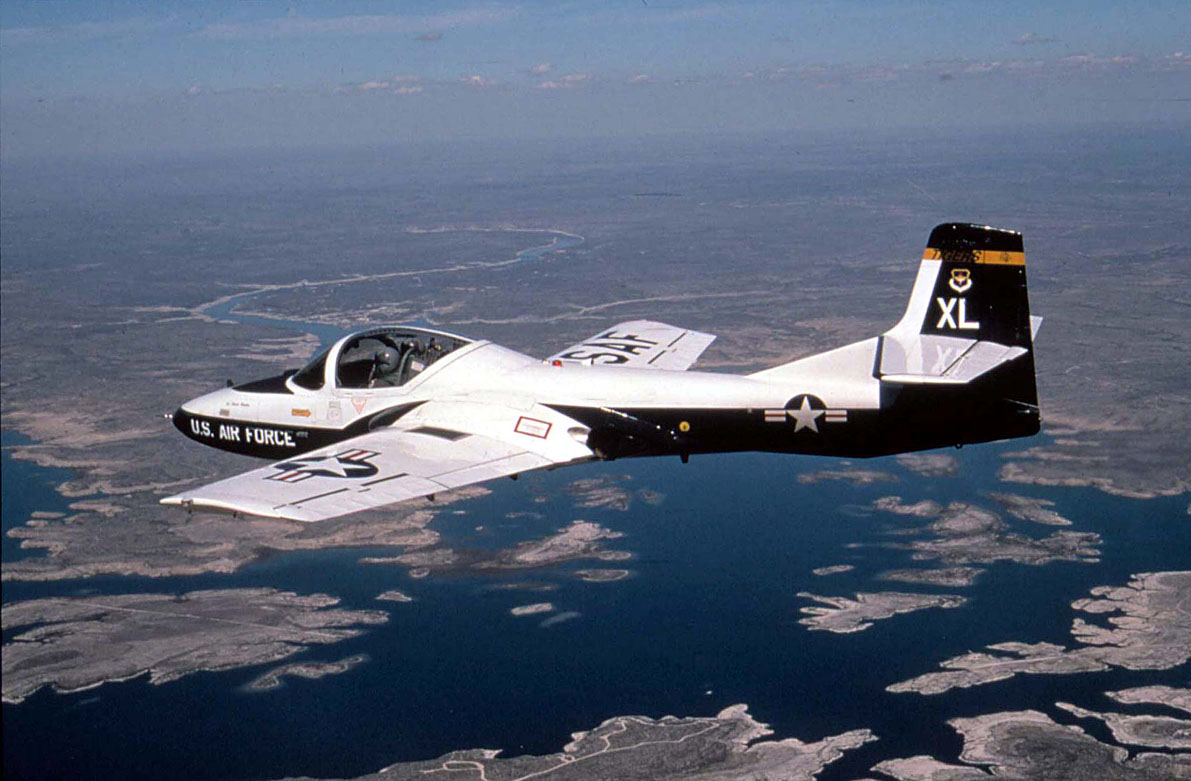
The Cessna T-37 was Cessna's first jet aircraft, a twin-engine, side-by-side two-seat trainer designed to take United States Air Force cadets from primary flying straight into jet operations. Universally known as the "Tweety Bird" or "Tweet" for the piercing shriek of its small turbojets, it went on to serve the USAF for more than half a century and was exported to a number of allied air forces as their standard jet trainer.
The T-37 is a twin-turbojet, side-by-side two-seat military jet trainer built by Cessna, developed as an intermediate trainer to bridge the gap between propeller primary trainers and front-line jets. It was Cessna's first jet design and became the standard USAF jet trainer for decades, as well as a widely exported type flown by several allied air forces.
The T-37 originated as Cessna's winning entry, the Model 318, in a USAF design competition for a two-seat side-by-side intermediate jet trainer, for which fifteen proposals were submitted to the Air Research and Development Command. In the spring of 1954 the USAF awarded Cessna a contract for three prototypes plus a single static test airframe, and the type was designated XT-37. The first flight was made on 12 October 1954, flown by Bob Hagan; one XT-37 prototype was subsequently lost in a flat spin, though the pilot ejected safely. The XT-37 was powered by two Continental-Teledyne J69-T-9 turbojets, licence-built versions of the French Turbomeca Marbore IIC, each rated at 920 lbf (4.1 kN) thrust. The production T-37A was broadly similar to the prototypes bar minor fixes identified during flight testing; the first T-37A was completed in September 1955 and flew later that year. Deliveries to the USAF began in June 1956, and the Air Force started cadet training on the type in 1957. The first T-37B was delivered in 1959. The last T-37B was formally retired from active USAF service on 31 July 2009, closing well over five decades of front-line training use.
The T-37 is a low-wing jet trainer with a side-by-side two-seat cockpit, powered by two Continental-Teledyne J69 turbojet engines, licence-built derivatives of the Turbomeca Marbore IIC, each producing 920 lbf (4.1 kN) of thrust in the prototype configuration. The small turbojets drew air through intakes that produced a distinctive high-pitched shriek, so loud that even by jet-aircraft standards the type was described as a "Screaming Mimi"; this whistle gave rise to the enduring nicknames "Tweety Bird" and "Tweet".
Instructors and students regarded the T-37A as a pleasant aircraft to fly. It handled well and was agile and responsive, though it was not overpowered, and it was capable of all traditional aerobatic manoeuvres, making it well suited to its role of introducing student pilots to jet handling.
The type progressed through several production variants: two XT-37 prototypes, 444 T-37A production aircraft, 552 T-37B aircraft, and 273 T-37C aircraft, the latter often supplied for export customers.
The T-37 was the USAF's standard intermediate jet trainer from 1956 until the last T-37B was retired on 31 July 2009. It was also exported widely. Brazil received Cessna T-37C aircraft from 1967, operating 65 unarmed examples (numbered 0870 to 0934) as advanced jet trainers of the Brazilian Air Force until 1981. The Hellenic Air Force took delivery of its first 25 T-37C aircraft in the 1960s, operating them with the 361 Basic Training Squadron of the 120 Air Training Wing at Kalamata; a further 15 were acquired from Jordan's air force in the 1970s and 1980s, and the type was retired from Greek service on 27 October 2002 after 38 years. The Royal Jordanian Air Force operated 15 ex-USAF T-37Bs with No. 6 Training Squadron at King Hussein Air Base, Mafraq, until 1987, when the CASA 101 took over the basic jet training role. The Peruvian Air Force received its first seven T-37B trainers in July 1961, flown from Wichita to Lima as part of an initial purchase of fifteen aircraft under the US Military Assistance Program; a total of 32 T-37B aircraft were eventually delivered to Peru. Portugal selected the T-37 for its air force in 1961 after a competition against the BAC Jet Provost T3, taking delivery of 20 aircraft in 1963 (serials 2401 to 2421) followed by a further six (2425 to 2430); these served with Esquadrilha 102 "Os Panchos" at Sintra and formed the basis of the Asas de Portugal display team, until a wing failure in December 1990 led to the fleet being grounded ahead of replacement by the Alpha Jet. Pakistan likewise chose the T-37 in 1961 over the BAC Jet Provost, receiving an initial batch of nine T-37Bs in 1962, thirteen more in 1963-64 and a final six in 1967-68; a later order placed in 1975-76 for newly built aircraft could not be fulfilled and was instead met by 19 aircraft drawn from USAF stocks, all operated by the Pakistan Air Force Academy at Risalpur. Turkey also operated the type, including T-37B aircraft based at Izmir-Cigli.
Pilots and instructors who flew the T-37 found it a pleasant, forgiving aircraft: agile and responsive without being overpowered, and cleared for the full range of traditional aerobatic manoeuvres. That combination of predictable handling and aerobatic capability, allied to its role as the type on which generations of jet pilots took their first turbojet steps, makes it an aircraft whose character in the simulator centres on approachable, honest handling rather than outright performance.